

#1 - Aaron Burr did nothing wrong. There’s absolutely nothing wrong with dueling; it’s a fantastic social technology for ensuring that male status contest doesn’t become a competition over who can act the most like John Mulaney, and in the vast majority of cases didn’t end with anyone dying. Meanwhile Hamilton was a vindictive asshole who never got over Burr beating his dad-in-law fair and square in a Noo Yawk senate race and spent years disparaging Burr’s character for it, describing keeping him out of power as a “religious duty” and eventually dropping a “despicable opinion” of him at a dinner party that instigated the duel. Gore Vidal famously speculated that it was gossip about Burr fucking his daughter Theodosia, to whom he was extremely close, and while that was an invention it seems to me the aspersion must have been of that general caliber to get Burr to demand an explanation for Ham’s comments and eventually press for satisfaction. In the context of the era Ham had said something extraordinarily damaging and refused to retract it after being extended numerous opportunities, and if you think killing someone after that in a formal duel is “wrong” you are spiritually a woman and no one should listen to your opinion about anything. Also Burr definitely was trying to conquer Mexico—but explain to me why that’s such a bad thing when he does it but supercool when Polk does the same? At the absolute worst the dude was a proto-William Walker. It was easy to hate him in the context of 19th century politics especially because he wasn’t a Bentham’s Bulldog-like axiomatic thinker a la Hamilton and Jefferson who performed disinterest in a fart-sniffing way and pretended everything was about muh principles, but the dude obviously did have his own set of ideals—which speaking of, the only truly shitty thing about Aaron Burr was his support for women’s suffrage.
#2 - Jefferson and Madison got the better end of the Compromise of 1790 versus Hamilton. This is probably the respect in which Lin Manuel Miranda was most retarded and overly Puerto Rican in his understanding of early U.S. history. Putting the U.S. capital on the Potomac gave the young nation and its political machinery a disproportionately southern character FAR longer into the nineteenth century than you would have had with a Philadelphia capital, which looking at the demographic balance-of-power math was slightly north-biased at the time but would have become basically right around the Age of Jackson, when most of Hamilton’s project got obliterated only to be redeemed and retroactively legitimized decades later by the Lincolnites. And while it’s absolutely true that the deal enriched Northern commercial elites tremendously, Burr in the musical is equally right that from the perspective of your average Joe in NYC Hamilton kind of just sold New York—and the entire North—down the river for his own particularist and elitist ambitions that weren’t even all that durable in the medium term, resulting in multiple decades of the South having far greater somatically-felt legitimacy and political prestige, which you can bet your ass not only hardened the Virginia Dynasty but also made compensated manumission far more expensive to press for versus complacently kicking the can down the road until Haiti / the cotton explosion / Calhounism combined to make southerners too intractable on the issue to resolve it peaceably a la Great Britain. Moreover the capital being incredibly close to Richmond made Virginia’s secession during the Civil War cataclysmically important and turned what could have been a minor sectional revolt into something approaching a second revolution. So I’m sorry, but calling Hamilton a genius for the Potomac deal is the single most retarded thing in that otherwise splendid musical in that it treats symbolic capital as obviously less important than hard institutional capital, reflecting the jejune and Yglesiasbrained mindset of the 21st century neoliberal beigoid who’d be a lot less pedestrian in his takes if he only read some Bourdieu.
#3- The War of 1812 REALLY WAS a Second Revolution. People underestimate its importance these days because it was kind of a stalemate against Britain herself and it’s embarrassing to talk about the White House getting cooked, making it relevant to most people chiefly as the genesis of Jacksonian greatness. But the war’s ackshual significance was in breaking Indian power in the American interior—another thing modern peepo love to downplay—thereby removing a massive dagger from in between our ribs that Great Britain used to keep America as a quasi-vassal state for decades via the Jay Treaty, which was so Anglophilic it basically precipitated the entire First Party System whilst hugely stoking hitherto inchoate sectional tensions. And speaking of…
#4 - American sectional conflict was never flatly “North vs. South.” Presenting shit that way is politically useful to both northern moralists and southern revanchists, but it makes a mess of the ackshual ideological and realpolitik dynamics of that era which were a lot more fluid and complex. The correct breakdown would look something like:
New England: Initial northern pole; ultra-literate and mercantile in orientation; initially more populous than other northern regions and also more ideologically and institutionally coherent. Represented at the national level by John Adams and later his son Quincy. Paradoxically began as the most anti-royalist region of the country only to rapidly become its most Anglophilic. Federalist and later Whig→ Republican stronghold. Main issue was traditionally commercial stability, and later became a hotbed of abolitionism and Radical Republicanism, which I’ll later argue in this piece was in part a way of moralizing an opposition to longstanding disproportionate southern political influence. Never quite had the same level of preeminence over northern politics that Virginia had over the south due to NYC’s rivalry with Boston and Hamilton’s rivalry with Adams, which broke Federalist power early on and ensured early preeminence of the Virginia Dynasty.
New York: Secondary northern pole, which gradually seized commercial primacy from Boston (especially after 1825 when the Erie canal made it chief entrepôt into the North American interior, displacing New Orleans), but never quite managed to seize intellectual or moral primacy from the Puritans in intra-northern politics. Generally more mercurial and less ideological than the Bostonians and focused heavily on dynastic politics and especially commercial land speculation, which got a lot of New Yorkers invested in Free Soil politics because they didn’t want those rednecks in Charleston buying up all the good land in Missouri and filling it with niggers. Punched below its weight for a long time due to the rivalry with New England as well as factional tensions between e.g. Hamilton and Burr and the Old Dutch versus English. Was also the chief Loyalist center of power during the American Revolution, which gave it a complicated status during the first few decades of the Republic.
Pennsylvania: Tertiary northern pole, which derived prestige from Ben Franklin’s international celebrity and its institutional legacy as the first American capital, but never had much of a unified front politically due to its hugely heterogenous demographic character—compared to other states it was an early magnet for German and Scotch-Irish immigrants that Franklin himself famously thought of as disgusting wogs—though it probably retained more soft power than any other region as the most important swing vote and honest broker between the northern puritans and southern cavaliers, and played probs the biggest role of any region in peopling the Northwest Territories, while Philadelphia was always a serious rival to Boston and NYC both commercially and intellectually. In a sense Pennsylvania can thus be thought of as the most “American” of all regions (also we can kind of treat Jersey as half in the Noo Yawk pole and half in the Pennsylvanian one).
Northwest Territories (Ohio + Indiana + Illinois + Michigan + Wisconsin): Started off dangerous and full of injuns but increasingly became the backbone of the North—peopled by New Englanders, New Yorkers, Pennsylvanians, and even lots of Southerners who were okay not bringing they blackpeepo along, under a cultural regime that merged the sensibilities of all of the above. After the war became arguably the nation’s primary center of gravity and main character (with Ohio especially becoming a President Factory), and had a lot of legitimacy as an honest broker between Southern Redeemers and Radical Republicans and as the chosen home of Honest Abe (a native-born Kentuckian). Primary issue in the antebellum era was always Free Soil—they wanted to send their sons off to Missouri or Kansas without it being full of enslaved blacks, hence the Oregon constitution having a No Niggers Clause. Note however that this was NOT the same thing as abolitionism, and the average Northwesterner cared about as much about what happens on those Alabammy plantations as you care about the African children who die in cobalt mines to make your iPhone.
Virginia and the tidewater: Primary southern pole that carried unparalleled prestige for the first few decades of American life due to its colonial heritage, proximity to the capital, and status as the birthplace of the Virginia dynasty, producing a hugely disproportionate share of the country’s finest generals and statesmen long past the point at which it was producing a commensurate share of the national GDP. That said by 1861 it was materially more industrialized and far whiter than most parts of the Deep South, as by that point tobacco planting was a sclerotic industry and most of the money to be made was in cotton production in swampier climes—which Virginians themselves certainly supported by selling slaves down the river en masse into the Calhounist Cotton Kingdom and setting up their cousins and second sons up on recently-cleared Indian land, but was also distant enough that plenty of Virginians were very attracted to Clayite Whig ideas about national improvements and had a lot invested in unionism, hence John Bell beating Breckenridge there in 1860 and the House of Burgesses initially opposing secession until Lincoln called for his 75,000.
Lower South: Secondary southern pole, initially centered around Charleston and its commercial relationship as a rice exporter to the Caribbean sugar islands. Younger than the Tidewater and far more aggressive about slavery—hence Edward Rutledge being made the Fuck Niggers Guy in both 1776 and John Adams—though Georgia was famously chartered as a free colony before being subsumed by South Carolina Thought and North Carolina had a lot more white smallholders than either Virginia or South Carolina and can kind of be seen as its own thing. Famously was the source of the Nullification Crisis and Calhounism—an ideology that treated slavery not as a regrettable thing to be phased out but more as a positive good to be pursued on an industrial scale—as well as the initial decision to kick off the Civil War by firing on Fort Sumter.
Upland South (Kentucky and Tennessee): Less a tertiary pole than institutional daughter-states of Virginia and North Carolina, respectively, which inherited much of their culture while eventually becoming major centers of nationalism during the early Republic, producing both Henry Clay and Andrew Jackson. Early on their main concern was getting John Bull out of the continent and neutralizing the Indians, after which they became a lot more mercurial and IMO inherited Pennsylvania’s initial status as the “most American” region. During the Civil War Tennessee followed Virginia reluctantly into war and was a pretty crucial source of manpower and industry before getting conquered early on and putting almost all the pressure on VA, while Kentucky unsuccessfully attempted to stay neutral.
Old Southwest (Alabama + Mississippi + Louisiana): The Vvardenfell of Dixie—an enormous swath of freshly-cleared Indian land full of quasi-Barbadian slave hives attached to a longstanding but in many ways culturally foreign presence along the Mississippi River centered around New Orleans as a fading entrepôt. Ruled by a class of vigorous and entrepreneurial slavers that generated a lot of the Confederacy’s early political energy (Jeff Davis being the main example) but much less of its manpower, military leadership, and industry of consequence. Hugely wealthy due to cotton (and sugar in LA) before the war, but outside of Nawlins never especially prestigious and kind of became the country’s buttmonkey after.
So that was obviously a lot.
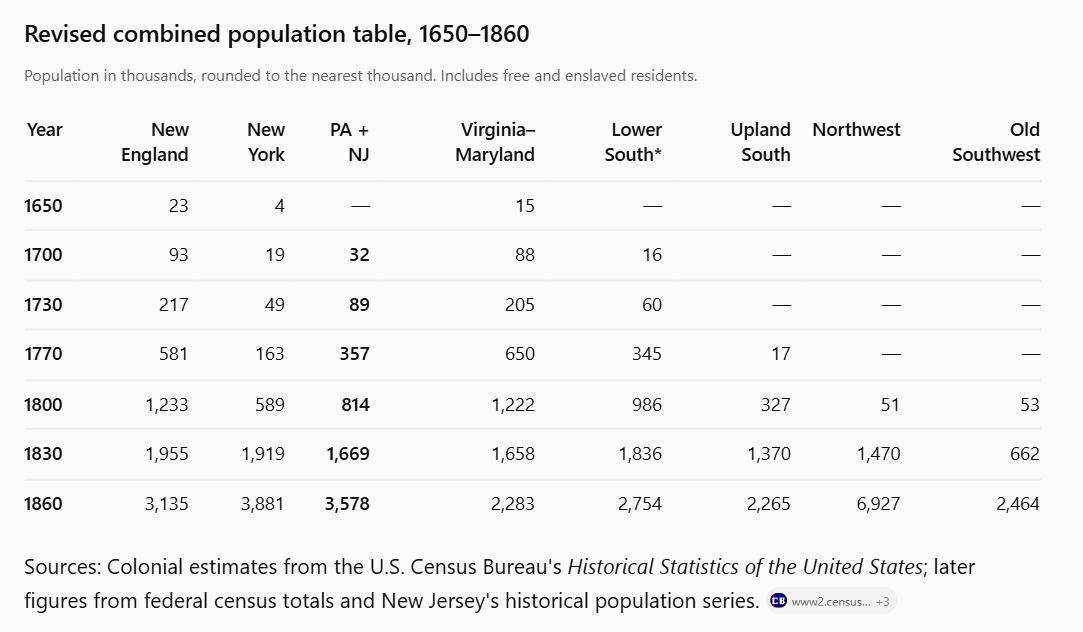
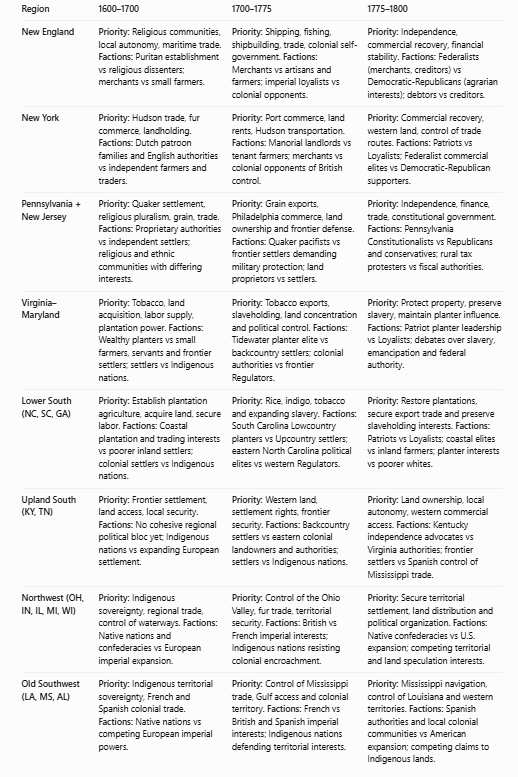
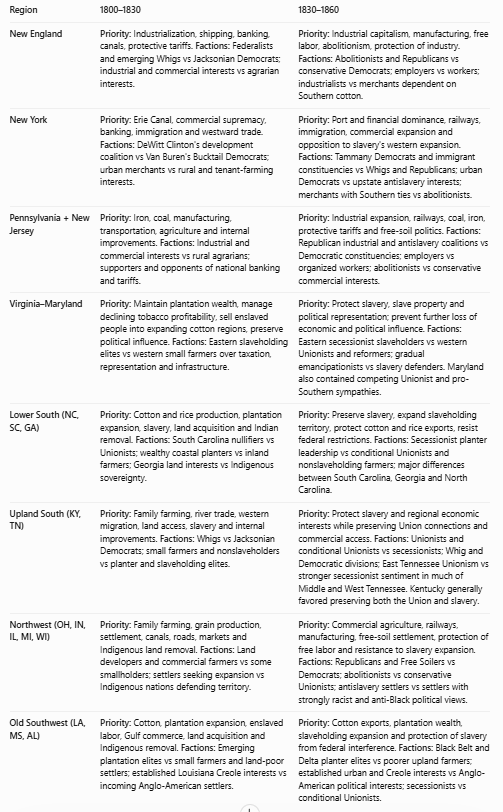
Here are two tables that I think will make things easier to understand.
First is relative population over time:
Next and arguably more important is sectional interest over time:
Pretty interesting, huh?
Just wait till you see my take on the Civil War, which neither Lost Cause guys nor Shermanpoasting faggots will especially appreciate.