

So the thing to keep in mind about this shit is that eventually the house always wins.
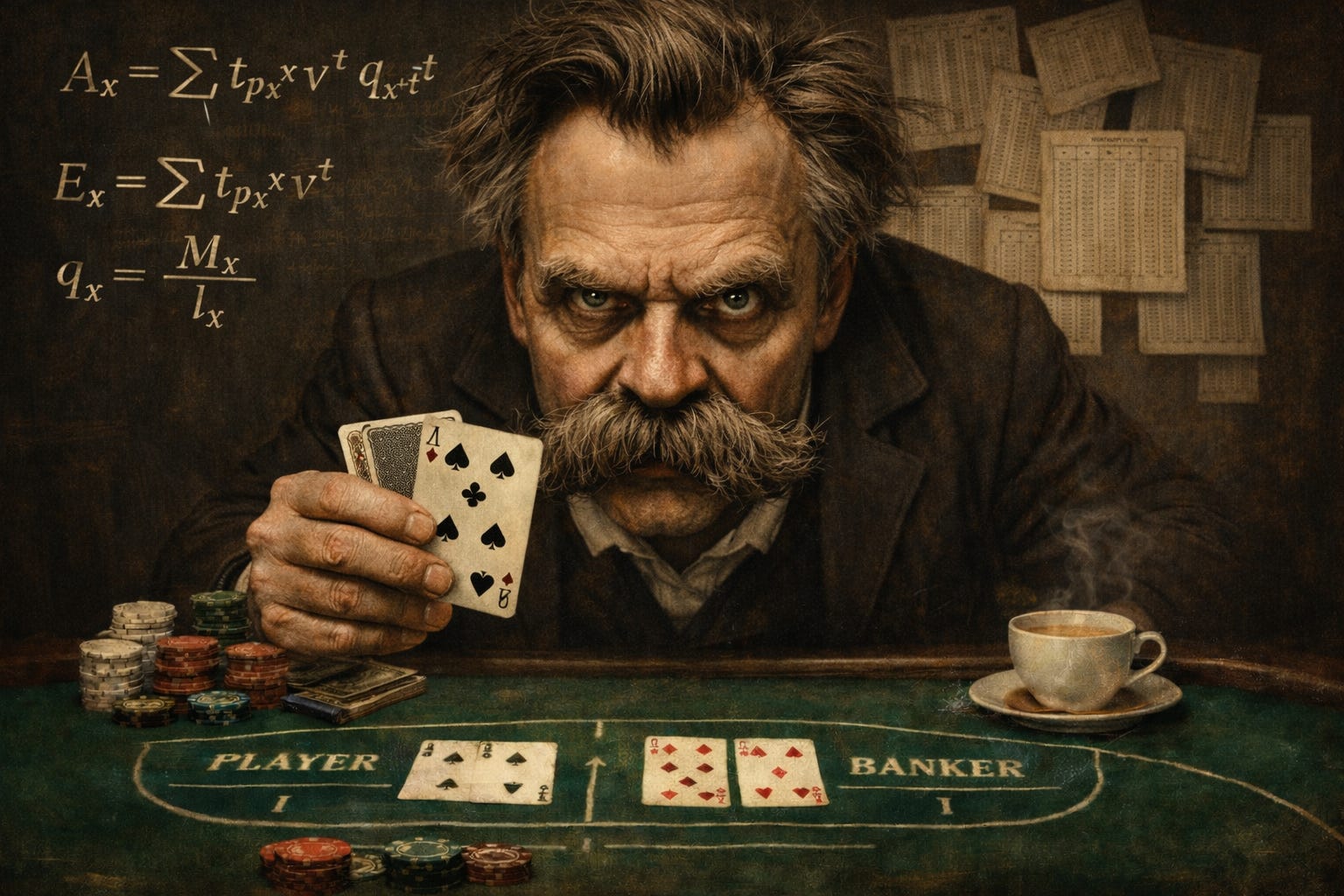
And it probably reads as patronizing I would even think to start there, right?
Not like software engineers never have to learn about the Law of Large Numbers.
Thing is in most contexts that’s kind of just a heuristic intended to stop flyover tards from taking out a second mortgage for DraftKings liquid—which by the way makes quite a lot of sense at the Mutual of Omaha lunchline resolution even if it lands as sort of jejune in ears as rarefied as ours, because it turns out cognitive load’s a mean bitch, and most people kind of shit their pants unless you give them a toothy set of portable and moralistic cliches to beat themselves over the head with in a way that scales.
You told me you were Brahmin earlier?
One way to think about it is that when talking to vaishyas of any race it’s kind of just self-indulgent not to code switch into a register of expected value, because that’s where the merchant lives mentally: in these vapid little hotdoggish Dave Ramsey parables that while obviously the basic brick and mortar of civilization will never NOT feel like erasure to Brahminical neurotypes who live in the tails—which lowkey sucks because if the kshatriya fail to handle that shit correct you’re basically stuck in a nonstop ouroboric culture war that despite being socioculturally vitalizing and game theoretically dominant on like an EU4 level kind of fries your soul as an individual and you ever see that video they took of Nietzsche before he died?
Shit’s eerie; a bit Lovecraftian.
Which I suppose tracks quite well given he and Howard Phillips were kindred spirits in a sense, having been respectively the penultimate and last of the White Brahmin.
Not surprising they went mad, really.
Who wouldn’t die of hooker-syphilis or name their cat Niggerman after watching their peers make some fake and gay Molotov Rib Pact with burghers amidst scarcely any pushback except from sandy-eyed LARPers like Tolkien and Wagner who can’t admit the Nash Equilibrium was always White Kshatriya getting gaslit, scapegoated, and memed into huffing mustard gas in Belgium followed by a fifty century epilogue of Newsom-DeSantis debates atop an ontologically locked-in uncle’s basement regime steered by Buttigieg Nyarlotheps. It’s obviously upsetting to realize civilization’s just a highway to Last Man Maximalism… but that also seems kind of the only real terminus given Hitler himself proved Might Makes Right works a lot less well when you say it.
Because the house always wins.
Six decks. Dealer stands on soft seventeen.
House edge, played correctly: 0.47%.
The felt is new enough to still smell faintly chemical. The dealer—a woman in her forties with a wedding ring and acrylic nails—flashes me a two under her ten and does not blink.
I double into it anyway. Basic strategy says you must. EV over emotion.
The man at third base hesitates on a hard sixteen against her face card. You can feel the table turning against him, which given this crowd isn’t superstition so much as thermodynamics. Registers as childish asking for narrative in a system that only dispenses arithmetic.
He hits; busts. Everyone exhales like decency’s restored.
The thing about card counting isn’t the count itself so much as the camouflage. You raise your bet when the deck is rich in tens and aces, and in a true count of +4 might have a one percent edge over the house—provided you can handle the tide, which to unpracticed hands often feels like wrestling a kraken. With a SD per hand of approximately 1.15 you can play perfect for hours and still be down a mortgage payment—which is why the move is to vary the bet slowly. $50. $75. $125. No spikes. Never clarity.
The pit boss does not care if you are right.
Corporate life is much the same, I’ve found. Correctness is often a necessary condition, but seldom proves sufficient by itself; one must be correct in a way that does not cause surveillance to activate. The visible edge invites heat. Smoothed edges compound quietly. Tortoise, hare.
The man who hesitated on sixteen will tell his wife later that night he “had a feeling.”
He did.
It was negative expected value made flesh.
You see what I’m getting at, bro?
At least for me house always wins isn’t some pedestrian Dave Ramsey bullshit so much as the basic linchpin of my sanity—a sort of keystone axiom to my worldview more broadly, which I guess could be described as actuarial.
You know, that was actually my profession in a past life—
no offense.
Anyway, all I mean to say is that: way I see it? Everything is priced in, sometimes overtly but most times not, and ever since the Somme we’ve lost a lot of the scripts once relied on to avoid everything turning into McDonalds, which means our only tenable options are playing the bugman vaishya EV game selling hole to Nyarlothep, or playing instead some kind of high risk asymmetric variance game… only not quite like clerics so much as in the way us white boys are renowned for playing Spy vs. Spy with Mephistopheles. No prevaricating puts or caviling calls to weigh us down—
just a great big shrieking elevator shaft between Jesus and Judas.
Of course it’s crucial you understand the latter route will proverbially speaking almost always land on you contracting syphilis from the most Lou Salome-adjacent hooker in Weimar while your midwit sister Yes Ands your life’s work into the next civilizational scapegoat du jour—that outcome, too, being priced in, and also quite precisely the result you’d expect from full lucidity given how retarded and self-deluded the average person is. Then again, basically all cognition is cope on some level, and all religions either an attempt to metabolize that fact or gaslight oneself into functional sanity through an integrated array of cognitive biases and scapegoating mechanisms.
Only thing is if you’re the sort of neurotype who ends up there at all you’re probably going to get there no matter how hard you fight it—assuming I guess you never have a near-death experience that recalibrates you or get memed into conversion by the right puss, which isn’t uncommon. Failing that, though, your life is almost certainly going to resemble at least in broad strokes that of a Houellebecq protagonist, which means you should probably aim for the one in Submission.
In other words: don’t be a nihilist in any cartoon sense—let alone go Full Diogenes about “truth,” which in our soft modern world can only end up with you back at home yelling at your mom for getting the wrong thing at KFC. Rather you should try your best to self-delude with heuristics that dispel cognitive load and let you accrue power and status and pleasure by acting like Pete Buttigieg or Davidson to whatever extent you can… and whatever extent you can’t do that help you metabolize the world in a way that offers predictive and explanatory fidelity as a Stirnero-Strausso-Schmittian.
What does that look like in practice?
For one thing really internalizing that this isn’t Tuck Everlasting and entropy is kind of just inevitable—hence that other cliche about Death And Taxes, which is lowkey just The House Always Wins applied to life generally, and becomes especially useful when you realize taxes are a metaphor for all of life’s gay little frictions, but anyway—what I’m trying to convey is that life doesn’t really have story arcs that wrap up neatly or give you a happily ever after sans pit-in-the-stomach epilogue… except precisely to whatever extent you Believe it does. And as much as we bigbrains mock the mindset bros and Crypto Catonians, the one dude like that I’m still friends with is doing pretty fuckin fantastic right now, and that’s in no small part because maintaining purposeful control over one’s thoughts and actions is increasingly kind of all that matters.
Which I’m the first to admit I’m pretty wretched at myself; in my actuarial days I landed that first credential briskly enough purely by dint of IQ, but by the time I needed to study for FSA exams that shit was like pulling teeth—only, like, mine.
Hence Vegas.
And it’s actually funny—cause people tell me all the time they love to visit here but have no clue how I could make it my home? Whereas for me it’s just the opposite i.e. why on earth would you visit a place like THIS on your days off? Why not instead be a little fanciful—go somewhere like Sweden, for instance, where everyone’s still mostly blonde enough to pretend thermodynamics don’t exist?
Vegas is homey to me because Vegas is honest.
The lighting is cruel here; the oxygen pumped in.
The women all performing enthusiasm in sequins… which sure as shit beats the pretense of virtue you get from those performing enthusiasm in pantsuits.
At the end of the day we’re all whores once Robert Redford pays a call; some of us just have a higher price tag than others—or, increasingly, expect more abstract and less fungible currencies whose exchange preserves positional status while dampening ambient social tension and maintaining plausible deniability even internally.
But give someone enough of what they want in just the right register and it’s insane how fast restraint starts to read more as cowardice and dignity land like a sneer.
And once you realize everyone’s kind of a whore?
You suddenly realize no one is.
Baccarat is what you play when you understand the real game is theoretical loss.
Five hundred a hand at sixty hands an hour sat for three makes for $90,000 wagered.
Banker edge: 1.06%.
Theo: $500 × 0.0106 × 180 = $954.
Comps at 35%:
≈ $334.
Room. Food. Car. The casino has already decided what I am worth!
I play banker—flat, and no theatrics.
An older black man sits two seats down. Linen shirt, cufflinks, voice like bourbon. He’s betting banker as well—but not flat. Busty. Guy grinds $5,000 a hand. Calm, rhythmic, no alcohol.
Which is, what—like a $53 expected loss per hand? Which at three hours puts his theo a bit under ten grand, meaning my dude walks away with roughly $3.3k in comp for the evening.
Homeboy isn’t really gambling at this point so much as farming the rebate curve—increasing tail risk for all of us, and taking dollars out of my pocket.
After an hour the pit boss leans in, murmurs something about “table balance.”
The man smiles without showing teeth. They comp him dinner and walk him out politely.
Grinding banker at size is tolerated until it isn’t.
The house prefers volatility—what it loathes is precision.’
Across the table a Chinese man in a tailored jacket keeps betting tie. The payout is seductive—eight to one. He hits once. Table murmurs. He increases his wager. Misses three times in a row.
The man isn’t stupid—just responding to variance with hope, the same way all of us do many times each day. We seek dramatic outcomes, moral clarity, public vindication, opting for the distant possibility of eight-to-one glory over the quiet, steady erosion of banker discipline.
People don’t understand that most durable hierarchies are built on marginal edges sustained over obscene repetitions. Marriage, for example, is a banker bet. Dull, and slightly negative. Compounding.
The Chinese man hits again. He gets another murmur—and then an awkward clap.
He frowns. Hope really is the most expensive bet in the building.
Halfway through the second shoe a younger guy takes the empty seat beside me.
Too clean to be drunk. Too tense to be relaxed.
He watches the Chinese man peel the cards, and then glances at my stack.
“You always banker?” he asks.
“Mostly.”
“Why?”
“Cheapest bleed.”
He nods as if that confirms something he suspected.
He bets player first hand. Wins. Looks at me.
Player edge: 1.24%.
Difference from banker: 0.18%.
At $500 per hand over 180 hands that’s $162 in excess structural leakage.
Nothing per hand. Tuition over time. But he doesn’t know that yet.
The Chinese man increases his tie bet. I switch to player.
The younger guy notices. Thought you said banker.
“Visibility changes the math,” I say.
He studies that longer than the cards.
The Chinese man misses again. Doubles. Misses.
Kid lowers his bet to match mine, copying my strategy less than my temperature.
After twenty minutes he stops betting every hand. Watches instead. Asks about rating systems. About how the casino calculates value. About how often they back people off.
He is not here for spectacle. He is trying to reverse-engineer the room.
The shoe ends. The Chinese man leaves quietly. The kid colors up early. Despite being down maybe eight hundred, he doesn’t look crushed. He looks curious.
We step away from the table. He gives me a dry smile and nods.
“Good shit.”
Thanks.
“Name’s Sehdev, by the way.
And if it isn’t any trouble… any chance I can buy you a beer and pick your brain a bit?”
On the main what divides us isn’t “morality”—it’s neurotype.
That and positional status and material circumstance.
Everything else is a fake and gay spook—
including, by the way, most conceptions of free will and human agency..
Now clearly we experience ourselves as having agency in the moment—and in all fairness probably do need to maintain such a pretense just as a pragmatic Straussian thing to stop suburban women from voting to abolish prisons or something, but the actual observed agentic variance in just the able-bodied adult population is far and away too stark—and besides that shakes out far too asymmetrically by sex and race specifically, which are clearly load-bearing variables here—for liberal democracy to be seen as anything but cartoonishly unworkable and not a little ghoulish for moralizing outcome asymmetries by default when it would be a lot more dignified and gentle to instead narrate them as products of genetic or cultural or material circumstance.
That said, I’m not trying to make this political.
Just saying the world isn’t fair and never has been fair and never will be fair and quite frankly shouldn’t be subject to any attempts to make it fair because fair isn’t even an analytically fucking coherent concept given all moral judgments sit downstream of power and status parsed precognitively in a way it seems almost no one is aware of in themselves but we all see constantly in others, in response to which we’ll generally either want to pathologize—think “he’s a narc,” or “she has BPD”—or essentialize as basic fundament of who they are or if we actually like them / they’re in our ingroup simply not register it at all or do so as less of a fault or backsolve some excuse for it.
And people tend to shit their pants and scream at you when you point out just what it is they’re doing. They can’t be responding to incentives. They can’t be strategic actors, because for stupid dumb retardos strategy makes you bad I guess? Huskers fans kind of just need moral realism because it lets them arbitrarily salami slice the world so they can think themselves better than people by dint of moral character—their operative morality always seeming to align conveniently well with their neurotype, and a lot of times hyper-fixating on pedophiles specifically as they run a bit déclassé to hold any real gravitas trying to reproach normal high status sluts and rakes.
Because mechanistic status / power realism and normative nihilism—despite being obviously true just descriptively—simply aren’t as adaptive as ignorance, brashness, and bigotry, and often just make you a bit of a dissolute freak if we’re honest who needs to change Niggerman’s litterbox.
Yet some men aren’t made for the litter.
And one finds ways to distract himself.
Bright lights and bad decisions. Girls with bad fathers. All a lot less heroic than bouldering with Wagner—but one meets the world where he can. If I can land anywhere between, say, Mishima and Houellebecq that feels dignified.
We’re all just kind of Nietzsche-knockoffs at this point, is the thing. That great mustachioed Prussian figured out basically all the important shit a century before anyone should have, and everything since has been either derivative or obscurantist.
I majored in philosophy at first, you know. Started college at fourteen after cheating my way through—anyway, I got bored of that shit by junior year, because while in the twentieth century analytic shit laid essential groundwork for fields like linguistics and cognitive science and more broadly than that played a key role firming up scientific epistemics it’s begun in recent decades to kind of just look like pedantry with tenure.
Now I’ve been everything under the sun politically—but my epistemics, metaphysics, meta-ethics? I’ve had them half my life now and have never seen any particular reason to change them given everything that seemed intuitively correct to me at 16 likewise does today, except I guess in domains pursuant to aesthetics, ethics, or politics, which again to the extent they aren’t deterministic tinctures of neurotype and Fortuna’s writ are quite frankly kind of just your opinion, man.
Anywho—I’m hardly a philosopher these days, am I?
Just some déclassé and washed-up degenerate gambler.
I’ll take it. At this point anything beats another ten years of failing my way up insurance towers with carpets hued like inadvertently left-out lunchmeat.
Looking back I’m surprised I even made it that long.
Though I guess it wasn’t too terrible at first—because Sehdev? The way you described yourself three years ago? TOTALLY me in 2016. And it’s a good fuckin feeling, right?Fancy corporate digs, big dick paycheck to swing around and impress those chickies, old people in other departments lowkey sort of deferring to you because they know you make more, just in general a certain Sorcerer’s Stone energy…
Feels pink as puss for a solid year.
Only then you keep hearing No No No.
No, we won’t pay you commensurate with the salary survey you and I both know is universally seen as canonical for our field; No, I won’t go back to your apartment with you, and I’m your manager; No, we’ll not consider introducing a new life-contingent annuity product specifically marketed to black people so as to arbitrage their vastly higher mortality rates which the state arbitrarily insists can’t be reflected in actuarial tables even though sex for instance routinely is except in Montana of all places and meanwhile it’s cool to market Tyler Perry movies to black people and so I don’t even think my idea would be all that illegal but anywho—actuarial is at its core a profession dispositionally suited for Asian women, as it’s ontologically just profoundly Chinese.
Which I don’t mean in like a boomer racist Asians Are Good At Math way but rather a “asians are more predisposed on average to risk averse behavior due to a causal chain precipitated ultimately by rice supporting more people per hectare than wheat as well as a lower median time preference due to cold winters” millennial racist way—that and that whenever we identified a bug in the admin system that was shortchanging policyholders the executives would always call a decision to continue ripping them off a “business decision,” which felt vaguely Ming Bureaucrat to me—and speaking of the SOA’s credentialing regime carried out via examinations is lowkey kind of Confucian
Though to be clear, there’s precisely nothing wrong with being an Asian woman.
In fact, when I look back on all the actuaries I worked with through the years with whom conversation generally proved more winsome than scaphism nearly all were Asian women. They’re good at their jobs—and are temperamentally suited for it.
Scotch-Irish men, on the other hand, are probably up there with black dudes as the sort of folks you very much DO NOT want setting your insurance premiums.
That said if you do somehow get your hands on a high IQ one we’ll likely be able to model risk gradients in higher fidelity than just about anyone else—it’s just anyone interested in that probably belongs in academia or something instead, as real actuarial work at least at the junior and midlevel consists as a rule mostly of faffing about in an Excel model some other asshole designed 7 years ago and updating shit ad hoc while trying best you can to internalize loads of insurance regs and best practices so one day you can be the guy who makes the needlessly complex spreadsheet that crashes all the time and everyone fucking hates, which it turns out for the most part involves copying a bunch of formulas from your old exam notes into excel and
Anyway no one becomes an actuary because it’s fun. Attracts quite a lot of squares. Trustworthy people, though—lowest divorce rate of any profession, actually.
Three guesses which industry is highest.
Only the thing about us gamblers? Turns out we model the world kind of exactly like actuaries in practice—which is to say probabilistically. If we cheat on our bitch more or something then that’s a delta in risk appetite you’re seeing and not worldview.
And when your risk appetite is high—and not even for the reward potential so much as because if you don’t perpetually feel like you’re gonna die maybe your brain has a hard time letting you do much of anything other than languish about gooning all day whilst shoving half baked down your gullet—then your operative calculus starts to look remarkably different from that of anyone even the least bit lunchline-legible.
Having said that, I think it behooves us now to revisit that very first thing I told you.
It’s true for the lunchliners—full stop, and without caveat—which for them is fine. Budget two grand to blow on Hooker Disneyland and treat it all like entertainment.
The heuristic holds also at the other end of the horseshoe if you’re an Elon type—and especially a Warren, but even a Trump—in which case you yourself are house: an apex institutional actor who The System will protect in a toothy and liarry way on account of too many important people having fucked the same eleven year-old.
But everything interesting in life happens outside that fork—usually for peeps who live in the tails, being fluent in the ways in which +2 SD feels different from +3 SD, and whose experiences, as a rule, are not broadly legible to the herd. Men like that—e.g. me, because it still feels a little pretentious to say “We” here—live in the crevices and shadows and gray areas of life; that unfilled negative space behind Aunt Lilith’s dresser where you can hide and peak your head out just a bit to steal a sneaky glimpse of her tidders as she walks out of the shower, slack-jawed and oblivious.
She’ll stab you with scissors if she sees you.
Get a pic of em on your Google drive? Then she’s munching your jizz for eternity.
Everything behind the dresser is like that—hence people not caring usually whenever something bad happens on one of your assorted rapscallion adventures; ultimately all is fair behind the dresser; anything goes if you can get away with it, in both directions.
And such stories won’t be useful to the lunchliner—or to Warren, for that matter. The former is too conformist and risk-averse, and the latter too transfixed on scalability to care about something so removed from EV—which means you're mostly just noise to them, and they aren't especially concerned with making you feel Seen in their models
Good.
Because the house always wins.
American wheel. Thirty-eight pockets. One green zero would be tolerable. Two is doctrine.
There’s no strategy here—at least not in any way that requires a calculator. Closest thing is kind of a meme one you probably saw on Reddit at some point called Martingale (ironically also the name of a street in Chicago where the Society of Actuaries once held court), which in essence just amounts to doubling up after losses, which the philosophers call the “sunk cost fallacy” and in practice tends to transform routine bleeding into eventual amputation.
Because the wheel has no memories; cares not one whit what you are “due.” She is allowed to choose whomever she pleases, whenever she pleases, and you need to work on that entitlement.
And if we’re honest Roulette is more of a carny act than gambling qua gambling—just has a French name, which means it codes semiotically as sophisticated and high status by default.
It’s also kinetic and social and mathematically simple enough even girls understand how it works when you explain it clearly, and so if any of this shit gets a man laid it’s probably this.
I take a marker for fifty grand I don’t need, which is obviously why I take it.
You see, markers alter posture. The pit boss stops hovering about like a stepdad and instead starts to orbit you like he’s about to ask to do your homework, while the host now introduces himself without being summoned. Such a line of credit is a lot less about liquidity than it is classification. You’re no longer just a tourist now so much as exposure.
I buy in for ten. Stack it neatly.
Black chips at the base with a handful of purples for texture.
I bet five hundred on black.
True probability: 18/38.
47.37%.
House edge: 5.26%.
Expected loss per spin:
$500 × 0.0526 ≈ $26.
One guilty Uber Eats lunch to occupy space convincingly… think I’ll take it.
A hedge fund executive stands to my right. No socks—gross. Wedding ring on hand, though it seems a bit tighter than can really be comfortable. And yet no wife to be found. The man shifts his weight between his feet and puts a grand on black. Symmetrical towers; trying to look bored.
Hm.
The fellow wins twice, and the second time the girl beside him laughs a little too brightly.
Sequins. Clavicle sharp as punctuation. Hasn’t yet decided who at the rail is real…
On the third spin, green.
Zero.
The rake feels positively ecclesiastical.
Ringo reloads immediately, of course; I stay at five hundred, cool as a cucumber.
He glances at my stack. Sees the purples. Sees the marker chit resting near my chips.
”Ah.”
And that’s when he recalibrates.
“You press on streaks?” he asks.
“Only if you believe in non-independent trials…” I say.
He smiles, unsure of himself and trying his very best to remember some shit from a statistics class he may or may not have taken during the Clinton Administration.
Smiling, I turn slightly toward him—and not the girl, which he notices.
“Wheel memory is a cognitive artifact...” I observe. “Each spin’s orthogonal. But clustering ackshully does happen within finite samples, and that’s where people hallucinate signal.”
The man squints a moment—and then a twinkle.
He nods more confidently now. “Right. Law of small numbers.”
“Exactly.”
The girl’s head tilts as he increases to two thousand on black, and I stay at five hundred.
We win again, and now he looks over at me mischievously.
“Positive drift…” he says, testing the phrase.
“Variance masquerading as destiny…” I reply.
He laughs. The girl laughs alongside him, having precisely no idea what we’re talking about. Still she flicks her hair and leans more into him. He smiles, and says it more confidently:
“Positive drift.”
She giggles again, and the phrase is now his.
Green hits next spin.
I lose five hundred. Do not react. He loses two thousand and sighs.
The girl leans into him, whining in a voice half her age:
“Nooooo! Your positive driiiiiift!” She cackles mischievously and gets another drink.
He scratches the back of his head and leans toward me.
“You… uh, think Martingale ever works?”
I cock my head enigmatically.
“It works just fine… until it doesn’t. Which is exactly the point.”
He nods slowly, and then repeats that to her, not realizing she’s his to lose at this point and he has no further need to impress her. That he still attempts to do so registers to me as both a little endearing and a little more sad. Thankfully my man isn’t likely to fumble it tonight… though tomorrow morning is almost certainly a different story.
He wins.
”POSITIVE DRIIIIFT!”
A few people look at her annoyed. She covers her mouth, then burps.
”Ooh!”
Shitfaced—nice. He gets her coat and drapes it around her chivalrously.
Dude’s clearly half in love with her already… which is kind of inspirational, frankly.
She smiles and twirls her hair, and he smiles at me excitedly, and I smile back.
This is what roulette is for.
Not for beating the house, but as a heat sink, a source of catharsis, and a lot of times if you play it right, every one of the good bits of LinkedIn with none of the aspartame.
Blackjack pit has eyes. Baccarat room has memory. Roulette is chaos. Bleed 5.26%—a leech, controlled entropy—and in exchange the surveillance algorithm relaxes. You become noise.
After twenty minutes I step off the rail. Up a little, down a little. Doesn’t matter.
Ringo colors up soon after, down maybe four grand? The girl takes her heels off as they turn and prepare to take their leave towards the elevator.
But first he hands a card to me.
“Appreciate the framework, kid.” he says. “We should connect.”
Firm’s name embossed—real capital.
I nod, thinking already of ways to incorporate into his business presence that new catchphrase of his already entwined semiotically with pussy and power and me.
As if reading my mind, he turns to the girl and gestures vaguely in my direction.
“Positive drift...” he says with a wink.
She hands him her heels.
Whenever you find yourself chased by a bear the very first thing you should remember is that you don’t actually have to outrun the bear—just the fat kid running next to you.
Don’t hate the bear—nor the fat kid, yourself, or anything, really. Peace and love, etc.
That said it’s the bear who you really don’t want to hate. Only it’s not about morality at all here so much as cold hard self-interest; the bear smells the resentment on you and reads it rightly as your fear, which ultimately only makes it want to eat you more.
The move is to ignore the bear at first—just genuinely pretend it doesn’t exist.
Then once you’re experienced you incorporate the beast into your circus act.
But you never try and fight the bear. To other gamblers it reads as hugely déclassé to operate in a house-adversarial frame given it either presumes Caesar’s Palace has some special vendetta against you in particular or suggests you yourself are fattest kid in camp whereas anyone worth anything these days is carrying around their Stanley full of fat kid slushie basically everywhere with them, and among that particular order this is all just kind of an unspoken ambient understanding.
Because the lunchliners would come after you like Shrek if they saw you eating fat kid.
And it makes not even the slightest difference that the average man on the street wouldn’t even know where to start trying to reliably distinguish it from bear.
Which of course means all candor on your part in such matters is usually an own goal.
Because here’s the thing—literally all rules-based systems implicitly price in the likelihood of rulebreaking as well as the cost and probable success rate of meaningful enforcement when determining the regime to that end, which is basically always going to involve tradeoff logic between false negatives and false positives such that anything but a maximally onerous enforcement regime is tacitly consenting to at least the possibility of successful rulebreaking—this being, of course, the Narnia portal at the back of the space behind Aunt Lilith’s dresser: that any rule you get away with breaking is one the system functionally consented to you breaking, its writ not being ontologically entitled to compliance in excess of credible coercive power.
Meanwhile basically all longstanding or widely observed social dynamics ought to be framed ceteris paribus as globally stable equilibria within a basically efficient global market filled with many many opportunities to positive sum arbitrage one's particular talents and resources and preference stack against those of broader society—where by the way as a rule pretty much everyone is lying constantly both to themselves and the world at large in a language game that functionally amounts to ensuring the frame (“rules,” here) is at exactly the right resolution and angle to secure an optimal outcome for oneself without letting one’s counterparty feel instrumentalized. This isn’t easy to discuss, however, as most people genuinely believe themselves to be a sincere and volitionally autonomous agent acting in an affectively earnest way, when in reality said affect is by definition post-hoc epiphenomenal brainsplooge your bitchy mean-minded amygdala is summoning from the aether to perfume the blood and offal preordained conclusions in your bone marrow.
Slots are for people who do not want to think.
Return-to-player varies by machine. On the Strip it’s typically 85–92%, whereas most of the off-Strip locals’ joints have it at 92–96%. Then high-limit rooms are sometimes higher—96–98%—but the denomination changes the bleed.
Anyway, house edge is simply 100% minus RTP, so an 88% machine carries a 12% edge. Put differently: every $1,000 cycled through the machine has an expected loss of $120.
The machine does not care whether that $1,000 is fed in over ten minutes or six hours. The algorithm resolves outcomes on each spin independently, using a pseudo-random number generator seeded continuously. There is no streak. No “due.” No memory.
The illusion of near-miss is intentional.
The reels stop one symbol above the jackpot. Dopamine spike without payout. The brain registers “almost” as information. It is not information. It is choreography.
I do not play slots to win. I play them to disappear.
The ringbearer—Chuck, I guess—collapses on the booth next to me and sighs.
No jacket now, and no girl.
He looks worse than he should for a man down only four grand.
“Hey,” he says, too casually.
I’m feeding hundred-dollar bills into a $25 denom video slot tucked against a pillar. Not flashy. Not progressive. Just a 96% RTP machine the casino keeps for whales who think denomination implies fairness.
Max bet: $75.
House edge: 4%.
Expected loss per spin:
$75 × 0.04 = $3.
Three dollars to think without interruption.
Chuck stands beside me for a moment, watching the reels animate cherries and stylized dragons. “She’s… complicated,” he begins.
Of course she is.
He tells me the rest in bursts. Morning. Hangover. He tried to escalate the magic from last night into something declarative. She wanted space, of course. And so he pushed. She pivoted. Mentioned the ring on his finger lightly. Not threatening. Just observant.
Now she’s “confused.” Wants “clarity.” Suggests maybe his wife should have clarity too.
Not blackmail. Not yet. Just leverage being priced in.
I press the button. The reels spin. Miss.
“She texted me a screenshot of my LinkedIn…” he adds like that’s the obscene part.
“You used your real card,” I say.
He nods.
I hit a minor bonus. $420. The machine erupts with triumphant MIDI brass.
Net negative session remains intact. Slots are honest; you exchange control for tempo.
Chuck rubs his temples. “I don’t even like her like that,” he says.
“No,” I reply. “You liked who you were next to her.”
That lands.
I cash out $3,180 from a $3,500 buy-in. Theoretical loss for the hour:
Roughly 600 spins × $3 ≈ $1,800 theo.
But variance favored me slightly. Slots are indifferent to narrative.
I flex my back against the pillar. “She’s not going to tell your wife,” I say.
“Wha—how do you know?”
“She doesn’t want to destroy you. She wants to own the option to.”
He looks at me as though I’ve diagnosed something terminal.
“You escalated too quickly,” I continue. “You tried to convert stochastic chemistry into forward guidance.”
He blinks. “So what do I do?”
The machine hums. An elderly fat woman in a mumuish dress two seats down from us presses her button with devotional regularity. I sigh. “You downgrade the frame.”
He waits.
“Send a message. Light. Non-reactive. Something that reframes last night as variance.”
He looks confused. Waits again.
I sigh. “You were overserved. I was overserved. Fun night. Let’s keep it simple.”
He swallows.
“That’s it?”
“That’s it.”
“And if she pushes?”
“You agree with her.”
He stares.
“You get why she’d feel that way. You respect boundaries. You value discretion.”
He shifts his weight. “And if she brings up my wife?”
“You thank her for caring about your family!”
He almost laughs.
“She won’t expect that,” I say. “You remove the oxygen.”
I insert another bill. Spin.
Miss.
He watches the machine. “You really think that works?”
I shrug and smile softly. “Everything works until it doesn’t.”
He smiles faintly back at me. Half-nods.
The trick with leverage is pretty simple:
If you look afraid, it compounds. If you appear calm, it decays.
Blackmail requires panic to appreciate.
I hit another small bonus. $750.
Total session now slightly positive. I cash out again.
He checks his phone.
No new messages.
Chuck sighs. Pockets it. Tries to look bored. Looks over at the machine.
“What are you even doing on these?” he asks, gesturing at the slot in contempt as though the two of us hadn’t just met at the Pussyjuice Clown Wheel.
I suck my teeth. “Buying anonymity.”
He frowns.
I look over.
“Blackjack tracks patterns. Baccarat tracks discipline. Slots… track coin-in.”
I tap the screen.
“I can cycle $50,000 through this bad boy in two hours.
At 4% edge, that’s $2,000 theoretical loss. Comp rate around 30%….”
“Six hundred back,” he says automatically.
“Plus backend. Plus host memory.”
He nods slowly.
“So you’re not trying to win.”
“Just exist inside the algorithm.”
He laughs softly. “Jesus.”
“No,” I say softer. “Just math.”
His phone vibrates and he looks down.
She’s replied.
Short. Neutral. Non-committal. No mention of wife.
He exhales. “You were right.”
“I mean, circumstantially….” I say, feeding the ticket back in.
“What matters more is I was probable.”
He watches another spin.
Miss.
“What do I owe you?” he asks.
“Nothing,” I say
I smile.
In actuarial work the first thing they disabuse you of—after the adolescent infatuation with one’s own cleverness, of course—is the illusion that the world is deterministic.
Deterministic models are for slide decks.
Take a male life aged 42. Assume mortality improves at 1% annually. Assume lapse at 5%. Discount at 6%. Project cash flows. You get a smooth vector extending obligingly into the future that flatters the mind and suggests that inputs, once specified, are able to yield outputs with moral certainty.
Except the real world is stochastic.
Mortality clusters. Lapses spike during recessions. A virus appears from nowhere and drags your tail distribution into the light like a drowned animal. Variables you’ve always treated as independent discover each other in the worst possible year.
The mean survives, but the path to it becomes jagged and humiliating.
And so you start wide—scenario bands. Fat tails. Sensitivity analysis. And then as constraints accumulate—age fixed, underwriting class fixed, policy language fixed, reinsurance treaty fixed—the variance starts to collapse. Not because the world has become orderly, but because degrees of freedom have been progressively eliminated.
Social dynamics obey essentially the same logic—and the most typical failure mode of intelligent young men? It’s beginning deterministically.
Take your boss Bertrand—you told me earlier that the same day you joined his team you overheard the feller calling you “déclassé” on a phone call to his wife after he’d assumed you’d left the building. And the problem there, I’d hazard, is that you walked into Bertrand’s office earlier that day with basically a clean model, where recognition follows competence and achievement leads to advancement.
Which is… fine. It’s just high school. Too elegant; legible, Wrong for that room.
Because when you as a male enter an unfamiliar hierarchy, the correct posture is always stochastic. Wide priors. Low variance speech. Watch the covariances.
You do not yet know how status, ideology, class background, and aesthetic preference are like to interact. You do not yet know which variables are load-bearing.
Instead, you behaved as though meritocracy were a deterministic machine.
But let’s fix Bertrand’s parameters.
We know: wealthy, liberal, Massachusetts WASP—not even a personality so much as a very particular cultural distribution that already tells us tomes.
His material position: secure. Marginal dollars are irrelevant. Reputation is everything.
His status is inherited equilibrium; authority derives from continuity, not disruption.
Resulting incentive gradient: preserve hierarchy while denying hierarchy exists. Reward talent that harmonizes. Penalize ambition that declares itself.
Precognitive bias: equate understatement with breeding. Equate overt striving with insecurity. Interpret visible optimization as vulgarity.
Now let’s add another vector: yours! Indian Brahmin background.
Even if attenuated by Americanization, the substrate persists.
In that ecosystem, status is discussed explicitly. Achievement is named openly and celebrated. Rank is acknowledged. Transaction is not shameful; it is structural. You are trained—implicitly or explicitly—to optimize within clearly articulated gradients. The world is competitive but legible. Honor attaches to visible competence.
And that, my young friend, is where the Brahmins of Boston part ways with their counterparts in Tamil Nadu.
In India a Brahmin who pretends not to care about rank would be treated by peers as unserious. In Boston, a Brahmin who acknowledges rank openly is seen as déclassée.
Because the Boston Brahmin survives by aesthetic concealment. He universalizes his own equilibrium and calls it neutrality. He does not speak of hierarchy; he inhabits it. He does not negotiate status; he performs effortlessness.
You, on the other hand, signal calibration. You treat status as a legible variable to be analyzed and optimized. You allow ambition to surface in your diction. You negotiate explicitly. In your native frame, this reads as competence. In his, it reads as “striving.”
And striving is the cardinal sin of inherited status systems.
Yet Bertrand did not experience a moral judgment when he called you déclassée; he experienced a taste reaction. Something in your cadence violated his aesthetic prior.
And that is not conscious. It is pre-rational, and he would earnestly deny it if asked. The man believes himself to be meritocratic. Most men in entrenched hierarchies do.
But once you lock down his variables—material security, reputational incentives, aesthetic bias—the output becomes deterministic.
A visibly optimizing subordinate triggers subtle recoil.
You made the error of revealing your distribution too early;
you collapsed the variance before mapping the room.
Had you begun stochastically—speaking in the language of stewardship rather than leverage, framing ambition as collective flourishing rather than personal ascent—you could have allowed his priors to update gradually. Once enough variables were fixed—your reliability, your deference to aesthetic order—you could probably then introduce sharper edges. But in practice individuality has to be earned. It is not declared.
Now, in actuarial science we code assumptions explicitly, but in social life we tend instead to bury them and call the residue “character.” Bertrand’s character is a function of an equilibrium that rewards concealment, while yours is a function of one that rewards visible optimization. Crossed wires are inevitable when two equilibria mistake themselves for universal law.
And so entropy remains undefeated—the taxman must have his due, Sehdev!
But observe that within bounded systems, variance actually can be managed—provided you have the humility to admit that the model you prefer is not the one the room is running, as well as the mental fortitude to inhabit the latter without losing your own model or going insane.
More importantly, you need to be confident that it’s worth it even to try.
And if you have an easy answer to that, you shouldn’t.
The only sport I’ll ever bet on with real money is boxing.
Not because it’s ontologically purer or something—or even because I’m a particular fan of it because honestly I’m not at all and believe it or not that helps.
I bet on boxing because it’s mispriced—steeply so, and almost by tautology.
Two men. Twelve rounds. Judges whose incentives are ambiguous.
Promoters whose incentives are not. Think about it.
The public bets narrative. The line opened:
Favored fighter: -220.
Underdog: +180.
Implied probabilities after vig:
Favorite ≈ 68%.
Underdog ≈ 36%.
(The overround is the tax. Always the tax…)
The favorite was undefeated. Instagram immaculate. Jawline engineered by Providence.
Meanwhile the underdog was thirty-four. Two prior losses. Scar tissue above the left eye.
But if you watched tape instead of highlight reels, the distribution shifted.
The favorite’s last three opponents were stationary, and he’d never fought a pressure counterpuncher. His gas tank thinned after round seven. He retreated in straight lines.
The underdog lived in angles. Invested in the body. Took losing rounds early without panic— reminded me a bit of Sehdev in that. It was humble… but still very masculine in a quiet way.
But the public just sees youth and momentum, and so they price charisma in as probability.
I made the fight closer to 55/45—which at +180, the underdog implied 36%.
If true probability is 45%, and implied is 36%, edge is nine percentage points.
Expected value per $1:
(0.45 × 1.8) − (0.55 × 1)
= 0.81 − 0.55
= +0.26.
Twenty-six cents positive EV per dollar.
I did not go all in.
Kelly Criterion at 26% edge with 1.8 odds suggests roughly:
f* = (bp − q)/b
Where:
b = 1.8
p = 0.45
q = 0.55
f* ≈ 0.144.
So 14% of bankroll.
Ultimately I wagered half-Kelly. Variance is undefeated.
The favorite won the first four rounds clean. Commentary orgasmic. Twitter euphoric.
The live line shifted to -400 as the public mistook early control for inevitability.
Round five, though, the underdog began investing in the body.
Round seven, the favorite’s mouth opened.
Round nine, he stopped throwing combinations.
Round ten, the cut reopened above the underdog’s eye — and he smiled.
He won a split decision. The arena booed, and public called it robbery.
It was not robbery. Kennedy and Nixon—that was robbery.
This was distribution converging.
The favorite had built his identity on early rounds. Speed. Optics. Broadcast approval. He had never been extended into the ugly middle, and no one had thought to price in that tail risk because no one wanted to.
Because a lot of times markets get lazy around charisma.
Never quite so lazy, perhaps, as institutions and especially people and especially especially women, God help them. But pretty damn lazy—and flush with dumb money.
Anyway, the favorite isn’t going to metabolize this loss well.
He liked the undefeated record—coasted on that clean narrative arc just a bit too much given the attendant downside risk. But he derived momentum psychologically from a sense that the future had already been written and he merely had to step into it.
Sean would have bet the favorite.
Not because he couldn’t read tape—he just preferred the aesthetic of inevitability.
He would have mocked the underdog’s scar tissue. Called it provincial.
Said something shit-eating about declining marginal returns on grit.
And in rounds one through four he would have felt vindicated.
Certain temperaments really are brilliant at front-running variance—learn early on to read early momentum as structural advantage and get good enough at knocking folks off their feet to never have to wonder what George Zimmerman might have in his back pocket.
They experience any subsequent regression not as mathematics but betrayal. By round eight, when the body shots begin to tax the lungs, they do not adjust exposure.
They double down on identity.
By round ten, when the smile comes through blood, they interpret it as insanity.
Because they do not understand fatigue—only altitude. And yet it was the underdog who won this time, and that was because he’d priced exhaustion into his model from the beginning.
Some men lose because they are stupid. Others lose because they cannot imagine a world in which they are not special. But the sportsbook collects either way.
And the house always wins.
You found him in the apartment
Door locked. Silence thick.
The air was wrong in a way air can be wrong before the mind catches up.
There are certain failure modes peculiar to masculine friendship that don’t really exist anywhere else, and oftentimes simply aren’t spoken of. And so they sneak up on you.
Meanwhile, we all know how women betray each other. Women defect socially, and triangulate, and soft exile. But they’ll also talk about all that shit openly—and yeah, it’s invariably in a register of moralistic self-flattery a la Mean Girls, but other than that they’re usually quite candid about it and if anything perennially foreground women undercutting other women as a matter of state-diplomatic import .
With men there are too many collective action problems at play to be as candid—which to some extent is honestly a really great thing for the species as it keeps us competitive and vital and just generally on the prowl. And most of the time we’ll suffer through it just fine and with a stiff upper lip—try to fill the hole with other bros, or with our job, or our hobby, or God help us our woman.
What we’ll never do is show weakness before the other dude in the ricinwell dyad—or compromise on basically anything anymore, because to do so would feel obliterative.
It wasn’t like that at first, though—not in the slightest.
Because the Family Guy jokes are kind of right that men as a rule can collaborate a lot more securely than women under ordinary circumstances. Generally they’ll either fall into a pecking order through obvious and uncontestable merit or will specialize so as to maintain contextual primacy through domain expertise: think “he’s the rich guy, I’m the jacked guy,” or “he’s a bit taller but I’m a bit smarter,” and so on.
And it first it’s beautiful.
Two young men in their twenties share a couch, a city, a thesis about the world.
They are co-authors of an unwritten epic. Each sees in the other a reflected version of himself, only slightly more extreme, slightly more purified. It feels efficient.
You pool confidence. You amortize doubt. You take turns believing.
In actuarial language, the covariance is positive.
Your own variance shrinks in each other’s presence.
That’s the upside.
Failure modes begin to emerge when the model grows deterministic prematurely.
See, in youth everything is stochastic. Careers not yet fixed. Reputations not yet ossified. Romantic outcomes wide and volatile and hugely impactful. In that phase collaboration dominates, because of course it does. There is ample room in the world for two winners because neither of you understand what winning even means.
But as variables begin to lock down—salary bands, title ladders, women who choose one and not the other—the distribution narrows.
And sometimes a lot.
Which soon becomes problematic because masculine friendship has a hidden clause:
it presumes rough parity. And I really do mean ROUGH here, because men are pretty fuckin fantastic at doing mental gymnastics to keep up an equal and symmetrical perception of status and dignity with dudes they care about—or even just can enjoy talking about tidders with every now and then—so long as collaboration does not in too many modes begin to resemble direct and salient comparison. The moment such trajectories diverge meaningfully, collaboration turns into involuntary benchmarking.
Sean and you began stochastically.
Two clever boys—different flavors of the same basic archetype. He supplied theatrical disdain, and you structural discipline. He mocked your caution, and you admired his contempt for mediocrity. It was a splendid division of labor.
You gave him a couch, and he gave you myth—a fair trade at twenty-three!
Yet male collaboration tolerates asymmetry poorly once adulthood intrudes.
When you secured him that job, you thought you were extending partnership, but to Sean it registered as half-charity and half-status assignment. And it was humiliating.
Junior role. Structured hierarchy. Reporting lines.
You saw it as his entry vector, but to him it read as ontology.
Had he done as you urged him—stayed, persisted, learned, perhaps eaten a slice or two of humble pie—then he’d become the one catching up to you: that shy and small and until recently virginal Indian boy who for the past two years had seen the lad as elder brother. Someone chadly and capable and unbothered, none of which he felt like right now, and none of which he’d ever be again to you now that you were getting laid.
If he blew the job off and got canned? He could preserve narrative purity—very easily, in fact, coming as he did from stock not unlike Bertrand’s and so enjoying a baseline legibility as dignified that you didn’t. He knew that, even if he’d never acknowledge it.
So he let his performance slip. Attempted briefly to unionize the Mutual of Omaha claims department. Fat shamed an obese coworker for cheekily eating his peanuts.
Got fired.
That was the first visible fracture.
Letting you pay his half of the rent for another year while barely even looking for a job and puking his guts out all over the carpet was I’d hazard the second.
In evolutionary terms, male coalitions generally form to acquire territory and mates. But once territory stabilizes, the coalition either formalizes hierarchy or naturally dissolves, with symmetrical competence usually routing that dissolution into rivalry, and asymmetric competence routing it to sycophancy. But make no mistake: there is no indefinite egalitarian equilibrium among ambitious men.
Sean did not want to formalize hierarchy.
But he also did not want to lose.
And so he simply reframed.
He began to critique your stability as a compromise. Your salary as surrender.
Your discipline as fear. It didn’t feel to him like malice. Just keeping himself sane—and in a twisted way also maintaining the integrity of your friendship, because so long as he could degrade your trajectory rhetorically, the parity assumption might survive.
But masculine friendship rarely survives prolonged asymmetry unless one party voluntarily accepts subordinate status or both of them retreat from ambition entirely.
And neither of you were especially built for retreat.
You continued upward—incrementally, bureaucratically.
He continued laterally—but mythically, and beautifully.
And in the short term, lateral looks more romantic—even inspires jealousy at times.
Over the long term, however, compounding humiliates romance.
And there really is a particular cruelty in watching a friend age out of his self-concept. The world narrows. Stochastic possibilities collapse like an Ortolan into deterministic outcomes. Titles ossify. Peers stabilize. You’ll open Facebook one morning to pictures of your first girlfriend in a wedding dress and stare at it for three minutes. One of you will invite the other on vacation and realize he’s a dick if he doesn’t offer to pay for it, and then resent the other dude for being such a broke and useless scrub.
And at that point masculine collaboration kind of just has nowhere to go—unless, perhaps, the two of you share some common and diachronically binding Mission.
But if one man has integrated himself into structure and the other remains mostly oppositional, their incentives start to invert. The structured man becomes a reminder of compromise; the oppositional man becomes a reminder of lost purity.
And nothing breeds mutual resentment more surely than incompatible time horizons.
You mentioned that he was abrasive near the end—that he needled you, and had a tendency to undercut your achievements in small and ostensibly playful ways.
That’s pretty textbook competitive drift. Except unlike in most cases he was not competing for your job or your woman—he was competing for the moral high ground. If he could cast you as bourgeois, he’d retained the mantle of authenticity.
But masculine collaboration fails when admiration turns to calibration. The second you begin to ask, even privately, “Am I ahead of him?” the coalition has shifted from cooperative game to zero-sum subgame.
And Sean in particular could not imagine a world in which he was second. He could imagine poverty. He could imagine exile. He sure as shit could imagine martyrdom. But under no conditions could he stomach the possibility of being average.
It’s clear you didn’t like Sean very much by the end
I know you can’t even countenance it yet—seems absurd and ghoulish and wretched.
When you can countenance it, you deserve to know that this was never a moral failure on your part. It was priced into the implicit governance logic of your friendship from the very beginning. And this sort of thing happens when covariance turns negative.
You should also realize that what you’ve been grieving—and maybe that’s the wrong word or it, but you did say it was dissociative and numb, and that’s not even the least bit of an irregular way to grieve, by the way—is not merely the man.
It is the stochastic phase of your own life—that era in which neither of you had yet been forced into a deterministic model of yourselves, but were still enough of the way there to be interesting and not a little glamorous to the other.
There was parity then. Brotherhood.
You had gone for a run that morning.
Or were you about to? The sequence blurs.
You called out his name once—lightly, as if volume could preserve dignity.
When the door opened, there was no more myth left. No more symmetry to preserve. No narrative arc. Just a body occupying space in a way that did not admit revision.
All collaborations end eventually, but most do very gradually—through distance, marriage, geography. Others end in rooms where the air can’t move.
And when you stepped back into that hallway, keys still in your hand, you understood instantly something vanishingly few people ever will—something that can’t be passed down in any coding bootcamp or philosophy class or actuarial exam prep seminar:
Some failure modes are not miscalculations.
They are identities encountering variance that they were never built to survive.
In the beginning we’d play in the park on Sundays.
The concrete tables where we sat were sunburned and permanently caked in pigeon shit, the boards inlaid tile that made every endgame feel a bit municipal.
Sean brought his own pieces.
Weighted. Slightly chipped. Knights with boisterous little snouts. He said the park sets were “ideologically egalitarian and thus aesthetically unforgivable.”
At the time I was rated eleven hundred online, which in park terms meant dangerous enough to blunder creatively but not dangerous enough to punish anyone.
Sean was north of master strength—not titled, but close enough that hustlers gave him space whenever he unpacked the clock. “Chess,” he said once, flicking my king’s pawn two squares forward before I’d fully settled into the seat, “is the only domain where contempt is rational.”
I blinked.
He shrugged.
“Most people play Hope Chess,” he clarified. “which is a negative-sum strategy.”
He played 1…c5.
Sicilian—of course. Against beginners he could have played anything, but instead he opted for asymmetry. He liked tension early; liked to demonstrate that equality was a temporary illusion.
I developed my own pieces sensibly. Knights before bishops.
I’d read something about principles.
“Principles are for people who don’t calculate,” he said, smiling.
“Which is fine. Calculation is exhausting!”
He sacrificed a pawn on move eight. Not necessary. Not even best. Just instructive.
I took it.
“Good!” he said. “Materialism is a healthy instinct. But now you’ll have to live with that.”
Two moves later my king was on an open file.
Only he didn’t checkmate me immediately. He tightened.
“See, this is what you amateurs don’t understand,” he said, leaning back against a pillar with sunglasses slipping down his nose. “The point isn’t to win. It’s to remove counterplay.”
A small crowd had formed by then: park regulars, tourists, a kid with a skateboard.
Sean performed without appearing to perform, narrating my blunders like a magic trick.
“See, when you push that pawn, you weaken the dark squares. You think you’re attacking, but you’re kind of just ventilating your own house.”
He grinned.
I flushed—but laughed.
He had that effect on people, his cruelty never quite detached from charm.
Midgame, though, he paused.
“You’re playing for tactics,” he said. “when you should be playing for squares.”
He pointed to a knight outpost I hadn’t noticed.
“Control that square and half your problems dissolve.”
He was right.
And when he was in that mode—didactic, animated—he was luminous. The insecurity receded and the acidity became flavor rather than venom.
He checkmated me in twenty-three moves. Not flashy; just clinical.
I reset.
Second game, he played 1.e4.
Open game now. He wanted me to see something different.
“You’re too attached to symmetry,” he said as I mirrored his moves. “Symmetry is comfort. Comfort is how you stay eleven hundred.”
He offered a piece sacrifice again—except this time I declined.
He raised an eyebrow. “Growth.”
I survived longer. Even found a tactic that won back material.
The crowd murmured, and Sean’s smile tightened.
“Cute,” he said. “But it seems you don’t quite understand the position.”
Three moves later he executed a quiet rook lift that suffocated me.
After the handshake he lingered.
“You think chess is about intelligence,” he said.
“But if you want the truth? It’s about comfort.”
I tilted my head.
“The best players are the ones who cannot tolerate ambiguity.” he said.
“They need certainty. And so they calculate until there is none—even if it drives them insane.”
I smile knowingly. “You mean like Bobby Fischer?”
“Exactly.” He tapped the board.
“See, you’re comfortable being slightly worse. I’m not. And that’s the reason you’ll plateau.”
It was half advice and half indictment—and for the most part he meant it generously.
I asked him once why he didn’t pursue a title formally. He waved it away.
“Politics. Travel. I don’t feel like begging for norms in Eastern Europe.”
He said it lightly, but his fingers drummed the table.
There are times in chess the engine says 0.00 but the human knows one side is easier to play, and Sean lived in those positions. Objectively equal, but subjectively strained. He needed to dominate the board. Needed the audience. Needed the laugh after a sharp sarcastic comment. Needed the visible arc from chaos to control.
When I blundered a queen in the third game, he burst out laughing.
“Jesus. Did you just hang that?”
He softened immediately. “Sorry. Sorry. We’ve all been there.”
He hadn’t. Not like that.
He set up the pieces again.
“Okay,” he said, more gently now. “So let’s look at why.”
And for twenty minutes he walked me through the geometry of the mistake.
Diagonals I hadn’t considered. Loose pieces I’d ignored.
The way one careless pawn on move twelve had made the blunder inevitable ten moves later.
He was generous with knowledge. Less generous with parity.
As the sun dipped and the park thinned, he packed his pieces slowly.
“You’ll break twelve hundred soon,” he said. “Maybe thirteen if you stop playing like a bitch.”
I smirked and he studied me a moment, as if calculating something deeper than ELO.
“Just don’t get good enough to think you’re good.” he added.
It was advice—and something else.
A month later Sean entered a weekend Swiss in Jersey—in the under-2000 section.
He sent me the link with a laughing emoji.
“Basically community service,” he wrote. “I’ll be home by Sunday.”
And on paper it genuinely was a little absurd. Sean was two hundred points stronger at a minimum versus the field, most of whom were accountants, high schoolers, or retirees clad in polo shirts tucked into jeans.
Round one was against a 15 year old and he won in eighteen moves. A miniature. Sacrifice on h7. Mate on g5. Texted me the score sheet with caption: ethics violation.
Round two he got a quiet position out of the opening. Queen’s Gambit Declined. Nothing dramatic. Slight edge. Cleaner structure. He told me later he was already calculating prize distribution in his head: “That was a mistake,” he said, grinning as if the punchline were still clever. “Never spend winnings before conversion.”
Around move twenty he missed a small tactic.
Nothing fatal. Just a pawn. He shrugged it off.
By move twenty-five the position was equal.
By move thirty he was worse.
His opponent—a fat balding software engineer with a USCF rating in the 1700s—
did not attack. He just improved pieces. Quietly. No flash.
Sean later reported he began to feel something then. Not fear, though; irritation.
He sacrificed a piece for activity. Objectively dubious. Psychologically consistent.
The engine later said -3.2.
He flagged in a dead-lost position.
The room didn’t gasp, because no one was watching.
He walked outside and bought a coffee. Texted me: “Variance.”
He smiled when he told the story later. Leaned back. Sunglasses on indoors.
“Low-stakes tournament,” he said. “Didn’t even prep. Honestly kind of beneath me.”
He withdrew after round three. Cited a headache.
“Norm tournaments matter,” he added. “This was just reps.”
It was all said very lightly—honestly, too lightly.
Some men analyze defeat until it yields instruction, and other men quarantine it.
Sean clearly preferred quarantine.
Sehdev, on the other hand, was an analyzer.
…which is admirable in markets and fatal in romance, Sehdev.
Men and women fail differently in love because they optimize different objective functions and then lie about them in opposite directions. Men pretend they are optimizing for transcendence while actually optimizing for optionality; women pretend they are optimizing for optionality while actually optimizing for timeline.
That’s a simplification, obviously.
It’s not an inaccurate one.
Sex is pretty obviously the load bearing variable here—though a lot of variance clearly exists in other dimensions: religion, social class, and cultural heritage.
And let’s talk about that last one, actually.
In American dating culture, and especially in coastal professional America, there is a long adolescence built into the system. Men are told—explicitly—that commitment is something one graduates into after sufficient capital accumulation. Women are told—implicitly—that they must appear unbothered by that timeline if they wish to remain desirable within it. And so the upshot a lot of the time is four-year relationships with no ring and no rupture; a holding pattern disguised as partnership.
Now compare that to Indian culture—or at least the version your parents were raised inside—wherein the timeline is explicit and courtship is teleological. Dating is not an aesthetic in that ecology, nor is it normatively frictionless; it is a pre-engagement.
You and Radha, obviously, were raised in the liminal space between those equilibria.
And second-generation children are always bilingual in incentives—aren’t they?
You internalized American delay and Indic prestige. She internalized subcontinental urgency alongside hypermodern romantic individualism. And so you could tell yourself that you were being prudent, that you simply needed “clarity,” that your career wasn’t quite where it should be before you made something irreversible—perhaps even virtue signal to her about how unlike those rakish white boys you actually treat an institution like marriage with all appropriate gravity?
And Radha, meanwhile, could tell herself that you were thoughtful, that you were ambitious, that you were not low value and desperate like all those other men who rushed her—all of which seems to be perfectly true, by the way!
It always is in these situations.
People never believe me, but everything actually kind of is just priced in.
Anyway, I’m not trying to narrate you as a villain, Sehdev, it’s just—I mean, four years?
Didn’t you say she was older than you? That variable isn’t exactly abstract here. Every year you defer, her distribution narrows. Nothing oppresses women quite like biology.
Yet let’s be fair—you clearly didn’t just wake up one morning and decide to string the girl along. Almost no one is that villainous. What you did was simply… modern. Banal. You allowed the status quo to persist because it served you, and the house always wins.
You retained sexual access. Domestic ease. Social proof. Relief from loneliness…
You said Radha was your first girlfriend, didn’t you? And that it took you quite a while to lock her down? I mean, it checks out—who wants to get back on the apps after that?
On the other hand, your mother didn’t like that she was older, and that she only had a bachelor’s degree—fucking Indians, I swear—and you can hardly blame a lad for not being thrilled by the prospect of a lifetime of Ray Barone drama. And in a few years your salary will basically double. which means if all goes well for you it wouldn’t be that hard to trade Radha in for a chick just out of college… or maybe even a white girl?
Oh, don’t look at me like that, Sehdev! Your behavior on Hinge during the first ten minutes of this conversation told me everything I need to know on that question.
It’s fine! You aren’t doing anything wrong by the standards of the day, after all.
Should Radha ever complain it’s she who looks like the incel. Which means you can always appeal to ideals of frictionlessness and come out looking better than her by calling it “evaluation”—even if in truth you were only ever compounding convenience.
There is a particular masculine failure mode where a man believes that because he has not explicitly promised forever, he is morally neutral. He treats inertia as innocence.
But that is not how time works, and you know that—at least on some level.
You ran a half-Kelly on her twenties—and in all candor, Sehdev?
Inelegant.
And déclassé as anything—not in Boston, perhaps, but very certainly in Tamil Nadu.
And before you bristle at that: no, she was not unaware.
She had your number the second you picked her up at the Baccarat table.
And women will defend the sort of men who waste their time, always and everywhere. That’s the closest we get to thermodynamics—a revealed preference equilibrium that exists because to admit error would be to incur catastrophic ego loss, which of course is why they eroticize the status coding of male remove multiple years past the point they’d ever foreground such a thing if single, and likewise will insist on narrativizing masculine delay as depth, eternally reinterpreting hesitation as gravity.
If she stayed with you four years, she was obviously pricing you as sufficiently high EV to justify variance—which, again, I can’t say I disagree with her judgment.
You might be déclassé, Sehdev, but no one would call you low value.
You were not exploiting a naïf. Just inhabiting an equilibrium both of you sustained.
The cross-cultural wrinkle is that while in Boston, delay reads as discernment, it reads as disrespect in Chennai, and both of you knew that perfectly well—which meant you two were negotiating both codes simultaneously, without naming either.
Couldn’t have been easy.
And so when recently she began asking you more directly about a ring—a lot more so than ever before, and so soon after your best friend’s suicide—you heard constraint, and when you deflected, she heard betrayal. Neither of you were “wrong,” per se— just operating under time horizons largely intractable under modern frictionlessness.
Now!
You could continue to navigate this alone.
You could model incentive gradients yourself, continue analyzing Sean’s collapse, Bertrand’s bias, Radha’s timeline, and your own existential inertia; treating your liminality like quicksand instead of as that lovely little space behind the dresser.
Or.
You could let someone else help you price the tails…
I do structured calls. One hour. We treat your life like a portfolio.
No moralism. Just expected values and enforcement regimes and scenario planning.
Two hundred an hour—paid upfront. Pretty normal for the industry. Just understand you’re not paying for “advice” so much as for a second set of eyes on your blind spots.
Because the thing about blind spots is that all—actually, wait.
Hey, Sehdev?
Why’d you say the door was locked from the inside if you were the one who found him?
We’d been chewing on each other all week.
Little digs. Nothing that draws blood.
Just enough to make you check your ribs in the mirror.
That night I went too far. Called him a bloodless little corporate faggot.
He told me I smelled like rent I couldn’t pay.
I told him he smells like a dirty fucking snake-charming street-shitting dothead Indian Pajeet.
He actually laughed at that one.
And for the first time in months I was laughing too.
And then I was back in the bathroom puking my guts into the shitter, bottom-shelf bourbon and acid coming up like something alive. My eyes were watering so hard I couldn’t even make out my own reflection. When I came back out he was sitting on the couch playing on his phone.
Still. He looked up. Smirked a bit, eyes soft.
Then sighed.
“Truce?”
He handed me a mug. It was Chai.
It smelled right. Cardamom. Milk. Ginger. The smell of his mom’s kitchen when we used to crash there during winter break because neither of us had anywhere else to go.
I took it and we sat.
He started talking about our first apartment with that faggoty smoke alarm that screamed all night. The time we tried to cook dal and set off the very same smoke alarm and ended up eating Lucky Charms for three days. I laughed. He laughed too.
We talked about that summer we both thought we were going to get rich off some retarded fucking app idea. The nights we’d sit on the fire escape and argue about whether talent was real or just marketing—and the time we got so mad at each other we stopped talking for two days because something something boundaries. For a second it felt like we were back there.
Two 23 year-old idiots against the world.
“I’ve been fucking her, bro…”
It literally just slipped out.
Sehdev’s lips tightened; he didn’t have to ask who.
“Radha,” I added anyway, because I’m retarded.
Sehdev breathed heavily and looked away, nodding slowly.
He took a sip of chai.
I swallow. “For a while.”
Nothing.
“She’d… come over when you were at work.
Or out. Or… whatever.”
He nodded once.
I sigh. “She… asked me to move in today.”
There it was. And so why not whole hog? “Said she doesn’t care if I make money.
Said I could stay home. Write. Coach. Whatever. She’d handle it.”
I waited for something—a twitch, a swallow, a crack.
Nothing.
“I broke it off,” I said.
His brow furrows. “Why?”
I laughed. “You kiddin? Sean Maloney is not some fuckin house pet.”
He looked at me for a long second, then sighed.
“She was offering you safety,” he said.
“I don’t need… safety.”
“You need something.”
The chai was too sweet.
“I was going to kill myself tonight,” I said.
The words came out flat. Not dramatic. Just placed on the table between us.
He leaned back. “You’ve been saying that for months.”
“I mean it.”
“You don’t.”
“She said you wasted her time,” I said.
He didn’t move.
“She said four years and nothing. Said you made her feel small. Said you were stringing her along because you liked having someone cook for you and suck you off.”
Still nothing.
“She said she wanted to hurt you….”
That one made him blink.
“She said she wanted you to feel stupid for once.” I swallowed.
“She told me things about you,” I added. “Mean shit. Personal shit.”
He leaned back. “And?”
“And… and she told me something else I wasn’t expecting after all that, but definitely wasn’t wrong.” My voice cracked and I hated that it did. “She said that you deserve better than her.”
That’s when he rolled his eyes.
Actually rolled them—as though I’d just miscalculated something obvious.
“You think this is about HER?” he asked.
“It… was?” I snapped. “It was for her! She… wanted you to know.”
“She wanted leverage,” he corrected, rolling his eyes.
“I was going to kill myself tonight,” I said again, mostly because I didn’t know what else to say.
He sighed. And then his mouth quivered a bit at the ends.
He bit his lip. And then: “Sean,” he said calmly,
”Have I ever told you that I was almost a spelling bee champion?”
I stared at him a moment. “Wha…?”
He stood and walked over to the whiteboard in the corner of the room. Didn’t write anything.
“In regionals,” he said, “they give you roots, right?
They give you language of origin. Part of speech. Sometimes a definition.
If you’re good, you’re not memorizing words. You’re just memorizing patterns.”
My chest was tight. What the fuck was this shit about?!
“French loanwords,” he continued, pacing now.
“Accents matter. Stress patterns matter.
And if it ends in -é, there’s a reason.”
“Sehdev—”
“They’ll tell you: from French. Adjective.
Meaning socially inferior. Fallen out of status.”
He looked at me, smiling softly.
“And you don’t panic. Just break it into morphemes.”
The room felt strange. Like the air wasn’t circulating properly.
“De-,” he said softly. “From.”
“Class.”
“É.”
“You understand the mechanics! Never just guess.
But people think we’re memorizing the dictionary…”
My heart was beating way too loud. “SEHDE—”
“Spell déclassé.” he said authoritatively.
“Jesus Christ…”
“No, that’s not it.
Look, Sean—I’ll take you to the hospital,” he said evenly,
“But only if you can spell déclassé.”
I laughed, but it came out wrong.
Manage to choke out: “Are… are you serious?”
“You’re sweating,” he observed.
I was. The chai tasted bitter now. My hands were tingling.
I swallow and take a deep breath. “D-e-c-l-a-s-e,” I said.
He shook his head. “Someone dropped a consonant.”
“D-e-c-l-a-s-s-a-y?”
He exhaled slowly. “Wrong vowel.”
My chest burned.
“Think about origin!” he said. “Think about morphology!”
The room felt smaller. “Two s’s?” I muttered.
He tilted his head. “Say it,” he prompted.
“Déclassé.”
“Spell it.”
The letters slid away from me every time I tried to line them up.
My vision fuzzed at the edges. “I can’t breathe,” I said.
“You’re breathing,” he replied.
I tried again. Nothing. Just blank.
He watched me struggle for a full thirty seconds.
And then he sighed.
“Did you really imagine I didn’t know you were fucking her?”
I blinked. “Wha…?”
“I was hoping you’d get together!” he continued. “I thought maybe you’d both leave!”
My ears rang as Sehdev threw up his hands. “Sean—I’m fucking gay, you stupid faggot!”
he shook his head at me in disgust, almost bored. “Did that literally never occur to you?”
My brain stuttered. “Whaaaa…?”
“I figured if you were together, you’d both be out of my hair! Ditch the twinky déclassé scrub roommate, trade my beard in for something barely legal and blonde to impress Bertrand, and all without an ounce of guilt because it would be about you and Radha fucking ME over! Not even my feminist cunt sister could chew me out for ‘leading Radha on’ or such nonsense if it’s an Indian girl-White guy situation; the optics would be atrocious for her at Thanksgiving. It was the perfect plan, and would have given all three of us what we wanted—perfect arbitrage. Except, no. You had to ruin everything for no reason because you somehow think you’re too good to be kept despite literally not getting a fucking job—which how does that make sense?”
I couldn’t feel my fingers.
Sehdev sneered at me, eyes cold. Then shook his head.
“Unbelievable. Can you believe I ackshully used to be in love with you?” he said shaking his head incredulously. “Or at least I fucking WAS—until you started acting like such a lazy, worthless broke-bitch self-pitying piece of shit no-good white trash redneck faggot all the time. Unironically, bro? Most revolting thing I’ve seen in my life.”
He shook his head again; sneered.
“Almost made me think I liked cunt again a few times...”
Sehdev stepped closer. “Almost.”
“And given…” he added quickly,
“…your clear inability to spell déclassé….”
My mouth opened wide, but nothing came out. The letters were gone, and room felt airless.
He approached me slowly, indulgently, with a look in his eye a little like Ben Finegold gets whenever he’s about to show some amateur how his position collapsed nine moves ago.
Sehdev runs his fingers through my hair.
“You don’t even read as especially tragic to me anymore, Sean!
Just kind of… second-rate. A little pedestrian. Unimpressive.”
“…and déclassé.”
Sehdev looks at you, dearest reader, and winks.
I’m sorry for not calling you more, Mom.
I’m sorry for not letting you leave the first time, Allison.
I’m sorry for yelling at you that time, Andy; all you really wanted was some peanuts.
And… uh, hey… uh, God? Or like… Jesus? I know I’ve been an atheist my whole life bu
On January 10th, 2023,
at 2:10pm EST,
I—Sean Maloney—expired.
at the ripe old age of twenty-six,
to the dry, sliding hiss of a zipper.
“Uh, yeah dude… I’m pretty sure we’ve never met before.”
Stepping closer to the 27 year-old baby I smirk and cock my head a bit to look cool.
“I wouldn’t be too sure of that. I’ve been known to change my look a lot…”
Kind of seems like that would code as high status.
She breathes through her nose and blinks slowly.
“Look, dude. Four years Zeta Tau Alpha—one as president. Three years college GOP, one as vice and the other two as prez. Then three after that with TurningPoint. So I’m not a bitch who forgets faces—kay? So if this is some retarded little pickup line…”
The Lady Mantis starts to give me that Go Away Or I’ll Embarrass You face, and then “OOOOOHHH—wait! Fuck, I actually think I DO remember you now. Weren’t you, like… that weird Substack dude who helped bring Sean-Sodomizing Sehdev to justice by getting him to make that one insaneballz psycho Reddit thread about the most optimal methods for making… like…”
Her eyes drift away. Mouth unsure.
I bite my lip. Ight kitten… leading daddy to the water hole, but waiting to see if he’s ackshully man enough to take the first sip? Mmnnh. I can dig it! Fo sho… Let’s just play it confident…
I clear my throat and push up my glasses.
“Uh, Maloney Baloney?”
Her eyelids close then, and she flinches.
In seconds my cock is diamonds.
And so I chuckle, puff out my chest a bit—and when she finally opens her eyes have leaned back on the pillar beside her with what feels like a shit-eating grin on my face.
She has a sour look.
Breathes heavily.
“We’ve really been trying not to use that term...”
My brow furrows. “Uhm, why? Aren’t you chicks always saying we need to celebrate the victims more and not the killers? So why not propagate a once-in-a-generation meme like that which isn’t just hugely virulent but is sure to keep Sean Maloney’s name in the history books where it belongs.”
As she looks away again and frowns I allow my own gaze to dance around the room, and can’t help but reflect a bit dismally on how thus far she seems to be the only chick at CPAC who doesn’t give at least a little bit hooker. Not just a Vegas thing these days… Smiling politely I make a quick mental note to use ChatGPT to create a bunch of feet pics of her once I at last make it back to my room.
She takes a sharp breath when her eyes return to mine, then smiles at me earnestly.
“You know… that was a really brave article you did. Showing everyone’s interiority like that—and, like, even literally Sehdev’s?! That took some real guts. That said…”
Why not balls?
“…it was also pretty juvenile, frankly.”
Theatrically she flicks her long chestnut hair back, hands affixed to hips, and then makes kind of an Ann Coulter back of the book pose whilst her face changes to that Kung Fu Panda expression you see on the poster for every Dreamworks movie.
“And while I would have been fine with all that shit in, like, 2016…”
My most favorite of numbers…
“Ah, so one of us back then?”
Now she’s the one cocking her head. “Ehmmmm… more Alt Lite, I’d say. But I dunno, it was whatever… anyway I’m not judging you or telling you what to do or anything…”
Why not?
“…cuz like I myself used to be crazier than literally anyone. Like, no standards at all, really! But at this point in my life I actually kind of do just want to build, like, an adult social network, you know? And it’s hard to rub shoulders in public with someone who drops hard r’s like commas and can’t stop talking about rape and like anal rape and feet and stuff constantly. If I’m honest it really is just kind of déclassé for me…”
My brow furrows.
“But isn’t it, like… cool to say nigger now? Or to talk about Jews, and stuff?”
Leo face.
“Ummmmmmmmmmmmmmmmm…”
I suck my teeth. “Alright, well—look: I’m an offramp. People see that; value it. These Zoomer boys who want to kill women and hate you guys and talk about Total N… ugh, Enword Death—I bring them back towards a chill and nonviolent sort of heterodoxy.”
She stares at me a minute—then nods, slowly. “Fair. Yeah, I think that’s probs true.”
Then she cocks her head the other way and smirks at me. “Buuuut also aren’t like Richard Hanania and Richard Spencer doing the exact same thing as you even more effectively, without using that kind of inflammatory language?”
I sigh to myself, eyes drifting away as Leon’s snake jailbird voice echoes around my braincage like anguished existentialist yodels crashing violently against the cliffs of Mount Pilatus: “Whenever you say NAWALT, all the ladies go… Nah, Walt!”
Quite so.
Turning back to her, I again cock my head to look cool, only this time in an angry way.
“Hanania is like Matt Yglesias these days on basically everything but teenage girls specifically—which, where did you come down on that, by the way? I’m curious.”
She blinks slowly, then wiggles her head like a viper to indicate she’s unfazed.
”I don’t even know what you’re TALKING about, dude! Like, sorry I don’t spend all my time on the internet like some of you guys...”
“Codes as high status. Nice.”
“Codes as TRUE, you dork!” She smiles.
“And also high status... because I’m high status. Sorry?”
“Fair.” I smile darkly at her. “So take Spencer, then—dude is still WN in basically every way that ackshully counts, and obviously more, like, “racist” qua racist than I am. For instance when I had one of his lieutenants on the pod early in 2024 the dude was arguing for repatriation, whereas I…”
“Duuuuude. I literally don’t caaaaare! It’s fine.”
“No, it’s actually not. Because you’re functionally okay it would seem with far more xenophobic ideals than mine so long as the presentation is gussied up with language that doesn’t offend anyone at parties!”
She looks away for a minute, then looks back with another Dreamworks face.
“Isn’t that, like… literally what the Alt Right was doing in 2015, though?”
I scratch my beard.
She continues.
“Whereas you’re kind of just acting like… I was gonna say 2017, but it’s honestly more like 2018 these days. Just really gives, like… wignat? Your ideas are super interesting and insightful, don’t get me wrong, but you gotta see how it’s holding you back in life and makes it impossible for you to ever interact with, like, polite society? And bro… like… what did parties ever do to you? You know, maybe you should try actually going to a few with like the overt goal of not ruining it and report back with whatcha think?”
A beat.
Slowly I nod back at her.
“Parties are a useful social technology…”
“Parties are a useful social technology…”
she mimics back at me in a cartoonish Elizabeth Holmes voice.
“Brooooo… can you just decide whether you want to be sixty or twelve already?
Or, actually? Here’s a thought: maybe try acting your actual fucking age for once?”
I scratch my jaw.
“I mean… I am serving as a real leader to quite a few Zoomer boys in the same way Charlie Kirk was, just more autistic. You know he and I were born just five days…”
“Ooh… yikes.”
“Wha—what?”
She bites down a devilish smirk.
“I mean, I… I shouldn’t…”
“Fuck off, just say it.”
“I mean, it’s nothing, just… I sort of figured you were like… forty or something?”
“FORTY?!”
“I mean, it’s fine, I get it… Millennial guys never got to learn about proper skincare and shit, not your fault. Just means, like, compounding—anyway.”
I sigh. “Well, I might look old for 32, but I kind of just AM young at heart. Probably in some kind of feedback loop with having dated younger women for so long… I just can’t deal with Millennial chicks, frankly—too aspartame HR lady, and those bitches were all calling me juvenile a decade ago. Zoomettes have always been more my speed.”
“Okay, but, like… I’m a Zoomette, bro.”
I scratch my head. Say: “But…”
“…among the very eldest of the Zoomettes, perhaps, but one of them all the same. Which means you might wanna actually listen to my take here—because you’re lowkey kind of giving huge fucking manchild right now.”
I frown.
Then sigh: “Look, I could tone down the ni… uh, hard-r and rape stuff. Be more polite company to some reasonable standard. But if I do that, how do I know anyone who makes that a condition for public affiliation is ackshully going to follow through?”
“Ugh, you make it all sounds so TRANSACTIONAL! It should be an internal thing!”
“No. That’s fucking womanny shitty WASP logic. It needs to be legible, consistent, and diachronically binding so that everyone can negotiate in good faith about…”
“Negotiate? What, is this The Tudors now?”
I cock my head to look cool again. “I mean, it could be...”
Two beats.
She half-snorts and half-scoffs through a languid little smile.
Blinks slow as shit.
I scratch my nose.
Suck my teeth.
“So where you from, anyway?”
She sighs heavy; looks at me like I’m a little retarded
Then smiles again. “My boyfriend and I flew in from Delaware.”
Relaxing now against the pillar I bite down on a smirk.
“Subtle.”
“I MEAN I could have easily done it earlier. Lowkey kinda wish I had, frankly… but also that’s not how I was raised. And I actually really didn’t want to be a bitch to you.”
“Is that right?”
“I mean I obviously did, not gonna lie... But I’m also not THAT much of a Zoomette! Unlike some of these trashy lil hoes running around these days I have morals—which is also why another part of me actually wants to be bitchy by default here, because it lowkey actually feels a little improper to have all these groty geriatric old-ass reddit pirates walking up to hit on me when I’m in a five year relationship…”
My face is garbed in ghoulish 4chan grin before the last word escapes her mouth.
“Five years…?”
There’s a beat.
Let it breathe a bit… like fine wine…
“Shit, woman—better tell that nigga to propose!”
Three beats.
Her face curdles up like sour milk.
We stand there for a while looking at each other.
Then she makes a Millennial Woman face.
Purses her lips. “That’s the sort of neg I’d expect from, like… an autistic homeschooled groyper kid going outside for the first time ever. It wasn’t even funny or smart... just really fucking juvenile. And honestly? Disappointing.”
For a moment I freeze.
And then I cross my arms. “BITCH, how are you calling me juvenile when literally ten seconds ago you called the guys in here geriatric reddit pirates?”
She makes a Spongebob face of incredulous exasperation. “That was a JOOOOKE…
like, are you seriously that fucking autistic that you think I seriously meant that?”
I scratch my cheek. Is this bih gaslighting me?
I mean, she has every incentive to…
Air passes through my nostrils.
…then again, if she is gaslighting me she won’t even recognize it as such.
I frown. “Honestly? I don’t know.”
Her eyes narrow on me.
Then she sighs and gives a little half nod. “You know, I’ve never been a feminist—never once in my life, even in the moments all my friends said I had to be if I wanted to support basic equal rights and shit. And I went to bat for guys during the stupid mattress saga, and even like Brett Kavanaugh. But then these past couple of years I’ve started to wonder if maybe I had it completely wrong this whole time. Cause there’s all this hostility I’m seeing now from men—hostility and grievance.”
I’m silent a moment.
Then I lean in and look her straight in the eye.
“You know, MLK was aggrieved.”
She giggles louder than I expected.
“M-L-fuckin-K! Is that your hero now?!”
More giggles—and than a roll of her eyes. “You know, Walt? You talk a big game about how everyone should Take Their Own Side. But what if for some people the way to do that doesn’t involve, like, Taking Their Own Side, cause they honestly don’t see the world that way? What if for them it’s more about keeping things chill and cool and fun and nice so dudes don’t want to fight each other over lame retarded shit they’ll stop caring about the second we leave anyway? What if it’s about just wanting pretty shit around me? What if it’s about not thinking about all the terrible parts of how the world operates in all these hyper detailed ways that make me spiral and hate myself and I have no control over? What if it’s about wanting to tell my love story in a way that feels cute and true and safe to my granddaughters even if like by science or whatever I may have met him fingers-first on a dance floor covered in goth puke?”
I chew on my lip and look away.
“What if I just really fucking hate being seen as a villain automatically when I’ve always been on your side and have been doing literally everything right by your own standards… which even STILL there’s always that faggoty little flick in your eyes where you stop caring as much about anything I have to say the moment I mention a boyfriend?!
That and seeing more and more Redpill guys gloat sadistically about treating their girlfriend like absolute shit and encouraging all their followers to go do the same?”
“Like, what if—and I’m just askin’ questions here—the reason some of y’all spiral into grievance isn’t because the world is so tragically unfair, but because deep down you know you don’t actually command it?”
There’s the faintest smile at the corner of her mouth now.
“Like… why should I have to reorganize my entire moral universe around men who couldn’t win even if I handed them the script?”
She blinks—
then laughs lightly, almost playfully: “Nah, Walt.”
My spine stiffens into granite.
I lock eyes with her. A beat.
“You meant that shit exactly how it landed.”
She’s silent for a moment. Sighs. “Duuuude, what do you even want from meeeeeeee?”
She massages her temples. Makes DMV black lady face. Her pedicure looks quite nice...
I breathe: “Apologize for calling all the guys coming up to you Reddit Pirates.”
“No. Because they are. Also, like… I don’t even feel like that’s a mean thing to say?”
“You said groty.”
She rolls her head back and sighs theatrically.
“Well… everyone who isn’t my boyfriend IS groty to me right nooooow!”
I pause. Nod.
“Well—that’s actually kind of sweet. Although just operatively speaking it does decrease your own optionality and creates a perverse incentive wherein…”
“Omigooooooood, really?”
She drops her jaw in exaggerated awe.
“Thanks for explaining my relationship to me—super helpful!”
I sigh.
Then cross my arms. “Also: you said groty in the context of “geriatric” and “pirate,” which makes me feel like this is just a straightforward amygdala-level physiognomic disgust reaction getting laundered in the most immediately legible moral grammar even though the underlying assessment has precisely nothing to do with morality.”
After that she stares at me a long while.
Then I get her languor again. And then that blink.
And then a smile—at least I think that’s a smile. Bit hard to parse, that.
Shaking her head, she makes her way past me, stopping only very briefly at my ear to whisper in words delivered slow as molasses and soft as butter:
“Sure does when you know physiognomy is real…”
As she saunters away I lean against a column and sigh wistfully at the sight, before withdrawing my phone to open ChatGPT.
Suddenly Rose is texting me pictures of her Shiba Inu. He’s cute.

Rose is even more so. Should fly her out again soon once I got this staffing shit sorted and idk… like there’s no salient Fuck Neverland Risk given she’s only 21 and pretty damn autistic all things considered. I was also her second sexual partner, which means I’d have to fuck up pretty bad to permanently poop the daddywell—though she does fuckin nag me a lot, and it’s not a little concerning that she’s lowkey trying to ruin her last boyfriend’s life right now and e.g. got him fired and unironically arrested.
This new breed of Zoomette really isn’t messing around.
Then again, pussy.
I order her to send me her tits.
I can’t tell if she gets my text because I have an android.
At 3:37 AM she texts me seven times begging me to call her because it’s an emergency.
She doesn’t answer because her dad just got there I guess and says she’ll call me back shortly. An hour later I learn her ex-boyfriend is out on bail and now countersuing, alleging I guess that babygirl lied about some idk it’s their beeswax.
That said she is quite terrified.
Wants Daddy.
Though I’m a little more molestery unc at first, if only because I highkey kind of root for her ex in this sitch, but am nonetheless able to route my baby’s anxiety somewhere halfway stable. Then I say some rapey shit to her to help her cum before recording a screencap vid of her playing with her shitter. Don’t upload it to Google Drive though cause anyone who sees Rose the first time almost always assumes she’s like fourteen and with these new Orwellian algos everywhere it’s honestly better safe than sorry.
It was fun taking her to the mall and having bitches my age give us the stinkeye.
Don’t quite know how I’d ever metabolize bitches Rose’s age giving me the stinkeye.
So perhaps this is risk appetitively optimal terminus?
I stay on the phone with Rose a fair bit longer than usual after ejaculating—yeah she’s easily worth the investment, I’d say. Comes from a decent family. Super duper autistic.
Naggy and annoying but that will ensure I stay mean enough… and she def uses being kitten baby w/e to have Pol Pot control admin over day-to-day bullshit, but I probably sort of need Pol Pot to avoid the LLM iguana failure mode so idk. So long as I can like eat her sexually whenev I don’t really care if she’s a bit Elizabeth Holmes outside that.
She wants to be like a dentist though… kind of gay.
I open my laptop and stalk the chick from CPAC.
Already blocked me. Efficient!
Maybe Radha’s up.
Madison is late.
Not late-late. Just enough that Chloe and I have already ordered drinks and checked the mirror in our phones twice. She texts “parking 🙄” which is funny because there’s valet.
When she finally comes in she’s glowing. Not makeup-glowing—momentum-glowing.
Like something good already happened to her today.
She kisses Chloe first, and then me.
Always in that order.
“You look sooo skinny,” she says, sliding into the booth.
I laugh. “It’s the lighting.”
Chloe smooths her napkin out on her lap like she’s resetting the table.
We talk about nothing for a while. The wedding next month.
Someone’s engagement that felt rushed. Someone else’s that felt overdue.
Madison orders a mimosa and Chloe copies. I stay with water and lemon.
They both notice.
Across the patio there’s a table of four guys.
You don’t have to look directly to know.
The air shifts a little when they look over.
Chloe notices it first—because of course she does—her laugh changing by half a pitch.
Madison doesn’t look, which means she definitely saw.
Tall dude gets sent over. He’s polite and smiles at all three of us equally, which is its own tell.
“You gals celebrating something?” he asks.
Madison answers. “Nooooooo, just escaping.” He laughs like she handed him something clever.
He introduces himself. Says Georgetown.
Says “policy” in that way men say it when they want it to mean more.
Chloe tucks her hair behind her ear.
I ask him what he actually does. He stumbles slightly. Recovers. He invites us to join them.
Madison glances at Chloe. Chloe glances at me.
There’s a second where it could go either way.
“We’re good,” I say lightly. “But thanks.”
He lingers a second longer than necessary before leaving.
Chloe exhales. “You hate fun.” she says, pouting.
Madison shrugs. “We don’t need to.”
Chloe stares at her for a beat too long.
The conversation pivots.
Madison mentions D.C. casually. “Still deciding,” she says.
Chloe mentions her boyfriend’s bonus, and Madison asks if that means a ring.
Chloe laughs like it’s absurd. “We’re not in a rush!”
Madison nods.
The tall guy walks past again on his way to the bathroom.
This time he looks at me. Not Chloe.
Chloe’s fingers still on her glass.
Madison sees it and doesn’t say anything.
The check comes. Madison suggests splitting evenly even though she ordered the truffle thing.
Chloe hesitates a fraction of a second before agreeing.
Outside, the hugs are warm but brief. Madison squeezes Chloe longer than me.
My phone buzzes before I get to my car.
Unknown number, one missed message.
Brow furrowed, I open it.
So… any good skincare recommendations?
I really like this one.
Holy shit, Walt.
You’re killing it with this one.
Have you finally found the meth dosage sweet spot? Because lately I no longer feel like I’m risking a stroke trying to read your stuff.