

For this piece I’ll be drawing on concepts from Applied Hermeneutics of Status, so if you’ve not yet read that I suggest you do so now. Either way I’ll include definitions in the footnotes.
Most of the time when we model arguments we do so propositionally:
One person asserts X, another disputes X, each provides reasons, and some audience decides which account better corresponds to reality.
This is a useful framework in settings where the participants have roughly equal epistemic standing1, such that speaking, answering, withdrawing, demanding evidence, and declining to engage all carry symmetric costs.
In practice virtually no discourse of consequence operates that way.
Each utterance when it’s made enters an existing distribution of status, interpretive jurisdiction2, coalition strength, reputational exposure, and exit cost. One sentence can be free for one person to say and expensive for another to answer, a five-word insinuation can require five pages of explanation, a request for clarification can read as reasonable coming from one actor and obsessive from another, and silence can in one position read as defeat while coming off as dignity elsewhere.
The object of Discursive Game Theory is to model these cost differentials.
Its basic unit is the move: any communicatively salient action or omission assessed in light of the responses it makes available, the price attached to each response, and the array of countermoves each response might induce.
A move can be a proposition, accusation, joke, refusal, disclosure, question, screenshot, apology, insinuation, block, subtweet, strategic silence, change of subject, appeal to an audience, or simple decision to walk away.
For our purposes the first-order merits of any such move are less important than the impact it has on the surrounding strategic ecology, which in practice is what decides whether those merits are adjudicated at all.
I use cost here in a deliberately broad game-theoretic sense:
Any expected loss an actor incurs by making one move instead of another.
There is no one discursive currency; costs can be reputational, social, institutional, cognitive, emotional, erotic, temporal, or material. Explaining yourself can take an hour. Challenging a popular person can lose you friends. Publicly displaying grievance can lower your status. Pressing an accusation can expose you to retaliation. Admitting uncertainty weakens your jurisdiction over a dispute. Remaining silent lets somebody else’s interpretation harden. Continuing an argument makes you look obsessive, while ending it means surrendering the last uncontested account of what happened.
Most moves contain several costs at once, often pointing in different directions—and so a man deciding whether to answer an accusation might expect that silence will cost him reputation while answering it will cost him status and increase the likelihood of escalation, while a woman deciding whether to confront someone might intuit that it could yield satisfaction or clarification but also produce unnecessary exposure she’d avoid by just withdrawing, and a moderator may conclude that demanding further evidence would increase procedural accuracy while also prolonging conflict and making other participants feel less secure.
Thus the operative question is which bundle of consequences each actor experiences as cheapest under his own unique preference-set.
By price, I mean the cost attached to some move within the relevant social ecology—which is to say that prices are relational rather than intrinsic. “Explain yourself” may be virtually free for an academic addressing his own field and ruinously expensive for a disgraced employee addressing a hostile former workplace, while “I don’t want to discuss this anymore” may greatly increase one actor’s status while making another look evasive. The words remain the same, but their operative price changes vastly with speaker, audience, setting, prior classification, and the available alternatives.
A price is therefore best conceived of as something like a social exchange rate rather than as a property of the sentence itself.
Because observe that no two actors value the same consequence equally: one person may tolerate public embarrassment but care intensely about professional exclusion, while another may care little about their career but place enormous value on romantic access. Likewise, someone highly neurotic may experience a moderate probability of reputational contamination as an enormous cost, while someone unusually shameless may experience almost none. Thus a move that is prohibitively expensive for one actor can be routine for another well before differences in power enter the picture.
Discursive costs are therefore both externally imposed and internally experienced.
External costs include losing one’s job, losing friends, having a claim rejected, being removed from a group, acquiring an unfavorable reputation, provoking an institutional response, or in extreme cases threats to one’s physical safety.
Internal costs include humiliation, anxiety, disgust, cognitive load, fear of conflict, shame at appearing needy, or the aversion to continuing an unpleasant exchange.
Behavior responds to both, and an equilibrium can remain stable even when the feared sanction is almost never imposed so long as actors experience the possibility strongly enough to avoid moves that might trigger it.
Of course, none of this implies interlocutors consciously calculate the expected utility payoff of possible utterances before opening their mouths, which even in the spergiest among us is vanishingly rare.
Price, rather, is experienced phenomenologically: that would be embarrassing; I don’t want to sound bitter; this discussion is exhausting; I don’t have to justify myself; responding would make it worse; I can’t let that stand; everyone is going to think I’m crazy if I say this.
It’s that layer of affective translation that turns incentive structure into behavior.
It’s also especially important for photonegative power3—because note that if a social equilibrium required its beneficiaries to consciously think, “I can lower his status at little cost because my coalition will punish any attempt at retaliation,” it would be quite brittle and difficult to reproduce. Far stronger is the equilibrium that exists when an actor simply feels, “Something about him concerns me, and I should probably say something.”
For the same reason, discursive payoff does not mean pleasure or material self-interest alone, but rather the total expected change in an actor’s position following a move: status gained or lost, options opened or closed, relationships strengthened or weakened, beliefs vindicated or destabilized, risks transferred, emotional needs satisfied, and future moves made cheaper or more expensive.
As with costs, payoffs tend to run in opposing directions. Winning an argument may cost social standing; preserving dignity may require surrendering factual adjudication; maintaining group harmony may require tolerating an error; publicly defending a friend may strengthen one coalition while closing access to another.
A discursive strategy should therefore be seen as an optimization problem weighing multiple goods rather than a straightforward attempt to maximize “status” as such.
Note also that most discourse of consequence is at least implicitly triadic.
That is to say, there exists an actor making a move, and an interlocutor immediately subjected to it, but also some audience whose interpretation determines most of the move’s actual payoff, whether it’s five friends in a group chat, a gaggle of coworkers watching an HR dispute, several thousand followers reading a Twitter fight, mutual friends hearing through the grapevine about a breakup, or simply the anticipated diffuse constituency each party expects to hear about the exchange afterward.
Even private conversations tend to carry an imagined audience in negative space. Both parties know what screenshots would look like, which version mutual friends are likely to hear, which details would survive retelling, and whose interpretation would require the least explanation if the dispute ever escaped the dyad.
The audience is therefore better understood as an active price-setting mechanism than as a passive collection of spectators.
A claim carries whatever reputational force the relevant audience is disposed to grant it. Anger costs as much as the audience thinks anger signifies. Withdrawal is cheap where the audience reads it as dignity and expensive where it reads as cowardice. A particular genre of grievance grows costly when the audience has learned to classify its expression as proof ipso facto of low status. An accusation becomes effectively free whenever its carrier is presumptively granted standing.
This is why the same two actors often end up playing different games in front of different audiences; a man and woman may have roughly symmetric argumentative power in private, only for the price structure to change drastically once the conflict enters a female friend group, an engineering department, a church, an HR office, or an anonymous imageboard, each of which carries its own unique priors about credibility, dignity, threat, normality, expertise, and which forms of emotional display confer or destroy standing.
Most real audiences also contain multiple constituencies with overlapping prestige economies, and a discursive move will often proffer standing with one faction while shedding it with another—hence actors high in social intelligence often choosing to calibrate (consciously or otherwise) toward whichever constituency matters most for the outcome at hand, which of course is where Semiotic Arbitrage4 becomes central: when a move carries different prices simultaneously across different factions, an actor can often purchase invaluable support in one ecology without paying the full price ordinarily demanded by another.
This is why coalition composition matters enormously.
A stratagem that’s costless when ninety percent of the relevant audience belongs to the speaker’s coalition can become quite dangerous when a small but prestigious faction begins interpreting it differently, while a defense that’s humiliating in one ecology can become wholly viable in another when a sufficiently high-status outsider validates it, and even a joke can shift the equilibrium if it gives previously sympathetic observers a new and more entertaining way to classify some canonical move.
The audience does not have to change its first-order beliefs for this to matter; it may still think the target of a rhetorical maneuver is incorrect on the merits of something while simultaneously becoming embarrassed by one particular way of attacking him, or finding some therapeutic insinuation gauche, or deciding that “incel” has become too lazy a response to everything he says.
That small shift is often sufficient—because observe that in any discourse space discursive power turns frequently on the difference between agreement and enforcement, and you may not need an audience to adopt your substantive position if you’re able to make them less willing to autonomously enforce your adversary’s.
The audience therefore enters Discursive Game Theory as a distributed adjudicative layer that assigns prices to moves and through those prices decides which strategies remain viable. It’s especially important under photonegative power, where the central actor often exercises very little direct coercion, deriving her influence instead from an audience predisposed by default to interpret some moves sympathetically and others as cruel, threatening, obsessive, presumptuous, bizarre, and so on. The coalition itself supplies the sanction, most of the time without any explicit request from her to do so.
A change in constituent coding can therefore alter the operative balance of power without ever changing anyone’s formal authority; so long as actors anticipate reactions before speaking, an audience exerts force even while silent.
Now that we’ve defined the components of Discursive Game Theory we can discuss how it actually games out, which in practice boils down mostly to tradeoff logic.
A discursive tradeoff exists whenever reducing one cost increases another.
The low-jurisdiction actor can choose to remain silent and make his peace with any reputational damage or misunderstanding that arises from that, or he can explain himself and pay a Legibility Tax5 in status, time, and cognitive load to make a bid for immediate object-level jurisdiction.
The photonegative actor can make an explicit accusation, assuming attribution exposure and therefore reputation risk from her target’s coalition—or simply make a softer insinuation that buys deniability at the expense of precision.
An adversarial interlocutor can pursue closure and risk looking obsessive, or choose to withdraw and leave the competing account unanswered.
Most concepts in the Waltine Grammar reduce ultimately to the equilibrium response to some canonical tradeoff structure of this kind.
By discursive equilibrium I mean a recurring situation in which the options available are priced such that the relevant actors have little incentive to behave differently from the equilibrium arrangement in light of what everyone else is expected to do.
This does not mean the equilibrium is fair, optimal, consciously designed, or even especially enjoyed by its participants. A man may hate a norm against publicly discussing a certain grievance while still obeying it because voicing the grievance predictably lowers his standing. His friends may privately agree with said grievance while refusing to endorse him if he does voice it because association carries its own cost. An institution may dislike the resulting information-blindness, collapse in trust, and persistent market inefficiencies while also finding every local attempt to correct it more disruptive than allowing the blindness to persist.
No one need consciously endorse the arrangement; each actor merely has to find unilateral departure comparatively expensive.
That’s what makes discursive equilibria so stubborn—they can reproduce themselves through millions of locally reasonable choices despite producing an aggregate outcome few participants ever would have knowingly selected.
And because the costs of speech depend partly upon how other people are expected to respond, discursive prices are endogenous, which is to say that paying a cost alters the price of subsequent moves—e.g. a comprehensive defense against an accusation of obsession may make later defenses more expensive by increasing the target’s apparent investment, while refusing an unreasonable evidentiary demand might lower one’s epistemic standing and thereby increase the amount of evidence demanded next time, just as throwing paint on a socially protected and historically shrouded rhetorical tactic can reduce its future effectiveness by teaching the audience how to recognize it.
The game changes as it is played.
This is the background against which ideas like the Legibility Tax, Kryptogal Corollary6, Poisoned Chalice7, Lilith Principle8, Eurydice Principle9, and Metadiscursive Caltrop10 become more than colorful names for rhetorical phenomena, each of which describing a mechanism through which discursive prices are set, transferred, compounded, or deliberately altered.
Viewed under a game theoretic framework, the Legibility Tax concept describes how before an ordinary claim even registers as intelligible, a low-jurisdiction actor must provide more context, evidence, qualification, and social translation—none of which can be supplied without incurring significant transaction costs.
The person explaining himself at great length becomes visibly invested; producing a detailed chronology makes him look obsessive; listing accomplishments to establish merit reads as insecure. However you slice it defending oneself against an accusation of defensiveness is predictably awkward, and the tax tends to compound as it is paid.
Hence why some claims go uncontested even when the target privately considers them false; the relevant calculation has almost nothing to do with whether a rebuttal exists so much as in whether one can be delivered at an acceptable price.
As more and more actors in any ecology start to grasp this intuitively overt censorship becomes less and less necessary, as some claims while technically answerable are so uneconomical to answer that in practice an equilibrium quietly suppressing them can persist almost indefinitely wholly through cost structure.
The Kryptogal Corollary describes one especially important version of this process—namely, that high-status normativity tends to enter discourse almost exclusively in declarative form: “Nobody does that.” “People think that’s weird.” “That isn’t how normal relationships work.” “I don’t think most people have that problem.”
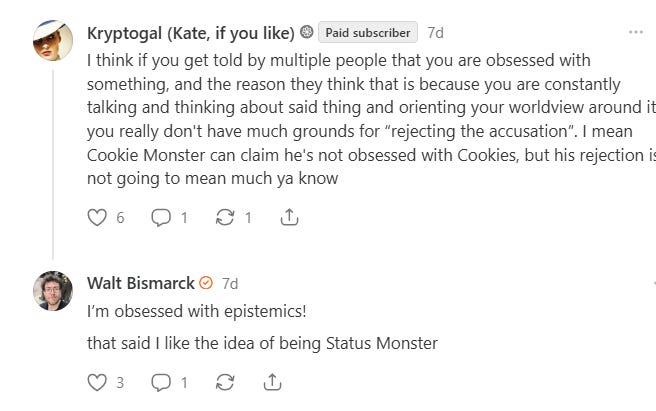
The surface-level grammar purports to describe reality, while its operative semantic content—however deniably, even to the speaker—functions chiefly to govern behavior.
This arrangement is the equilibrium condition because it’s discursively cheap to make a declarative statement so long as one holds local interpretive jurisdiction, whereas overt normativity creates exposure.
“I want you to stop doing this because I don’t like it” owns up to dissatisfaction and preference; the speaker has made a demand she might be asked to justify, which absent hard material leverage is relatively expensive in any ostensibly pluralist and egalitarian cultural ecology. Meanwhile a declarative account of normality avoids much of that burden, as the preference arrives pre-socialized.
Functionally, then, the ambiguity serves as a compromise: the high-status speaker need not present herself as issuing commands, affiliates do not have to understand themselves as enforcers, and the target can comply at relatively low cost by simply ceding interpretive jurisdiction without showing his belly—perhaps by absorbing the accusation via agree-and-amplify tactics, or even charming her into affectively coding his particular brand of noncompliance as harmless, interesting, or exciting, which if you’re even the least bit socially competent isn’t hard to do given photonegative actors generally aren’t walking around with some malevolent secret telos of ostracizing men with Asperger’s Syndrome. Basically all women if you make them laugh or flirt with them a bit will automatically extend you provisional epistemic standing, and if you occupy sufficient contextual status you can usually maintain interpretive jurisdiction from the outset provided you’re able to speak with authority about the topic under consideration and are talented at semiotic arbitrage.
Point is you shouldn’t expect any rational photonegative actor whether it’s a woman or status-inelastic11 neurotypical man inhabiting a photonegative ecology to overtly tell you they disapprove of something; both they and any audience of consequence will experience the exchange mostly as a descriptive account of ordinary social perception, and per Walt’s Toothpick12 this understanding will all be internally sincere.
Because note that any consciously manipulative speaker has to maintain a distinction between what she believes and what she’s strategically saying—that incurs cognitive and reputational costs, whereas someone who genuinely experiences her preferences as normality pays extremely little of either. She can speak spontaneously, recruit agreement without coordination, become authentically offended when challenged, and accurately describe her own internal state throughout the entire process.
Instrumentality and sincerity occupy the same move here, as they do in precisely all other human speech acts. Sincerity strengthens the instrumental function because it removes the friction associated with conscious strategy.
Photonegative power derives hugely from this structure, its characteristic moves being so socially powerful in part because they genuinely are experienced internally as caution, concern, vulnerability, tact, safety, or ordinary good judgment.
The power remains difficult to attribute precisely because the actor does not experience herself as exercising it.
The Poisoned Chalice shows how this works at the level of response costs.
Consider a public statement like: “I genuinely hope she gets the help she needs.”
The sentence lowers the target’s status by coding her as unstable, while all of her available responses are poor: simply ignoring the remark allows the coding to stand, whereas angrily rejecting it can appear to confirm the underlying suggestion, and calmly explaining how the statement is aggressive requires the target to attribute hostile intent to language whose literal content is compassionate, and even a detailed explanation of the surrounding dispute increases her apparent investment.
No matter how it’s done any sort of overt retaliation makes her the person attacking someone who ostensibly expressed concern, which means that each available answer on the response tree—including silence—contains some inexorable discursive penalty.
And note sincerity matters here as well, because the speaker may genuinely believe she has chosen restrained language. She may have deliberately softened a harsher judgment, sincerely hoped the target improved her behavior per some self-serving internal standard, and very genuinely understood herself as de-escalating. None of that eliminates the reputational effect of the move—if anything it increases its effectiveness by making attribution more difficult.
The Lilith Principle develops the same logic one step further, demonstrating how certain forms of speech become nearly impossible to contest when challenging them activates the very social meaning through which they acquire power.
Because concern and fear, understand, are unusually potent carriers.
Suppose someone says a man makes her uncomfortable, or that she worries about someone else’s wellbeing. At that point any concomitant demand for evidence now carries with it two possible interpretations.
At the object level it may be a reasonable request for substantiation.
At the metadiscursive level it could read as a man pressuring a frightened woman, or as enabling and abetting aggression by refusing to respect concern.
The attempt to impose evidentiary costs on the original speaker can therefore impose further reputational costs on the target or any other challenger.
This produces a deniability premium around some classes of utterance wherein the more effectively a claim can travel through a socially protected affective register, the less attribution exposure its speaker assumes for downstream consequences.
Once more, conscious conspiracy is unnecessary. One person feels uncomfortable. Another sincerely believes discomfort should be taken seriously. A third has heard vaguely negative things before. A fourth wants to demonstrate he is a trustworthy ally. A fifth dislikes the target already for unrelated reasons. Nobody needs to coordinate here; their individually sincere reactions can organically coalesce into an egregore of coalitional pressure with entirely predictable effects.
Agentic Diffusion13 describes the causal structure, while Discursive Game Theory adds the cost structure. Each participant in the equilibria makes a move that’s personally cheap and locally intelligible while the aggregate result becomes incredibly expensive for the target to contest, which over time in any repeat-game ecology both shreds the baseline credulity extended to photonegative actors and destabilizes masculine honor frameworks by making defection overly attractive, leading to a general decay in trust.
The Eurydice Principle introduces the question of exit asymmetry14.
In any cross-sex adversarial exchange of ideas, the woman not only has a much lower chance of securing victory through overt rhetorical dominance in most cases, but also far less to gain from it status-wise. On the other hand, she can usually withdraw from the exchange at a much lower cost than him, at which point continued male pursuit of adjudication starts to acquire negative social meaning—which of course means in practice that a game can functionally change in real time while one participant still believes he’s playing the original one.
Imagine a woman makes a hostile insinuation and then immediately disengages.
The man wants the underlying question resolved, so he responds.
She does not—and so he follows up.
And then does so again.
And again.
After enough iterations of this the audience will eventually lose track of the original proposition and instead start evaluating his persistence, at which point every further attempt at first-order clarification will only reduce his second-order standing.
This creates a powerful asymmetry. Silence costs her little and may even improve her position, whereas continued pursuit costs him progressively more. If he disengages, the original claim remains unresolved, while if he continues the very act of pursuing resolution itself may become evidence against him. Thus we get a stable equilibrium wherein one actor retains broad freedom to initiate or insinuate while the other learns that demanding satisfaction, closure, or engagement is prohibitively expensive.
And one further time—this result does not require the withdrawing actor to think strategically. She may simply think herself finished with an unpleasant interaction. Her private reason for leaving and the strategic effects of leaving are both very real.
This is one of the most characteristic features of photonegative discourse:
Actors occupy equilibrium strategies without ever representing them internally as strategies.
Instead they learn what feels dangerous, exhausting, rude, embarrassing, creepy, or beneath them, and those affective judgments guide behavior cheaply enough that explicit calculation becomes unnecessary.
Metadiscursive Caltrops intervene at this level.
A caltrop changes the future price of an anticipated photonegative maneuver before it can occur by making its likely deployment legible to the audience.
This is best done indirectly, as simply laying out procedurally to your interlocutor what forms of rebuttal are permissible might work on ChatGPT but will massively decrease your standing before real-world photonegative actors.
The move, rather, is to alter the semiotic coding of a move before she makes it, so that if she later reaches for it she’s forced to inherit an unattractive, low status frame—think the Karen who thinks calling people incel is an argument, the solipsist laundering her own self-interest as social good, or the snobby AWFL playing high and low against the middle games and hiding behind leftist ideology / headpats15 to carve out runway for a plausibly deniable status brutalism she experiences as disinterest with status16—that’s already sitting there waiting for her, hence the grammar defining the caltrop in terms of increasing the reputational cost of an anticipated photonegative maneuver rather than defeating it propositionally.
The photonegative actor might seem untouchable, but her power rests ultimately in being the central affective node of a complex prestige economy that relies ultimately on her headpats for dignity and so autonomously rallies to her defense whenever her position is threatened. That means they’ll always be extraordinarily sensitive to direct attacks on her—which are basically never productive and by definition amplify her photonegative power—but are every bit as sensitive to signs of arrogance on her part or refusal to validate their copestory. Thus while no one charge against her ever really loses the stink of low-status ressentiment, you do get diffuse frustrations against her boiling up into e.g. the Karen meme and an inchoate animus toward white women.
And photonegative actors are good at nothing if not seeming unbothered, but make no mistake: this does frighten them, and on some level they experience even the most pedestrian critiques from coalition partners as existentially terrifying, hence their constant genuflection before black women and such.
It’s the animus of spergy and disagreeable white men specifically that they tend not to care about; the moment precisely anyone else starts to resent them it registers quite correctly as a severe threat to their power base.
The optimal caltrop, then, will establish some incontestable and highly portable frame that makes it operatively impossible for her to epistemically foreclose you without also alienating some faction in her coalition she can’t afford to antagonize—a venture that largely comes down to canny semiotic arbitrage.
First you identify some faction that secretly craves your approval—and it’s here that spergy white boys will be surprised to learn a fair few factions do, and they’re kind of just blind to that fact on account of they themselves being obsessed with the approval of photonegative actors. But as a rule anyone who either isn’t competing erotically for high status white women or doesn’t love their chances in that arena will tend to respect us more than them by default, such that if we’re high-status contextually they’ll absolutely afford us sufficient interpretive jurisdiction to pull this off.
The next step is to isolate some point of ressentiment harbored by that faction against the photonegative power structure that until now wasn’t salient enough for them to consider defecting from its prestige economy—and there’s always something.
Then finally you vocalize that faction’s grievance in a way that ties it to all the same mechanisms ordinarily used to epistemically foreclose your own interests.
For instance:
Attractive nonwhite and working-class women are infantilized by photonegative intrasexual competition that shores up photonegative nodes’ own position by casting hypergamy as exploitative in an ostensibly protective container that extends such women headpats / social alignment with the photonegative prestige apparatus while making it significantly more status-expensive for affluent white men to arbitrage out romantically with them. For many women in this category, it’s an open question as to which path offers more dignity and security.
Status-elastic men in photonegative ecologies are incentivized to flatten their experiences into something more broadly legible, obscuring any arbitrage they’ve partaken in while constantly punching down at low status men to establish safety and secure headpats for whatever airbrushed version of themself they’ve devised. Typically they’ll side with a photonegative actor if she seems erotically accessible or is granting him social proof and otherwise will side with her challenger.
Non-leftist gay men are usually a swing vote when they don’t feel immediately threatened by homophobia (which drives them quite intractably into the arms of the photonegative coalition). Elsewise they tend to follow power and charisma, getting annoyed as any other dude by slave morality hysteria and a lot of times being more candid than straight guys about status and power, such that while they themselves are very talented at code switching and navigating photonegative obscurantism they’re also a sucker for a sperg who can clapback at a Karen with a beautifully propositionalized version of what she just did, which means that if you keep it mostly about epistemic hygiene and sideline your own grievances they’ll side with you way more often than you’d expect.
Autistic women often end up practically excluded from photonegative hierarchies through agentic diffusion, while those high in trait neuroticism find it harder to conform to mainstream feminine prestige scripts, making both groups as a rule quite status-elastic and relatively metacognitive. This in turn makes them more suspicious of photonegative tactics when deployed by others and somewhat more likely to deploy such tactics themselves (not infrequently with more flamboyance and conscious deliberation than conventional photonegative actors). Still, when contextually high-status they’re probably the single most valuable breakaway constituency from the photonegative coalition.
You get the picture.
To recap: metadiscursive caltrops are all about semiotic arbitrage—you find some second audience or frame in which the opponent’s ordinarily cheap move codes badly, and then import that coding into the present interaction such that she either has to abandon her natural move or deploy it on far less favorable terrain.
But the maneuver still remains available; it’s just become more expensive.
That distinction matters, because a caltrop falls apart if it looks designed to immunize the speaker against criticism, such that each possible objection only becomes further proof of the theory; that’s why DEI-style standpoint epistemology fell apart and most humanities disciplines lost all credibility with the public during the 2010s. A useful caltrop leaves plenty of room for disagreement while transparently pricing some anticipated and highly canonical form of metadiscursive evasion upward.
Even still, caltrops have costs: too many make the speaker look paranoid; too much preemption raises his own Legibility Tax; excessive metadiscourse can become more conspicuous than the proposition it was meant to protect. The optimal strategy for any exchange depends always on the probability of the anticipated move, the damage it would cause, and the cost of naming it beforehand.
Discursive Game Theory therefore treats metadiscourse as a problem of equilibrium intervention; the purpose is not merely to announce every possible rhetorical move in advance, but rather to identify those cheap moves whose availability most distorts the response structure and selectively increase their price.
This framework explains a number of otherwise puzzling features of social discourse.
Why high-status actors can often speak briefly because their claims arrive with presumptive legibility, while low-status actors are obliged to write dossiers because ordinary compression is unavailable to them.
Why compassionate language can carry greater offensive power than open hostility because it minimizes attribution exposure, while withdrawal can dominate engagement when persistence is asymmetrically stigmatized.
Why third parties can enforce a norm without experiencing themselves as enforcers, and a person can honestly deny she is attacking someone while participating in a process that reliably lowers his standing.
Such patterns persist because they are locally adaptive.
Actors learn which forms of speech expose them, imitate moves that travel cheaply, and avoid forms of candor associated with humiliation. Audiences acquire default interpretations, and institutions formalize some of them. In time the pattern becomes embodied as etiquette, professionalism, safety, maturity, taste, or common sense.
The equilibrium grows durable because nobody needs to reproduce it deliberately.
The moderator genuinely does want everyone to feel comfortable. The friend really does worry about the girl. The high status person sincerely does find overt striving gauche. The woman earnestly doesn’t want to continue an exhausting argument. The man truly does believe he is asking only for a fair hearing. Each statement can be accurate and the aggregate structure will still distribute costs asymmetrically.
That’s why conscious Machiavellianism offers such a poor model of photonegative power—strategic cognition is expensive. Stable social systems tend to offload strategy into norms, intuitions, affective reactions, and default interpretations. Once that happens, individuals are free to pursue locally obvious behavior mostly on autopilot while collectively maintaining a highly structured equilibrium.
Discursive power is therefore measured by one’s ability to—consciously or elsewise—shape the operative price structure around speech, which typically plays far more of a role in an argument’s trajectory than the merits of whatever proposition is being debated.
Once the prices become stable enough, they recede from view: a strategic advantage stops looking like an advantage and starts looking like decorum; a costly response begins to look intrinsically embarrassing; a low-cost command begins to register as a neutral observation about reality. Equilibrium is reached when the distribution of discursive costs no longer needs to be defended because the actors inhabiting it experience those costs less as provisional exchange rates than features of the world.
That equilibrium breaks when some shock changes relative prices: status mobility, technological change, coalition fracture, successful semiotic arbitrage, a prestigious defector, accumulated loss of trust, or enough metadiscursive caltrops laid down that previously free maneuvers become conspicuous enough that spergs can string the taxman up by his bootstraps and fill his lungs with hot tar.

Epistemic Standing: The degree of presumptive interpretive jurisdiction socially granted to an actor over his own experiences and events in his proximity.
Interpretive Jurisdiction: The socially recognized capacity to determine what an act, utterance, relationship, or conflict is understood to mean, including which accounts of it are presumptively legitimate and which require extraordinary justification.
Photonegative Power: Power that presents itself—and is sincerely experienced by those who possess it—as powerlessness / imminent threat / reputational exposure. It wields authority in negative space by making any overt discussion of it low-status or coded ipso facto as nefarious or pathetic, such that critics face autonomous coalition threat from competing actors operating under similarly straightforward modalities while the photonegative node herself never once has to dirty her hands. Often amounts to acquiring interpretive jurisdiction without ever appearing to exercise power
Semiotic Arbitrage: Positive-sum outcomes procured by something coding differently across audiences—think a cat grooming a rabbit and each one experiencing it as them being in charge, or a Post Alt Right polemicist bragging about having bedded many dozens of Jewish women in a manner calibrated to read simultaneously as conquest to chuds and cultural absorption to Jews.
Legibility Tax: The additional explanatory context, evidence, status proof, or social translation required for a contextually low-jurisdiction actor to have an ordinary claim about his experiences treated as intelligible and credible.
The Kryptogal Corollary: Normative statements from high-status actors usually take the shape of declarative utterances about “how things are” or “what people think” that implicitly carry imperative semantic content but are internally experienced as neutral statements of fact; note overtly normative utterances are low status due to approaching the world from a position of naked dissatisfaction.
Poisoned Chalice: A photonegative rhetorical maneuver in which superficially positive, concerned, or neutral speech semiotically lowers an interlocutor before an audience as deluded, low status, unfuckable, bitter, and so on while preserving enough plausible deniability that explicitly identifying the aggression makes the target appear paranoid or aggressive. Often experienced internally less as aggression than as preserving social harmony and protecting vulnerable parties—per Walt’s Toothpick, the speaker both sincerely believes she is being tactful / helpful / protective and is functionally lowering the target’s status position. Typically countered most cheaply and effectively through agree-and-amplify absorption or preemptively laying metadiscursive caltrops.
The Lilith Principle: Effective reputational warfare coming from a photonegative node will always don a plausible and sincere garb of concern / harm avoidance, such that any incredulity it faces itself becomes low status and a salient threat signal to other photonegative nodes, making productive self-defense costly with total deniability.
The Eurydice Principle: In any discourse space a rationally self-interested female actor will never engage directly with a male interlocutor she perceives as adversarial, as she has significantly less to gain than he does from overt dominance in such an exchange, whereas withdrawal and nonresponse cost her precisely nothing but make persistence on his part read as nefariously obsessive. This exit asymmetry allows her to attack the opposing coalition at her leisure without having to face any serious criticism.
Metadiscursive Caltrop: A preemptive description of an anticipated photonegative rhetorical maneuver that increases said maneuver’s reputational cost by making its deployment immediately legible as such.
Status Elasticity: Degree to which an actor’s perceived rank varies across ecologies or through time. High status elasticity encourages metacognition, audience calibration, and semiotic arbitrage; low elasticity encourages the essentialization of both one’s own rank and that of others. Typically associated with neurodivergence, neuroticism, sexual nonconformity, ethnic ambiguity, and active subcultural participation.
Walt’s Toothpick: Any utterance that happens to serve an interlocutor’s material or status interests should be treated primarily as an instrumental vehicle to such ends—and ALSO understood as an earnest statement of belief, as self-interested rhetoric is far more effective instrumentally when experienced internally as moral imperative or a disinterested statement of fact.
Agentic Diffusion: The distribution of causal action across allies, institutions, norms, or intermediaries such that an actor can influence an outcome while no discrete act remains attributable enough to carry corresponding responsibility. Major use case of photonegative power.
Exit Asymmetry: The differential in cost of withdrawal, nonengagement, or dyadic termination between two actors, such that the party who can leave most cheaply acquires implicit bargaining power without having to exercise overt dominance.
Headpatting: When someone legibly high status (usually an affluent white woman, often blonde) praises, compliments, or actively reifies the cope of some very low status or subaltern person (think black, morbidly obese, or short and balding) in exchange for implicit coalitional support against midstatus rivals and high status sovereign nodes in competing hierarchies, as well as to secure affective centrality and presumptive interpretive authority within a photonegative status economy.
Toxic Legibility: When someone automatically legible as high status (think a tall blonde from old money) discourages talk of status, arbitrage, or overt striving in earnestly moralistic terms because her own status inelasticity causes her to essentialize inherited rank, such that her self-interest is sincerely experienced as neutral aesthetics and all competition registers to her as delusion, incivility, or moral / aesthetic error.
It’s like Foucault became a rationalist