

Trujillo, Honduras — September 12, 1860
The thing about a firing squad is it’s the only audience on earth that isn’t allowed to leave before the end of a speech.
William Walker has been thinking this or something adjacent to it for hours now, and has already begun to draft—because there’s always a draft.
The padre by the cot is murmuring the thing padres murmur, and Walker is nodding along at appropriate caesuras while behind his eyes three sentences assemble that he’ll never get to deliver because they’re too good and too long and when a man in Honduras hears ¿tiene usted algo que decir? he’s afforded perhaps eleven words at most.
And yet the thesis stays; the thesis has always stayed. And when he inventories it—the gray-eyed man, five foot two in ruined boots, one hundred and twenty pounds of sunburnt Tennessee freckle, the self-appointed President of Nicaragua, deposed, recaptured, and condemned—what he has produced across the whole arc of the thing is a great unspoken interior speech, beautifully reasoned, addressed to no one, requiring a continent to gesture at, and ending, every single time, at a wall.
He finds this less depressing than interesting.
And that, a friend once told him—a friend now dead, most of them are now—is the whole of his disease.
Nashville — 1838
He is fourteen and they have made him stand.
The chapel of the University of Nashville smells of tallow and the damp wool of fathers, and William Walker has been made to stand because summa cum laude is a thing one does standing. But the boys around him who are seventeen and nineteen and shave are not standing, and he feels the precise temperature of their not-standing on the back of his neck like a held match.
The Latin orator is saying his name—and has, Walker notices, a faulty quantity on the penultimate of laudibus, scanning it short where it wants to be long, such that Walker has to physically discipline the muscles of his own face to keep from supplying the correction, because he is fourteen and correct and has already grasped in the way one grasps a thing decades before he has the words to indict himself with it that the great pleasure available to him in this life is going to be that of being ahead—by beat, by mile, by a syllable—and that the attendant problem is going to be what to do with all the time it saves.
Afterwards his mother—who’s going blind and to whom he reads aloud for two hours each night the Scott and Scripture and medical gazettes—takes his face in her hands and reads with her thumbs his cheekbones and small hard jaw and then says to him: Now what, Willie.
It’s less a question than diagnosis: Now what.
To the extent it is a question, though, it’s the only genuinely difficult one anyone will pose to him for the next twenty-two years of his life—and he answers it then the way he will forever, which is to say by walking out of the room.
Trujillo
They’ve left him a stub of candle and he’s using it to read the indictment again.
It’s the Honduran one, which is short and has the merit of being correct—which Walker has always admired, even when it’s deployed against his neck.
He runs a freckled thumbnail down the margin and ticks: Yes. Yes. That, also yes.
The British handed him over—specifically Captain Salmon of the Icarus, a lad with high ambitions and fantastic teeth plus the disarming gentleness of someone handing you over to be killed by a third party so said killing will have happened in the passive voice sans fingerprints, the Crown’s hands clean as a christening.
The Hondurans then did the arithmetic, and the arithmetic came out to the wall—which Walker understands full well, being an arithmetic man by disposition.
The trouble, rather, was he always kept solving for adventure, and today’s business always read more to him as asymptote than answer.
He thinks about Helen.
Having spent the last eleven years of his life not-thinking about Helen, said thinking once permitted arrives whole and intact and refrigerated with no decay at all.
That’s the splendid thing about a sealed room: nothing in it rots.
New Orleans — 1849
He’d given up the lancet for the bar—medicine first, Penn degree at nineteen and then cadavers and dropsies and baroque Latin inventories of ways the body quits—and then thereafter given up the bar, more or less, for ink, as law’s a thing that happens to people after; a janitorial science at its core, whereas William Walker wanted during.
But that’s just bookkeeping.
What matters in New Orleans in the wet mosquitoed August of 1849 is Helen Martin, who’s deaf and reads his lips at a fetchingly skeptical angle like she suspects his words of being slightly better than him, which is correct, and who has taught him a language made deliciously of her hands—a language he now speaks to her in crowded rooms across forty feet of manflesh and no one else can hear, which to a lad congenitally ahead of the room by three beats is like being handed a second face.
They had invented signs.
Not the Hartford signs or proper grammar of the deaf, but a private pidgin entirely theirs, smuggled, full of jokes that would die with their dyad—a flick at the temple, for instance, for liar, which she used on him often and accurately; a small sweep of the flat hand for the river; and also the one he’s not going to think about yet.
The yellow fever then takes her the way it takes everyone that year—which is to say comprehensively and malodorously in a pool of black vomit, her eyes going the color of retired lamps. But Walker does not leave. He’s read the gazettes; knows nothing in the entire arsenal of his abandoned profession can touch this, calomel being fraud and bleeding an obscenity, which means the one useful thing his medicine gives him is the intolerably precise foreknowledge of each stage as it arrives, which he sits in doing the only competent thing left, which is to keep his hands inside her field of vision.
At the end she cannot speak and he can’t lie to her in any language she can hear, and so he tells her the truth with the one sign, the private one, the gesture they’d made together and assigned its meaning between them like two children dividing a coin—thumb to lip, flat hand pressed once to breastbone, and then opened out to her fingers spread palm up—and her eyes find it, and hold it, after which with a hand that now weighs nothing she somehow manages to make the beginning of it back. Just the beginning, though: thumb to lip. She doesn’t get to the rest.
For his part William Walker will spend eleven years getting to the rest.
Because something in him quits afterward, declining to report for duty. This isn’t grief, exactly, as grief would demand a relationship; require him to stay in the room. It’s more that the part of him that used to flinch—that registered the gap between a body and a bullet and counted it as information—that this part submits its resignation quietly and under the table and never ends up being replaced.
Which certainly isn’t to say he becomes brave, as bravery is the management of fear and Walker is by this point no longer managing much of anything. Rather he becomes, in the clinical sense he would have used in Pennsylvania, risk-blind—the affect which in most men joins to consequence having been surgically lifted out of him—and what is left is a man that’s very fast and very charming and almost always correct, and also completely unable to register the difference between a good idea and a cliff.
Memphis — 1849, autumn
Now he co-owns The Daily Crescent—the liberal sheet; anti-slavery sheet; sheet that ran the long unsigned editorials about Free Labor as the engine of American progress, several of which were his and read even he would admit like a brilliant man arguing himself into a belief he’s renting.
Walker has come to the Memphis Railroad Convention because the future is a route, and that’s what’s always lit him up: the unbuilt thing, the picture not yet drawn, the transcontinental rail that will at last lash the Mississippi to Pacific and make of the nation’s interior not a hinterland but throat, everything of import passing through it.
He stands at the back of the hall doing the calculation faster than the engineers at the front, who keep saying thirty-second parallel and gradient question when the operative question Walker could answer in a sentence if they’d let him have the floor is instead one of psychology, namely which set of men will believe something’s inevitable before it’s even surveyed, as inevitability is the only grade that matters; one builds downhill from a foregone conclusion.
And it’s in the lobby, mid-calculation, that E. J. Gómez finds him.
See, Gómez runs La Patria—the Spanish sheet, and Crescent’s rival, in the vicious petty way that all New Orleans papers are rivals—and Señor Gómez is loud, and circled by men, and saying very loudly for the benefit of said circle that the Crescent is a coward’s organ; that abolition is a Yankee affectation worn by a failed doctor and failed lawyer and now evidently also failing editor—a man, says Gómez, who’s quit three professions now and will quit this one too the instant a fourth shiny thing—
TWHACK!
It was the accuracy that did it. Walker can take slander, which if anything he registers as soothing being just a factual wrongness he might fix. But Gómez, far less forgivably, has been correct; diagnosed the disease: the fourth shiny thing.
And so the body—the risk-blind body no longer counting cost—simply forwards the verdict to right fist, and William Walker, five foot two, hits E. J. Gómez, six foot three, square on the bridge of his raptorial Galician nose with a short sharp jab he does not remember deciding to throw yet experiences very distinctly as relief.
Said nose gives like wet chalk, and the circle scatters.
Walker stands in the spreading hush holding a throbbing hand and thought—said thought being, with awful clarity, that that was the most present I’ve been since she died.
He files it. He should not have filed it.
It will turn out to be the worst thing he learns about himself, and he learns it in a hotel lobby in Memphis over a railroad that for the record ends up built along almost exactly the line he’d worked out mentally—decades later, by other men, after he’s shot.
San Francisco — 1851
Gold had pulled the whole world west, and like always Walker ended up where all the noise was—that and all the shine, of course. Now he’s editing the Herald.
And it turns out the Herald is the kind of paper that gets its editor into duels—which in San Francisco at least is less a hazard of the trade than its primary appeal.
Now, naturally he’s dueled before—decorously, and with single-shot pistols: courteous instruments with one ball and thus one chance; an honest coin-flip, after which honor is satisfied and everyone goes to breakfast.
William Hicks Graham is a law clerk and notorious shootist who does not use dueling pistols, preferring instead Sam Colt’s new invention with six shots in the cylinder.
The relevant innovation of the revolver in the context of an affair of honor is that it removes the coin-flip entirely and replaces it instead with attrition: one doesn’t fire and resolve so much as fire and reload-by-thumb and then fire again, meaning the encounter has a duration now and functions less as an event than a process.
And Walker, well-prepared for an event, has his chest and leg perforated by that process before his courteous single-shot reflexes could finish the sentence they began.
Yet he does not, as he’ll note in the hospital, feel afraid even now, which he understands by this point isn’t exactly something to take pride in.
Then Edmund Randolph comes to the hospital.
Randolph—grandson of that Randolph, the first Attorney General, the Constitution practically their family heirloom—is the cleverest man Walker knows and only one who can keep up with him. He sits by the cot and they do that thing they do, which is talk at the speed of two minds who’ve never once been the slow one in a conversation, and Randolph lays out the filibuster idea—the whole gorgeous lunatic syllogism of it.
The continent is finished, Billy, Randolph says. Polk has eaten Mexico’s north. There’s no frontier left inside the lines—and a republic without a frontier is like a furnace with no flue—it has to vent south or it’ll burn its own house down, like Rome did!
And the South—this is where Randolph leans in, because it’s the part he believes and Walker does not; the part Walker will adopt in the same way he adopted abolition, which is to say as a costume that lets him into the building—the South cannot survive being penned. Slavery contained is slavery condemned; it has to expand or asphyxiate, and the new ground is all south: the isthmus, the tropics… a man could go down there and plant the institution in fresh soil and call it statesmanship with a straight face.
Empire, he says, is a safety valve—a civic necessity!
And Walker, who once wrote all those editorials against the very thing Randolph now is selling him—and at the time really meant them, more or less, to the degree he ever means anything—listens to the argument, and parses it, and considers the flaws in it, and then discards all those flaws without much worry, because beneath the argument and all of his friend’s sweeping proclamations of natural orders and positive goods, William Walker has heard the one frequency his ruined inner ear is still attuned to, which is to say the frequency of the unbuilt thing; the route not yet drawn; the during.
He does not want to export slavery per se. He could not, if pressed, generate fifteen sustained minutes of earnest feeling about slavery in either direction.
What he wants is to go where no one has gone yet fast enough—and Randolph has just handed him a flag to wrap his wanting in.
And so: Yes, says Walker, as he grins and bleeds ignominiously into a San Francisco mattress. Yes, I think that’s precisely right. And meaning every word of it—just not a single word in the way Randolph meant it—he goes.
San Francisco — 1854
The Mexico thing first—the rehearsal.
Lower California, Sonora, a schooner and a declaration and forty-five men.
He’d landed at La Paz and declared a republic—to wit, that of Lower California, and with himself as President.
And then, because one republic immediately seemed a thin gruel to a mind like his and the wanting always wants the next thing before the present thing’s cooled, he’d by unilateral proclamation annexed Sonora—a Mexican state he’d never set foot in and did not hold a yard of and hadn’t anything approaching enough men to even approach, and so decided to conquer wholly in the grammar of a press release.
Then everything went the way it tends to whenever one solves for adventure: no supply, no grateful little Mexicans awaiting liberation, desertion, the long retreat north on foot eating the mules, his men dropping like fruitflies, until at last his ragged remainder walked back across the U.S. line and surrendered to an Army major almost with relief, the way you’d hand back a borrowed thing you’d broken.
And now he’s in the federal courthouse, having been indicted by a grand jury under the Neutrality Act of 1794, which makes it a crime for a private citizen to wage his own private war on a nation with which the United States is at peace.
Judge Isaac Ogier is summarizing the defendant’s conduct for the jury with a face that can’t quite settle between contempt and something dangerously close to wonder. The judge recounts the lot of it—the landing, the declaration, the second declaration, the annexation-by-fiat of territory unseen, the march, the catastrophe—all of which keeps, against the magister’s ostensible will, acquiring a subtle odor of tribute.
Because even Judge Ogier would admit that when you lay it end to end it sounds astonishing—and also, Ogier’s deep exhaustion landing exactly on this word, wholly purposeless: a feat of pure trajectory, a cannonball fired at nothing in particular with enormous skill and no particular thought given at all to what follows. A man had crossed a desert with a skeleton crew and toppled a flag and christened a nation and even now could not, if you put it to him under oath, tell you what the hell for.
The judge, of course, does not say that. Instead he says the statute—and then the jury, who are San Francisco men, and like a fellow with sand in his guts, and not a little narcissistically find in Walker’s gorgeous and directionless audacity a flattering portrait of themselves, retire and return in eight minutes to acquit him on all charges.
The room cheers, and Walker stands and bows and smirks less roguishly than incredulously at himself for once again having gotten away with it, feeling in the cheering that old lobby-feeling, that punch-feeling, that most-present-since-she-died.
He files it, again—this time fatally—already drawing the next route farther south.
You can see it in his eyes if you know him, which at this point no one does.
Granada, Nicaragua — 1856
So here’s the campaign in brief:
Nicaragua is eating itself, Legitimists against Democrats, León against Granada—and the León faction, losing, makes the catastrophic decision desperate factions always make, which is to say import a sword they can’t afford and will not be able to sheathe.
Walker comes with fifty-eight men.
He calls them the Falange Americana; the press will call them the Immortals.
He loses at Rivas and learns; he wins at La Virgen and is believed; and then he does the one thing the locals can’t imagine because they think of the great lake as a barrier instead of, like him, as a route: he loads his men onto a transit-company steamboat and crosses the water at night.
He takes Granada, the Legitimist capital, while it sleeps, and ends the war in a night.
He installs a puppet, Patricio Rivas, the way you’d set a hat on a peg—and then sets the hat aside and takes the presidency himself through an election he supervises.
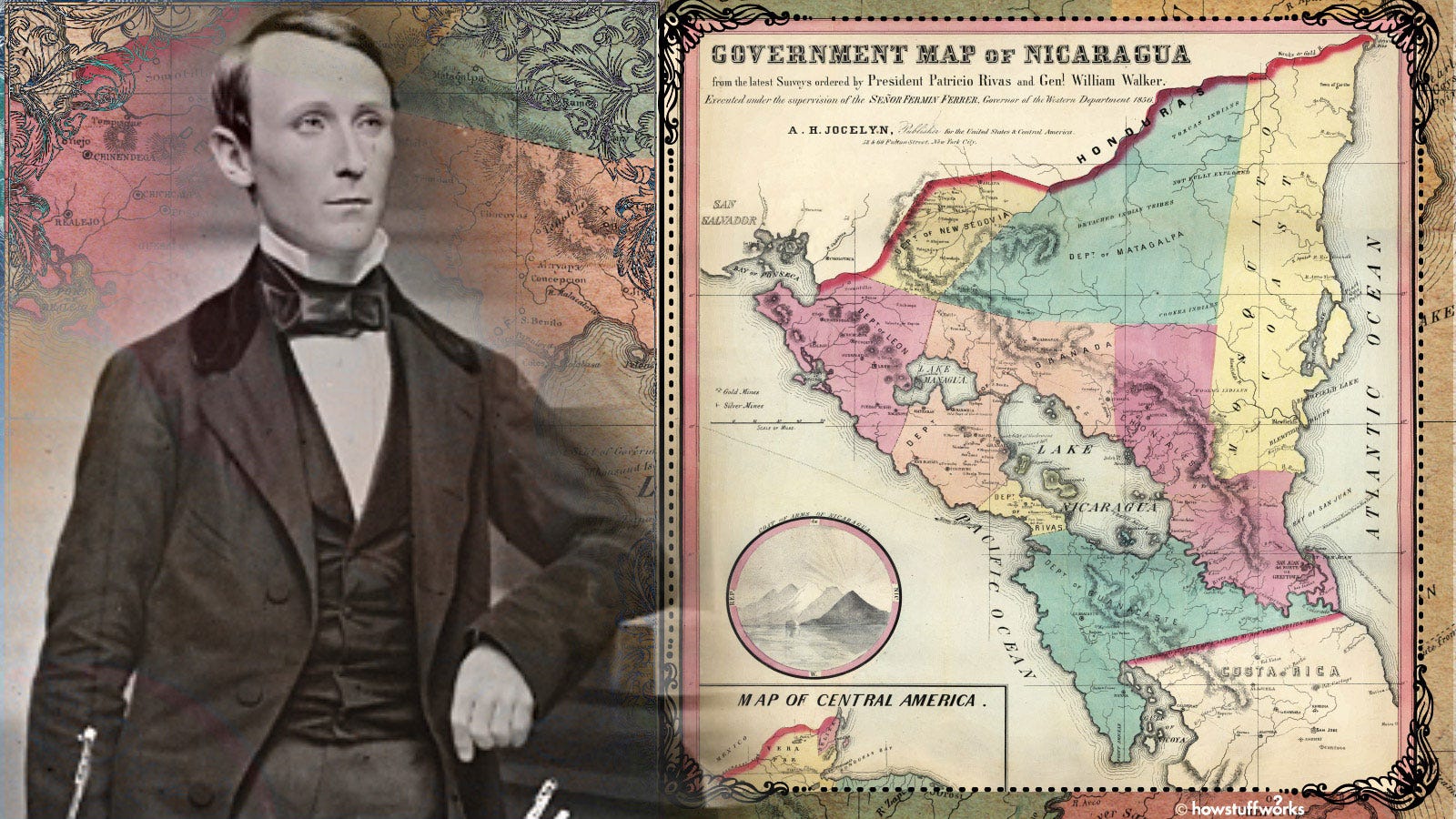
Now he stands on a balcony in Granada as the President of the Republic of Nicaragua— only thirty-two years of age, now master of an isthmus the entire commercial world has to cross to get from one American ocean to the other. Some of the locals have already taken to calling him the Gray-Eyed Man of Destiny.
Then the rider comes up from the dust with the dispatch, and the dispatch is the one he’s been waiting for—the legitimizing one; the real one.
Franklin Pierce, President of the United States of America, has formally recognized his government and received his minister—and shaken, by proxy, his hand.
The bandit is a head of state.
Walker reads it twice and his face does a thing it hasn’t since 1849, which is open.
He goes to his advisors—the careful ones, who’ve gently been trying to make him understand that one does not govern by trajectory; that a country is the opposite of a route, being something you have to stay inside of after—and he tells them.
He is talking very fast now in a flood of ideas overtaking ideas, no period strong enough to stop him: Recognition do you see what recognition is it’s not an ending it’s a floor upon which the thing is now assumed and lets us build downhill from here—and gentlemen we do not stop at Nicaragua, because Nicaragua is just the keystone! Instead we federate the five; add Costa Rica, Honduras, El Salvador, Guatemala; one republic at the center of the world— and then the CANAL! We hold the only ground where the two oceans nearly touch and we’re going to CUT IT! We cut the isthmus and the entire planet’s commerce flows through a ditch I—and then one of the careful men says, quietly, through a ditch we’ve not yet dug, in a federation not yet formed, of four more nations we’ve not conquered… sir.
Walker looks at him with real affection—and real incomprehension, the way you’d look at a man who has just objected to a symphony on the grounds that it is not yet over, and says: Yes! Isn’t it wonderful?! There’s so much left!
That there is so much left is to every other man in the room exactly the problem, but to William Walker it is the only thing in the world that has ever felt like enough—though even it will not feel like enough for very long, and some animal part of him already knows this. And it’s that very knowing that makes the smile, when at last it comes to him, so terribly bright.
He issues a decree reinstituting slavery—an institution Central America had abolished a generation prior, now brought back as keystone of the grand Randolph syllogism; the safety valve; the route to men and money from a simmering South.
Charleston — 1859
Removed now—Vanderbilt’s money and a coalition of the very nations he’d planned to federate had ground his army down to nothing, so he’d surrendered to a U.S. Navy commander and come home to write the book.
Throughout The War in Nicaragua he refers to himself as General Walker in the third person— a choice his publisher questioned and Walker defended on the grounds that it was more accurate, the President being, he said, a different fellow, now deceased.
The country is now one long-held breath from civil war, and Walker is on tour selling his book—and also the next expedition.
Tonight he’s the guest of honor at a Charleston table the length of a sloop, candlelight and old silver and planter aristocracy of the lower South arranged down both sides of it like a jury he intends to win—and by God, he is winning it, and magnificently! The fast talk has found its home here among men who want to be told that their cornered institution is in fact the cornerstone of a hemispheric destiny, and Walker tells them exactly that, the Randolph syllogism polished to a high Charleston shine, the tropics, gentlemen, are the natural and waiting field of Southern enterprise, and now the table is leaning in, the table is his, he can feel the room tilting toward Yes the way he could always feel it, the route forming, the inevitability he builds downhill from—
—and then the boy refills his glass.
He is sixteen, and careful, made invisible by long and brutal training. And as he pours, General Walker—reflexively, the way he caught himself almost correcting the orator’s Latin at fourteen, the way the hand threw the punch before the brain could ratify it—Walker thanks him.
He looks up, into his face, and says thank you—and then, because Walker can no more leave a human being unexamined than he can leave a route undrawn, asks the slave his name, and listens to the answer, and says it back to him to be sure he’s got it right.
It is nothing—the smallest courtesy on earth. Still it lands on the Charleston table like a dropped tureen, the silence absolute.
Because what Walker—raised up the easy river in a Nashville that held people in bondage the way one holds a fact, softly and ambiently without the febrile religious intensity of the cotton men, and who’d taken up slavery as flag far more than faith—what Walker has just done is treat the boy as a person at a table whose metaphysics depend on him being furniture.
And it’s then the planters see, in that one unguarded second of that thank you, what the señor in Memphis saw and those careful men in Granada after him: that this man does not actually believe—that he would chain the boy’s whole nation as advertisement and then thank him by name in the same hour and feel precisely no contradiction in it, because there is no center in him for a contradiction to tear against.
They had thought he was one of them—a true believer come to carry the gospel south. But they understand now, around the wreck of the evening, that Walker is a freebooter who has been wearing their gospel as coat, and that there is something in him far colder than a believer and hypocrite both. And so the table never quite warms again, and thus the money—or at least the lion’s share of it—stays home.
Walker leaves Charleston not understanding what he did wrong—only that the room had been his and then was not—and feeling, though he will not name it, because he never names it, the same old need rising that only the during satisfies: that of unbuilt thing and route south and wall he’s now walking toward at his usual half-beat ahead.
Trujillo — September 12, 1860
The candle is gone now.
The light through the slot has gone from gray to the flat gold of a coast at dawn, and so they come for him.
Observers will record that he is calm, and even courtly, the small man walking out into the plaza in his ruined boots between the soldiers with the bright incongruous interest of a tourist.
He had landed back in the region—the last route, the farthest south—and the British had taken him off the beach, very correctly and with very good teeth, and washed their hands in the passive voice and handed him here.
He understands all of it. He has done the arithmetic. He is, at the absolute root, an arithmetic man—and the arithmetic comes out, as it was always going to, to this.
They stand him at the wall.
The priest steps off.
The captain of the firing squad—a young man, the way they’re always young, the way Graham was young, and Salmon was young, and he himself has never stopped being the youngest in every room until precisely now—raises his sword and, because some courtesy survives even here, asks the condemned the only question that makes sense:
¿Tiene usted algo que decir?
And here is the great unspoken interior speech, finally, the thesis he has carried whole across a desert and isthmus and ocean and years, the speech that requires a continent to gesture at and receives—as it was always destined to—an audience of twelve rifles that cannot leave before the end.
He has it all loaded. The fast talk, the route, the inevitability, the there’s so much left. And he looks at the young captain, and he opens his mouth—
—and closes it.
Because there’s only one true sentence now in the whole vast warehouse of him, and it is not in Spanish and not in English and cannot be heard, and the only person who ever knew its grammar is waiting for him. He hasn’t gotten to the end of it since 1849, when he made her a promise he has carried, unfinished, ever since.
And so William Walker smiles—faintly, the observers will say, with a strange and untroubled faintness—and lifts his right hand, which does not shake, and signs it.
The whole of it, this time: thumb to lip; flat hand pressed to breastbone; then opened outward, fingers spread palm up, toward captain and rifles and gold coast and sky—the sign he and a deaf girl once coined in a city now eleven years and two thousand miles behind him—their word, a smuggled word, that meant, and always only meant:
I’m coming.
The captain does not know the language, and in just a few seconds no one else will either. He sees only a small, condemned man with sharp gray eyes making a graceful yet incomprehensible gesture, and mistakes it, very reasonably, for a benediction, or maybe surrender, or quite possibly nothing. And then he lowers the sword.
Thus William Walker at long last finishes his sentence, walking three beats ahead of no one now—even with the wall, even with the rifles, and for the first time since a wet mosquitoed August in New Orleans, exactly on time.