

If you like this essay be sure to also check out some of the best response pieces by my female collaborators:



One thing I’ve noticed talking to various female friends / girlfriends over the years is that basically all of them complain about having been sexualized as a preteen girl in a very traumatic way. Usually these stories involve a sleepover / pool party at a friend’s house and creepy behavior from said friend’s dad or older brother. The other big one is being ogled or catcalled at Target or something.
I am convinced that this phenomenon is mostly responsible for the fear and contempt modern women increasingly have for male sexuality (i.e. the rise of sex negative feminism among Zoomer women). I also suspect it to be the primary cause of the massively inflated rates of transgender identification among adolescent girls:

I came to this conclusion after doing some basic research and discovering that the modern era has ushered in an enormous decrease in the age of female puberty:
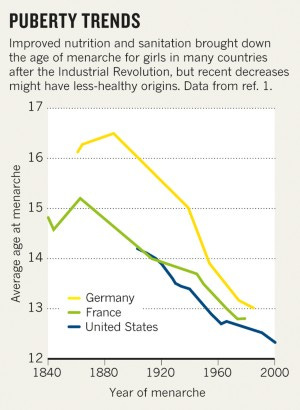
It seems very obvious to me what is happening here.
Girls are getting their periods and developing secondary sexual characteristics (boobs) 1-3 years earlier than they “should be” biologically. But they can’t psychologically handle the stresses of incipient womanhood (menstruation, intrasexual competition, sexual attention from men) because they still have the mind of a little girl.
And no, this isn’t simply due to improved nutrition from industrial agriculture—the trend has continued well into modern times. Consider this recent study showing a decrease in the age of menarche of ~1.5 years between mothers and daughters:
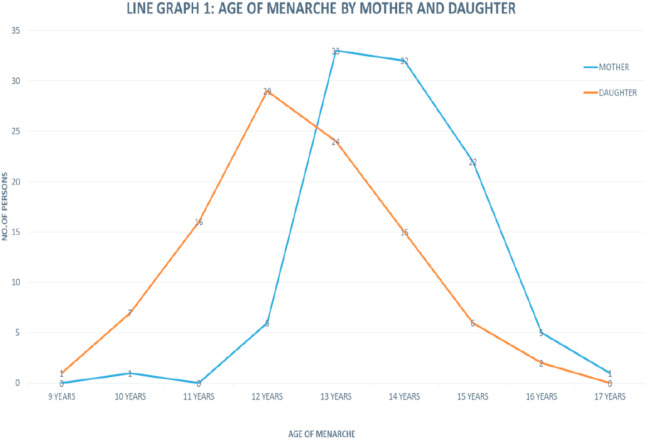
From the abstract:
A secular declining trend in the age of menarche has been reported in most of the developed and developing countries since the beginning of 20th century across the globe. Many studies were conducted to track this decline in the recent times.
Recent study by Population Association of America noted a significant decline in the age at menarche worldwide, which was observed irrespective of socioeconomic status, race or ethnicity. A downward trend from >16 years in the mid-1800s to< 13 years by the 1980s was reported.
Studies also documented the trend towards earlier menarche in England, Israel, China, India, Korea, Ghana, Mexico, Thailand, and the USA.
Results of the study showed that in Europe, the menarcheal age decreased from 16 to 17 years in the mid-19th century to 13 years in the mid-20th century, and among the Chinese girls the age at menarche declined from 14.25 in girls born before 1976 to 12.60 in girls born after 2000, with an estimated decline of 0.51 years per decade.
Here is another dataset I found specifically for the USA:

As you can see, the decrease has started to level off somewhat, but clearly hasn’t abated, despite the median American having been in a state of nutritional post-scarcity for decades now.
This is a big deal, because age of menarche is highly correlated with age of breast development and the onset of other dimorphic characteristics that will cause men to start treating you very differently:
And not just men, but also female peers:
I don’t think this phenomenon has a single cause, and suspect it to be overdetermined by various diseases of modernity—likely some combination of environmental endocrine disruptors, a sedentary lifestyle, a more unstable social ecology, fatherlessness, and increased exposure to pornographic material as young children.
Whatever the cause, girls are developing adolescent bodies alongside basically childlike minds and this is causing enormous trauma on a civilizational scale.
And that’s why you get so many teenagers these days wanting to cut their boobs off:
(Obviously this clip doesn’t portray Bebe as “trans,” but I think it very accurately captures the underlying sentiment behind this toxic fad in young girls)
It’s also why so many adult Zoomer women are increasingly disinterested in sex and are becoming femcels, political lesbians, or sex negative Dworkinites. This is actually an entirely reasonable response to the sort of experiences a girl will have after growing boobs 2-3 years too early.
My goal in writing this piece is to get female Substackers to write about this issue and spread awareness using a style of rhetoric that will appeal to more normie women (something I am very bad at and not interested in optimizing for).
This really needs to be addressed as a feminist issue—women have to lead the discussion. Normal people are too stupid and bigoted to let a man express any opinion on something as sensitive as this. The only reason I’m willing to start the discussion is that I’m incredibly autistic and disagreeable.
But most men aren’t going to touch this with a ten foot pole, because whenever you point out this phenomenon around normies you inevitably get some hatchet-faced schoolmarm going “WELL MEN SHOULDN’T BE LOOKING AT YOUNG GIRLS ANYWAY” and implying you’re a pedophile for even talking about this. Men are extremely afraid of being called pedophiles, so this shuts down all discussion.
Most of these women are simply retarded low openness bigots, but some are just reacting to their own adolescent trauma in an unproductive way, and I have a lot of sympathy for them. But this kind of censorious impulse is incredibly toxic and doesn’t help young girls at all. When trying to solve difficult social problems on the ground we must speak candidly about the world that actually exists, not the world that should be.
A lot of girls complain about creepy looks from their friend’s dad at a pool party. Suspiciously few of them wonder if anyone says the same thing about their own dad.
If they did I think they’d start approaching this from a more constructive direction.
Unfortunately, normies don’t really care about arguments and facts. They care about personal credibility and a position’s prestige coding.
Given this reality, I recognized very early on that I need to get women publicly endorsing this line of inquiry and adding their perspective.
That’s why I’ve spent the last few weeks asking my female guests about this topic on my podcast, Walt Right Perspectives.

In Episode 6 I spoke with Sai from Shəlaka Uvach, who offered some expert-level scientific insight on the chemical / social causes of early puberty.
She also presented a compelling explanation for how missing out on a pre-pubescent (but relatively mentally mature) adolescence prevents girls from developing a nonsexual intimacy with boys and feeling comfy in male spaces.

In Episode 9 I discussed the same issue with Lirpa Strike, who has been aware of this issue for a long time, having once incited controversy by railing against endocrine disruptors as a contrarian feminist blogger.
She also pointed out something that really resonated with me—a lot of the sex ed literature we were given as kids said that girls get their period between 14-16, even though all the girls around us got it from 11-13.
In retrospect this disconnect feels positively Orwellian!

Finally, in Episode 12 I spoke with the sex therapist Raven Connolly, who pointed out that early puberty produces many negative social consequences for young girls, and suggested that a degree of adolescent sex segregation might be an interim solution.
Raven emphasized the importance of effective parental communication during female adolescence, and highlighted the extreme psychological difficulty of raising an attractive teenage daughter.
Her comments about the large modern age gap between mothers and daughters (and the power dynamic that often emerges from this) are especially fascinating:
I don’t pretend to have any perfect solution to this issue. Neutralizing environmental endocrine disruptors is prohibitively difficult at this point, and it seems like puberty blockers are too risky. I also don’t want to spend too much time talking about this myself, because it’s just kind of a weird thing for a man to focus on.
But it really bothers me that more women aren’t talking about this, because I see it as an incredibly salient feminist issue that is causing an enormous amount of trauma to young girls on the ground and is poisoning relations between the sexes.
So to all the women reading this: please fucking write about this topic!
Talk about your personal experiences, look through the many many many many studies on decreasing age of menarche and see if you can’t come to any novel insights, and propose some creative solutions. I don’t care how crazy these solutions are—literally any suggestion is appreciated, because we really need to get people talking about this. That has to be the first step. If you send me some hot takes on how to move forward on this as a society, I will promote you very aggressively.
To all the men reading this: please send this article to all the rational and high openness women in your life who will give it a thoughtful read. It is civilizationally vital that we mainstream this conversation, but the only way that’s going to happen is if we can get the sheilas talking about it amongst themselves.
About a year ago I collected a bunch of demographic data sets about this subject for a class project on endocrine disrupting chemicals. Along with the average ages of menarche and thelarche(budding of breast tissue) decreasing we also have rapidly increasing numbers of highly precocious puberty(as early as 6year-olds, sometimes), and increasing prevalence of every kind of disease that is linked to hormone disruption in women. There are literally hundreds of biochemical systems in women’s bodies that are regulated by the same hormones that govern sexual development. There has also been nearly 4 decades of 1% per year decline in age-adjusted testosterone levels for men. Obviously, this decrease also goes with all sorts of health issues like a decrease in overall immunity, strength, bone density, muscle mass, sperm count, and just an overall shittier health. Not all of the data is demographic either, but demographic data establishes a widespread phenomenon. There is just as much chemical analysis and lab testing data to establish direct causal links between pollutant levels, hormone disruption, developmental issues in different animal species and also behavioral patterns associated with the hormone levels.
Can people reading here grasp just how many different kinds of social impact all of these chemical changes must be having? Your hormonal health directly affects every major decision in your life, both directly and indirectly. An early thelarche causing lifelong sexual trauma and making more women distrust and dislike men in general is just barely scratching the surface, in my opinion. This is not even to mention the many social causes exacerbating many of the hormonal disruptions, like lowered paternal involvement directly reducing age of menarche.
Putting together that project (with input from many mentors that are a lot more learned than I am) was the most devastatingly depressing experiences I have ever had in my life. Most professors, scientific researchers and engineers I have mentioned this data to are either already aware of it or are not particularly surprised by it. I have felt like an absolute lunatic as I try to explain to people twice my age, people who have multiple degrees in chemistry, medicine, or other STEM subjects, why this data has unbelievably far reaching consequences and why they should take it more seriously. I have tried and almost entirely failed at this so far. Perhaps I really am a lunatic and don’t know what I am talking about here, but there is never any convincing argument to the contrary to all the concerns I have raised. My argument is mainly based on the chemistry and the clear demographic data on the subject, which no one has denied. The best counter I got so far was- “well if it was such a major issue then wouldn’t there be a lot more noise about it? Since no one is talking about it it must not be that big of an issue”. I will put together another “lunatic” essay about it on my Substack soon-ish(I am in the middle of exams) for anyone wanting to read it, but frankly I don’t have a lot of hope that anything will be done about it, since the people that are best placed to do anything about it seem not to be bothered at all.
Anecdote from father of three young adult women: my daughters’ and their female friends were physically mature, i.e. breasts and waists and hips of adult women, by age 12-13, and still were mentally and behaviorally children. It seems plausible to me that this is occurring earlier than it has in the past and that this has negative consequences for the girls. This is a serious subject with serious consequences, and you are right to raise it. You were also right to attempt to move the conversation into domains, and among female commentators, where it will be accepted and taken seriously. Has Mary Harrington or Louise Perry written about this?