

First comes the recognition that everything soft is on a clock.
Meat on a table, cabbages in a crate, a bucket of fish pulled up hard from cold water—all drifting inexorably the moment they're touched towards rank and slippery collapse.
“Now” is a brief window; anyone who’s worked a bench or a field can tell you that. But throwing things out is for the craven man; the indolent. And so you reach for methods: sacks of salt stacked tall in tight formation; racks reeking of detritus drawn from smoke and sweat and fat; glass and stoneware dreaming in a mildewed dark.
You aren’t chasing permanence; just determining how entropy is for a time forestalled.
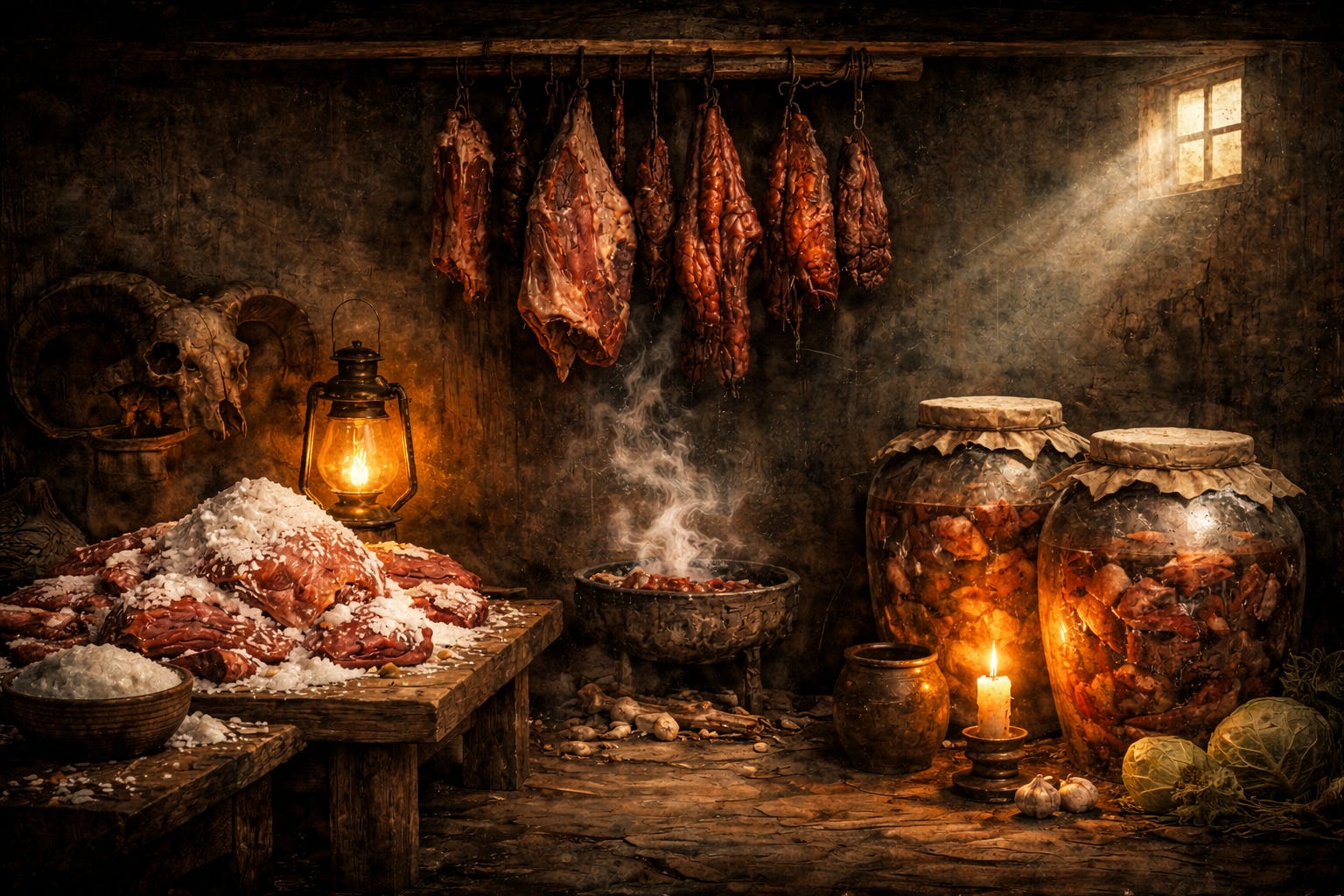
Salting is the hard answer. Like a road in winter you entomb the cut surface in heaps of crystalline sodium chloride, which instantly dissolve into a dense brine that forces its way into every fiber until osmotic pressure takes control. Water is hauled first out of stray bacteria cells and then the muscle itself, until under a microscope the field’s all shrunken shapes with walls warped inward—in layman’s terms, a killing ground: hypertonic, unforgiving, and statistically lethal to anything that wanders in uninvited. Proteins contract and lock up; the flesh grows firm; almost stubborn. Flavor sharpens, picking up a certain gaminess with hints of copper. This is preservation by dominance, simple and intractable; you don’t bargain with rot, just deluge the landscape with such overwhelming force that everything else breaks against it. The meat holds its shape for years if you do it right. Nothing can grow there; nothing gets close.
The drying rack is quieter; more disciplined. No mineral burn, no violent gradients—just air, heat, and time, kept in line. You slice to standard thickness, lay it out evenly, set the racks where air moves but doesn’t gust. Temperatures sit in a calculated band: high enough to repel moisture, not so high as to scorch. Slowly, molecule by molecule, water flees the tissue, evaporating into a passing draft. You track all this meticulously, watching numbers slide down charts where somebody else already determined when bacteria is improbable. Pigments fade and blur to a consistent and inoffensive taupe; volatile aromas lift away and are forgotten. What’s left is dense, useful, and stackable. It packs well; travels better; persists in shelves, bags, kits. And if it’s lost a little color or nuance, so be it; you aren’t trying to make a statement, just a product that behaves.
Fermentation takes a different kind of nerve—above all patience, as well as ironclad trust in a process you’ll never see directly. Instead of clearing the field you invite new players in, enticing yeasts and lactic acids to devour sugars and starches nestled deep in pickled flesh and belch out alcohols, gases, and polysaccharides. Then pH begins to sink and redox conditions shift until at last the microbial power structure tilts and it’s now the spoilage organisms getting outcompeted in an economy they no longer read correctly. Texture surrenders as cell walls yield to enzymatic attack and an alien breed of firmness emerges from the rubble with its own distinct way of pushing back when pressed. New scents appear that at first register as warnings—sour funk, sulfur, a hint of barn or sea—but with time become a signature of depth and work completed. What you started with is gone, but not lost; it’s been jarred, rewritten, and forced to make sense under a sharper set of rules.
All of these methods lean against the same essential impulse to keep perishable things around longer than they were built to last, and in all that’s preserved the method of choice is often legible at a glance—in the dense insistence of salt; thin exactness of dried tissue, pungent complexity of meat given space to fume and fester in the dark.
None confer immortality; in time even cured, dried, and soured things tend to yield or crumble or go quiet. But for a while, at least, they endure in altered form—each one a record of a choice about how to meet exposure, how much world to let in, and what changes are permissible for something that still wants, in its way, to be called itself.