
The Ravine
Chapter I

The car didn’t die on him so much as revoke consent.
A sigh under the hood, then a whimper, then silence—combustion itself apparently tired of carrying him forward.
He kept his hands on the wheel, headlights bleaching a useless dark, and thought how absurd it was, at thirty-three, to still be surprised when things quit. After all, this was the decade of attrition—jobs, women, bank balances, that brief flare when he thought he might matter as something other than a warning.
He could’ve called roadside assistance; sat scrolling headlines about other people’s implosion; waited for some fluorescent minority to fix what he couldn’t.
Instead he opened the door.
Cicadas in one register, crickets in another, the air heavy as a wet towel. In seconds his shirt clung to him like a boymom. Reminding himself worse fates existed—and that the Subaru would in any case soon feel like a coffin with upholstery—he stepped into the heat and went to the guardrail.
It was Carradined in Kudzu. Fifty feet ahead the metal dipped, marked by a scatter of wilted flowers—a dent where something once went wrong.
He stared a moment. Thought: that’s sad. Then climbed over.
The rail was sticky with heat—paint peeling off in strips like an embattled scab. Beyond it, the ground dropped off into a patient abyss.
Not exactly a ravine in the cinematic sense—no jagged cliffs or whitewater to baptize the fool who slipped—more like a hundred-foot grass chute no one had mown since Carter. Plastic bags twitched among the stalks, pale as animals in troubled sleep. At the bottom: trees, dense and insinuating, like where kids used to get molested.
He tested the angle with his boot. Semi-steep: not lethal, but not friendly either. The geometry of bruised ribs and sprained ankles. A fall survivable enough to humiliate. And climbing back would be punishment in itself.
The grass was thick, that late-summer wet that hid everything beneath it—rocks, snakes, beer cans, perhaps the bones of the person mourned by those wilted flowers? Every blade leaned downhill in solidarity, a hundred-foot sigh ushering him into the tree line.
He thought to himself: This is a bad idea.
…which, of course, makes it better than what I had planned.
And so muttering some half-formed prayer to gravity, he began his descent.
It was equal parts walk and skid, each step a negotiation. His hands groped at stalks that snapped unsatisfyingly in his hands as burrs assailed his socks like creditors. By the time he reached the bottom, his shins were striped with grass stains, and he felt he’d crossed a border he couldn’t name.
The air was cooler here; tinged with water and mildew. The woods loomed just a few steps away—dark trunks packed close like strangers in a waiting room, the ground soft with leaves and pine needles. Somewhere in the undergrowth water gurgled faintly, like a throat refusing to clear. The highway’s hum was already fading, more memory than sound.
He thought: climb back, wait for a stranger with cables. Or keep going, let the trees have you, see what else is willing to give up tonight.
And so he did.
Thankfully the faintest suggestion of a path presented itself—hard-packed dirt threading between the trees, just wide enough to suggest somebody else had been dumb enough to try this before him. He followed it because the alternative was negotiating the underbrush, which rather seemed an audition for tetanus.
Five minutes in he nearly tripped over a tire half-swallowed by moss. He kicked it, hard, and it made the hollow thud of something that once had purpose and now didn’t. A soda can rattled inside. He bent, shook it out. It wasn’t a soda can. It was a frog—pale, swollen, missing half a leg. It croaked once, then leapt away embarrassed
The path narrowed, then widened, then narrowed again.
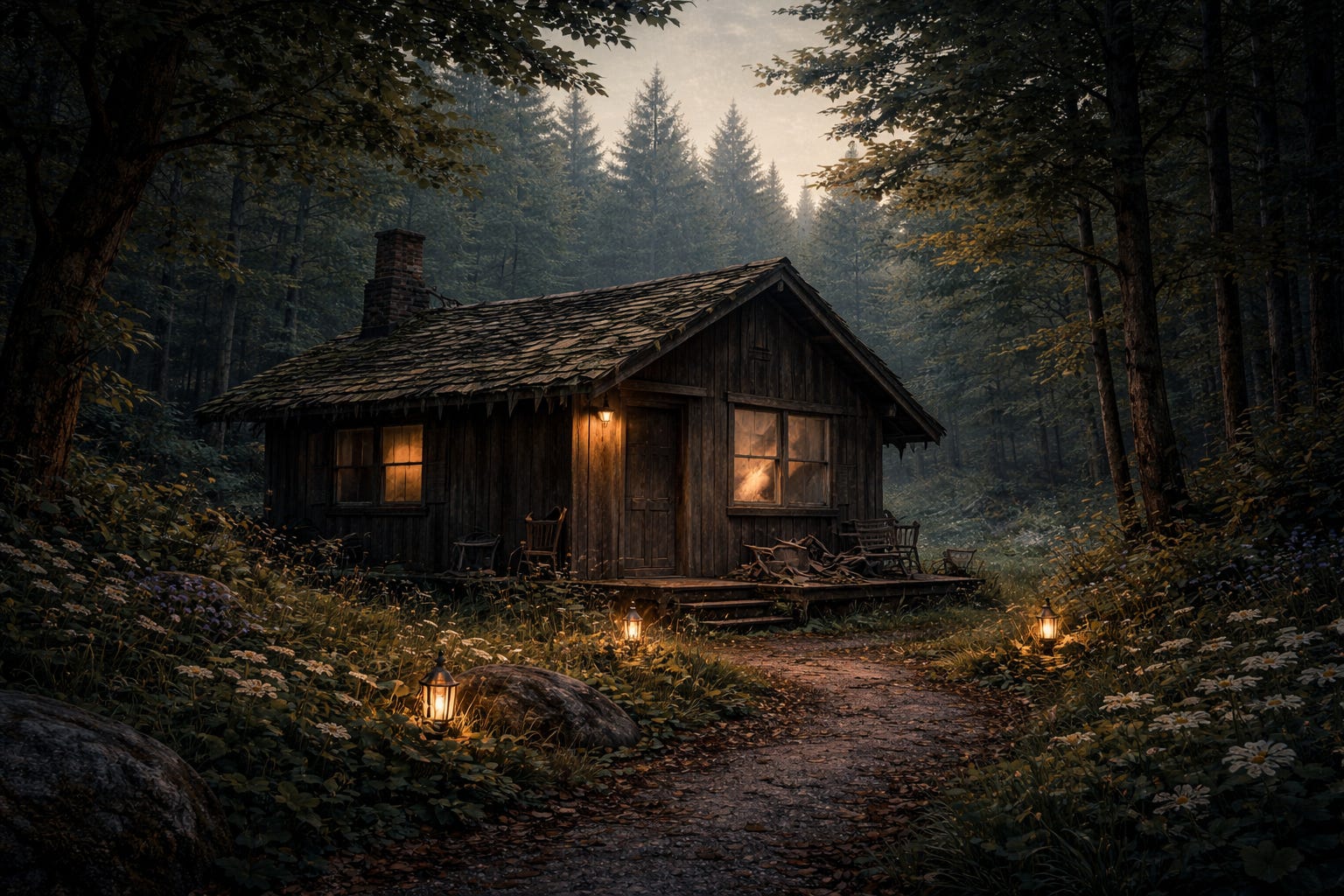
And then at last the trees got bored of themselves and gave way to a clearing—small but deliberate, as if cut out with scissors.
At its center: a cabin.
It leaned like it had been waiting too long. Roofline sagged, shingles curled like fingernails. One window fogged opaque, the other split by a neat diagonal crack. The chimney stood at an angle that at once suggested both pride and scoliosis.
He circled the place like a tentative hyena. No tracks. No car. No sign anyone had sweated in or out for years. And yet—an audible hum, low and steady, as though the whole structure was plugged into something deeper than the earth.
He crossed the clearing. Grass gave way to bare dirt around the porch, as if nothing dared grow too close. The boards bowed under his weight but refused to collapse—that would have made too much sense. His hand on the knob, a flicker of etiquette—he should knock. He didn’t.
The door gave easily, swinging in on hinges that should have screamed. Cool air slid across his face: not damp, not mildewed, but clean, conditioned, faintly lemon and faintly nothing. After the miasma outside it felt narcotic.
A single bulb glowed overhead, steady, its light flattening every shadow. The walls were paneled in pale wood, not aged so much as unfinished, as if someone had forgotten to assign them a personality.
In the center: a table. Square. Ordinary. Two chairs, evenly placed.
And against the far wall: a fridge. White enamel, humming steady, like an old dog still managing to breathe. The sound was domestic enough to make the rest of the cabin shrink, safer—like a kitchen glimpsed from some half-memory of childhood.
He pulled it open. Blinking at the order: a carton of eggs without cracks, celery crisp enough to snap, a sweating jug of milk. And beer. Rows of it. Bottles lined like a militia, labels wet in the light. Cheap, familiar, the kind of beer men buy in bulk when they expect company but not conversation.
He took one, felt the cold bite into his palm. Popped the cap on the counter edge. Foam hissed, bitter and chemical, and for a moment it was the best sound he’d heard all year. He drank long, throat burning cold, eyes half-shut like a man promised nothing and finally receiving.
The empty clinked on the counter. He opened cabinets.
Cans, stacked in ranks—soup, beans, tomatoes. Boxes of pasta. Peanut butter, crackers, instant coffee. Orderly. Unopened. Not generous, not indulgent. Just survival, shelved.
At the sink he twisted the tap. Pipes clanged once, twice, then delivered a thin rope of water that steadied into a clear stream. He cupped a hand, tasted. Not metallic, not earthy. Just fine. The sheer banality of it almost undid him.
He ate like a burglar. Standing at the open fridge, chewing cold chicken straight from the plate, swigging beer with the door still wide, as if someone might return any second to catch him. It was neither gourmet nor generic—exactly the shit he would have bought when he had money but had already stopped caring.
He laughed to himself and leaned on the counter. This, he told himself, was exactly the kind of moment he’d too often denied himself: spontaneous, unscripted, simply waiting to be enjoyed. Except enjoyment required a clear head, and his was already keeping score. Electricity without a bill. Food without a receipt. Water without a well.
Which meant—what? A trap, obviously.
…or dream?
The lights above him flickered, then didn’t.
Past the kitchen stretched a narrow hallway paneled in the same pale wood, less corridor than throat.
First door: a bedroom. Twin bed, quilt tucked tight, pillow centered, everything arranged like a photograph in a furniture catalog. The closet yawned open: empty, the single bar gleaming under the bulb like it had never borne weight. He put his hand on the quilt. Stiff, unused. He pulled it back immediately and left the light off.
Second door: a bathroom. White tile, spotless grout. Toothbrush still in its blister pack on the counter, a tube of toothpaste laid neatly beside it. Towels folded, stacked, perfect. When he flicked the light switch the fluorescent buzzed overhead, steady and clinical, as though he’d walked into a rest stop maintained by nobody. In the mirror he caught the face of an older brother he didn’t have. A little more worn, hairline giving ground. He wiped at it, but the faggot only stared back harder.
At the end: a larger bedroom. A double bed turned down, sheets taut, two pillows aligned. Against the wall a vanity, its mirror bare and waiting, no bottles or brushes, only a padded stool tucked beneath. The lamp on the nightstand glowed when he touched it. He turned it off again.
Back in the main room, the couch sagged, reeking of mildew and lemon cleaner. He dropped onto it, beer in hand, and stretched out in contentment.
He pictured his mother on the phone, voice taut: He was supposed to be here last night… The cops shrugging: grown man, maybe he ran? He pictured the headline—buried on page six: Writer Found Dead in Shack; Authorities Baffled by Fresh Groceries.
The faucet dripped once. The fridge hummed. Couch springs pressed into his back. He closed his eyes and told himself he was only resting until morning.
But the last thought before he slipped under was that the cabin, in its uncanny generosity, felt more like home than anywhere he’d ever lived.