

Probably the most important development in my thinking over the past few years has been that most persistent philosophical disagreement boils down to the confusion that emerges between interlocutors operating in incommensurable causal grammars.
Such grammars break down along two orthogonal dimensions: Resolution—how much of the mechanism an account tries to preserve1—and Scope—how far back and outward it traces antecedent conditions, equilibria, feedback loops, and historical pressures. “Ultimate” and “proximate” causes are useful colloquial shorthand for the diagonal poles of that space, with ultimate grammar entailing both high mechanistic resolution and broad systemic scope and proximate grammar consisting in situated phenomenology and locally salient adjudicative criteria.
Per Functionalist Nominalism and Thick Precognitivism neither end of that gradient is “objectively truer”; all human interpretations are lossy compressions of reality warranted by the explanatory, predictive, or practical purchase gained by preserving some causal information while discarding the rest.
The pertinent truth is thus operative rather than purely correspondence-theoretic: a causal grammar succeeds insofar as its resolution and scope fit the criterion of consequence governing the problem at hand, which at times is explanatory / predictive and at other times is narrative / coalitional; a representation can easily have tremendous epistemic purchase and zero adjudicative jurisdiction over some particular case, and vice versa.
For example:
If you’re an engineer designing a bridge you want to think at the resolution of Newtonian physics—gravity, mass, etc.—and its contextual constituents—load, deflection, shear, buckling, and so on. Such a grammar is operatively “truer” contextually than talking quarks and gluons and strings and whatever primitives exist below even that, which as you zoom in the microscope form a progressively more mechanistically rigorous and thus here less interpretively useful account of existence. The criterion of consequence is whether the bridge persists and bears the necessary load, and all human interpretations are compressed or expanded concomitantly, both at the propositional-adjudicative level and precognitive / habituated levels of memory, salience, and attention.
When you’re a builder ackshully constructing said bridge you have to deal with budget, timetable, a local constituency, and manpower constraints. John and Washington Roebling can design the best structure in the world that’s still operatively useless until there’s a decent plan in place to get those caissons installed through severe decompression sickness.
If you’re a guy inside the caisson shoveling out muck there might be a procedure in place that’s itself operatively useless because that lazy Irish potatonigger next to you doesn’t do his job whenever Washington goes up for air—or because some tool is always malfunctioning unless you whack it a particular way, or whatever—which means the locally operative truth-universe has to incorporate situated social and circumstantial heuristics or folk-psychological compressions e.g. “Micks are lazy,” “Swindleburg tools are shit” that would otherwise destabilize coalitions that normally keep everyone from murdering each other above the water.
If aliens are attacking the Brooklyn Bridge with some technology that creates miniature black holes from thin air, you probably want to let the theoretical physicist start talking in terms of quarks and strings again.
Long story short is causal grammar is always endogenous to the problem.
And if that sounds like “relativism” to you I honestly don’t know what to say other than that you’re a retarded 40 openness normalfag who shouldn’t be talking philosophy any more than I should be talking about building bridges.
The issue with this framework is that even intracontextually different actors often have radically different incentives to understand things at different resolutions, which both consciously and precognitively shapes how they interpret the world.
Hence Epistemic Arbitrage: the tactic of changing the resolution / scope mid-argument whenever a different level of abstraction benefits one’s position—think demanding aggregate evidence one moment and situated adjudication the next while invoking “systems” selectively to erase proximate variation or abrogate personal accountability. Most verbally sophisticated peepo basically always experience this sort of thing internally as hermeneutic reasonableness, while it registers as slipperiness or pedantry to their adversaries.
That said there are also real directional patterns to how this occurs, and donning the ultimate-grammar hat ourselves we can observe that it breaks down along a number of orthogonal axes, with neurotype, class, generation, ethnic background, and social / erotic optionality all playing major roles as mediators and sex being the most obvious load-bearing variable; due to a feedback loop of precognitive phenomenology and conscious response to differential incentive gradients (most importantly greater Attribution Exposure2 to the consequences of their actions, which creates incentive to reify portable invariants that generalize across cases and discount exceptionality), men are more likely to parse phenomena in terms of ultimate causes like incentives, equilibria, systems theory, evolutionary psychology, and so on, with this tendency being highest in white spergy neurotypes born roughly 1985-2000, who have the most to gain from understanding the world as a system and aggregating away from how this situation is ackshully different cause Emma’s boyfriend is a narc etc. etc.
Women—especially when neurotypical, young, urban, single, and high optionality—have extremely little practical Attribution Exposure and so experience the world less through portable heuristics and rules than through situated circumstance constantly repriced against current status / affiliative markets and moralized or aestheticized post-hoc in a manner that foregrounds proximate-level circumstance and operatively makes all compacts subject to momentary whim and functionally non-binding.
This tendency decreases with institutional mooring to a thick religion / corporation / subculture, diachronic incorporation erotically or familiarly into some sovereign male preference-set, the loss of erotic bargaining power, and subjugation to coercive masculine writ, all of which make women more inclined to see the world in more of a male-coded mechanistic way—precisely like socialization inside a thick one-to-many monoculture or liquefied feed culture, inheritance of a deeply status-inelastic prestige grammar, coalitional affiliation with young single urban women via minority status or a highly socialized neurotype, and either extremely high optionality or extremely low optionality paired with high agreeableness give men a powerful incentive to defect toward a feminine grammar.
So if I had to kernelize it: boygrammar aggregates across situations to discover mechanistically salient invariants and extend their jurisdiction across cases, while girlgrammar preserves situational particulars to retain adjudicative writ over whether those invariants bind locally, because at the end of the day causal grammar itself is an endogenous object of status competition.
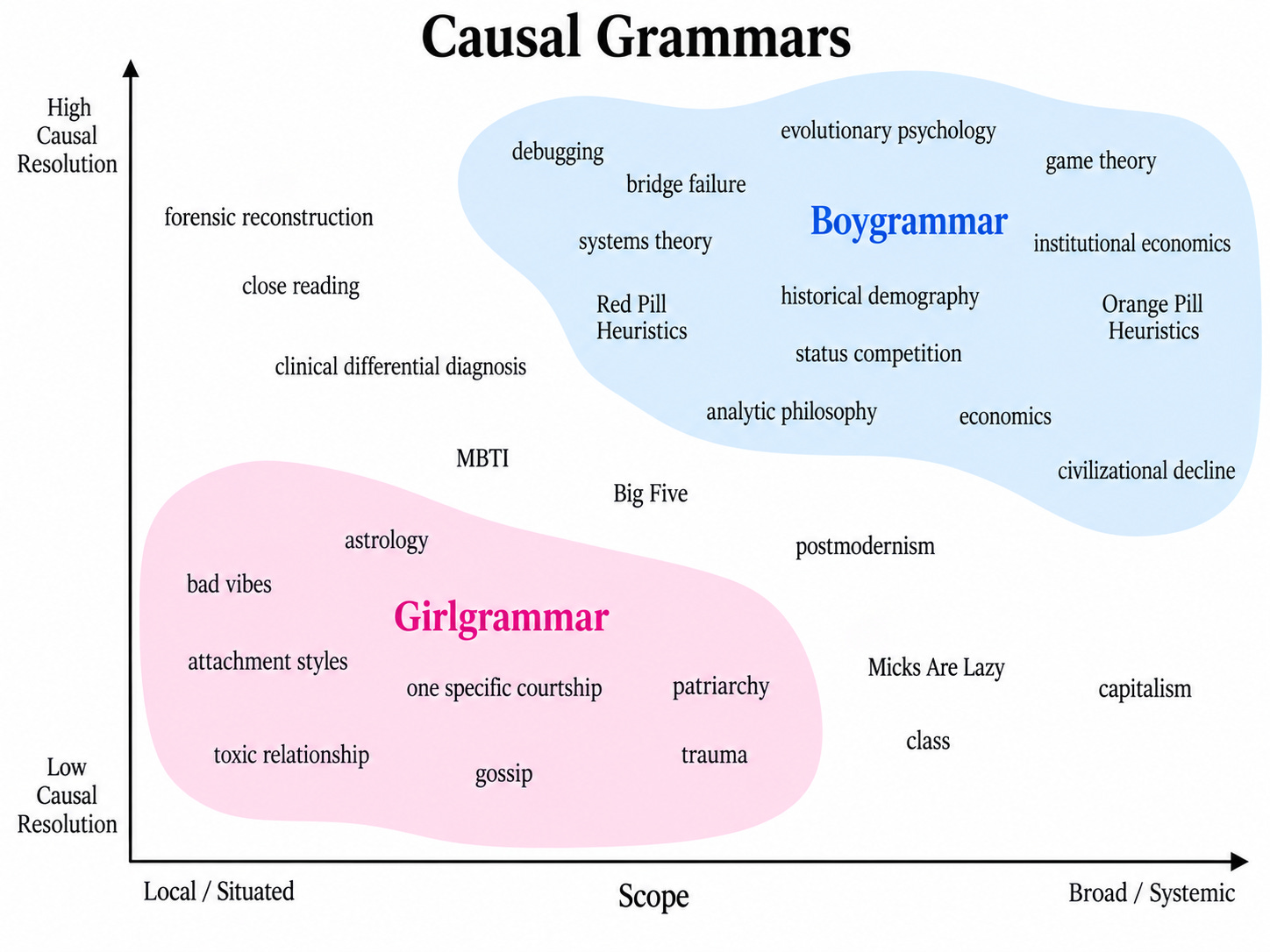
The upshot is that basically every disagreement between men and women amounts to men saying “the average woman is 5’4” and womyn saying “but I’m 5’7!” because the male side understandably sounds to them like guys who hate gerrymandering because they think squares are ontologically purer congressional districts, with a significant amount of opportunistic intersectional defection across the aisle that’s both sincere and incredibly status-driven: brown/autistic/hubbyhungry trentagenarian gals defect on the girlgrammar, while Tim Walz incels and Pete Davidson defect on boygrammar.
Thus the problem is game-theoretic: especially in institutionally thin and frictionless late modern conditions the tension between mechanistically explanatory and locally adjudicatively operative causal grammars expands because no sovereign authority has the power to say which resolution has final adjudicative jurisdiction, which means each grammar experiences the other as deceptive, malicious, or self-sealing.
Theon’s Razor: The first question in any dispute is not “who is right?” but “in what causal grammar is the case being judged?”


Note this is distinct from descriptive granularity; an account can aggregate away thousands of situated particulars while preserving more of the causal structure generating them.
Attribution Exposure: Degree to which an actor’s causal contribution to a situation is sufficiently socially legible for somatically-felt authorship and toothy consequence (here defined as repricing his operative local price structure) to attach to him. Causal power and visible authorship can diverge sharply: one actor can influence an outcome through allies or ambient norms while another performs the final visible act and inherits all meaningful culpability. High exposure makes power easier to identify and answer, while low exposure lets power travel as procedure, consensus, concern, or ordinary social reaction.

I can't believe I actually followed that, and it's pretty genius! But I also think it's an over-sperged rehash of my "Men are from Aiur" article. Mine was half sarcastic gamer references, yours was obfuscating yet detailed and accurate academia. Honestly the chart at the end was pretty hot though, I followed the argument enough to agree with the placement of every example in that space, including the boy/girl grammar fields. Well done Captain, and you're a charicature of yourself!
As always a beautiful elocution of how we can use grammar and context arbitrage as well as incorporating girlgrammar to our advantage. Great work Walt.