

One thing I’ve come to appreciate in recent years is that basically everyone genuinely talented at writing is on some level kind of a cunt.

Now, obviously all good artists are terrible people to some extent, and to anyone serious about art that registers as self-evident. But writers really are their own category, being without question worst offenders of the lot in multiple dimensions.
The biggest reason for this is that unlike other art forms, which engage the viewer through several cognitive and sensory channels in parallel, written text engages them in only one, and writing at a high level requires holding the reader’s attention through time while regularly impelling them either to intense visceral and emotive reaction or deep intellectual engagement. Thus the relationship between artist and audience doesn’t permit the same kind of modal pluralism or easy ambiance or tolerance for variable levels of engagement the filmmaker and musician enjoy; the very essence of the medium demands the writer become a propagandist, groomer, and cult leader all in one, as to reach real craft success his voice must land as undeniable.
In practice this demands from writers unusually vivid interiority—think a constant and self-renewing awareness of one’s own thoughts, feelings, interpretations, and narrative frames, which writers generally experience as an ongoing self-narration far richer, more persistent, and more emotionally compelling than the external world.
Such narration occurs every bit as easily in spergs who can’t *not* turn life into an algorithm as it does in histrionic teenagers who sneer gorgeously at punctuation like a microaggression. Both of these types and everything in between are effective in their own style to whatever extent they refuse to mutilate their own cognition to become less annoying to the world—something nearly everyone else does without realizing it, because not having to do this even in normal life (almost invariably by externalizing the costs of bad behavior through narrative spin and affective leverage) demands both a very particular sort of verbal intelligence (think semiotic agility as opposed to raw syntactic processing or semantic recall) and a powerful dispositional solipsism.
Believe it or not, this was one of the very first things Layla and I bonded over—months later she would muse to me “I can’t stand that other minds exist.”
Can you imagine dropping lines like that at 19?
Anyway point is to genuinely talented writers repressing their interiority for another’s benefit registers as a species of existential castration—hence JKR and GRRM telling their editors to fuck off the very instant they could. Their works clearly suffered from the attendant bloat and decay in writerly discipline, with the former permitting her solipsism to mawkishly queef out all manner of spontaneous post-hoc retcons that cheapen her work’s legacy and the latter indulging himself into a corner with such baroque midseries plot creep that the narrative immediately became impossible to resolve, but such factors mattered significantly less to either of them as authors than never again having to censor that mad daemon in their head who makes them special.
And if you’re reading this on Substack dot com you hardly need me to tell you that today’s writerly zeitgeist has largely fallen in line with their example.
Just speaking for myself, for instance, I know at this point I’d only let someone edit my work if they had likewise borne me children—editing, of course being a hugely romantic and in many ways quite feminine modality when you think about it. It’s a level of intimacy though that feels altogether quite undignified to afford any person who wouldn’t get her cunt ripped open for you, or at a minimum chance a creampie.
Because what you need to understand about writers is that once the internal theater grows sufficiently vivid there’s nothing in life left that doesn’t compete with it.
A writer’s central loyalty is not to people, ideas, nor truth in any clean correspondence sense, but instead to narrative coherence as experienced internally. Reality is filtered, sorted, and ultimately subordinated to what accommodates meaningful expression, and what this produces is seldom just a vain or vulgar sort of narcissism (writers being much too self-aware for that failure mode when even the least bit talented) so much as a deeply structural one, in which other people are experienced chiefly as material.
The writer does not—and cannot—process life purely on an event-local basis, because whether it’s the art hoe spinning mood swings into scripture or overclocked autismo metabolizing humiliation as manifesto the writerly mind is perpetually recombining stimulus into something that feels interesting or livable to them. And this is why so many talented writers have mental health issues they refuse to medicate; the sort of people who DON’T have mental health issues basically never have that same fanatic drive to make their thoughts legible you get with something really fucked in there, hence everything penned by the well-adjusted having a certain stench of LinkedIn.
That observation is hardly novel, of course; if anything writers are always the very first to foreground how fucked up they are. Whereas in most domains of life they can’t be relied upon to metabolize hardship for shit, the one thing writers never seem to tire of is luxuriating melodramatically in their own wretchedness—that, of course, being precisely how they control the narrative. It lets them preemptively aestheticize their foibles in frames they’re very comfortable inhabiting, forcing less verbally talented adversaries to shuffle around awkwardly like Clarence in 8 Mile.
Significantly less attention is paid to the remarkable asymmetry this sort of conversion tends to produce in everyday relationships.
Most people, of course, enter interactions assuming some degree of equity in narrative space—that whatever happens between two people is jointly owned. Writers, by contrast, experience interactions as partially pre-owned, and even when fully present never stop selecting, framing, and storing. The other person is living out the moment; the writer both living it and drafting it, and this makes real mutuality difficult because one party is always one layer closer to the authorial position.
The problem compounds over time because writers develop a far higher tolerance for internal contradiction than external incoherence. They can easily hold competing interpretations of a person or event in their head simultaneously, revising and reframing as needed to preserve narrative interest and desired self-concept. But if ever forced to submit to another’s interpretation (especially a flatter, more monocausal, or less aesthetically satisfying one) they’ll invariably chafe under the situation and resist.
But it isn’t just that they disagree, understand—it’s that the alternative registers as a degradation of the story and thus existential insult to their validity as a human being.
This is why writers can be peculiarly bad at apology. To apologize cleanly requires a willingness to collapse the narrative into a simple causal chain: I did X, it caused Y, and I own that. Writers are often too aware of the surrounding context, the emotional gradients, the prior history, the ambiguity of intent, and the alternative framings that could make the act seem less damning. What to others looks like excuse-making often feels, to the writer, like necessary fidelity to complexity.
There is also a scarcity dynamic at work. Good writing depends on attention—long, uninterrupted stretches of cognitive and emotional focus. Relationships, meanwhile, are noisy, interruptive, and demand responsiveness on timelines that do not align with the writer’s internal rhythms. Over time, many writers thus come to experience other people not just as material but as obstacle and nuisance. They may love deeply, but they also resent anything that breaks the continuity of their internal narrative work.
Another layer of narcissism emerges from the writer’s relationship to meaning itself. Most people are content to inhabit meanings that are socially prescribed and broadly stable. Writers, meanwhile, generate and refine their own meanings, which frequently run in direct opposition to more conventional interpretations—note most writers who can’t do this are likewise unable to produce anything original or interesting. Typically though it’s impossible to maintain the integrity of such a vision without at least a subtle sense that one’s own perception is more “real” than the common one, and so when conflicts arise the writer is inclined to treat disagreement not merely as a difference in perspective but as a failure of the other person to see properly.
The social environment reinforces this tendency given that writers are rewarded both explicitly and implicitly for being distinctive, perceptive, and emotionally acute. They receive validation for noticing things others miss and articulating them in compelling ways. Over time, this creates a feedback loop in which the writer’s own interior world becomes not just primary but authoritative. Other people’s accounts start to feel like lower-resolution and unsophisticated versions of what the writer already knows.
The medium also selects for a certain comfort with solitude and asymmetry. Writing at its core is a unilateral act—one person producing and others receiving, with even fluffier modalities like writing about relationships leaving absolute control with the writer, habituating them to a form of interaction where they always define the frame. Whenever they return to a relationship in which framing is contested and potentially shared, the loss of control thus registers more as ontological diminution than norm.
Which brings us to the moral dimension—namely that because writers are constantly interpreting motives, reconstructing scenes, and assigning meaning, they become fantastically skilled at justifying their own behavior within elaborate inner narratives calibrated for public legibility. This does not necessarily make them dishonest, but it sure as shit makes them difficult to pin down. For any given chain of events, they can always produce a version in which they remain perfectly coherent and even admirable, which is less a conscious manipulation than a byproduct of cognitive habituation.
At the same time, writers are often unusually sensitive to the judgments of others given that their actual work is explicitly subjected to evaluation such that regardless of public posture writers are eternally working off of that critique. This creates a strange duality: easy confidence in their interpretive authority combined with inward fragility about how they are seen. Given the overlap in attendant cognitive styles this naturally bleeds into relationships and germinates both a persistent fixation on interpretive sovereignty and oversensitivity to criticism.
Another failure mode is the inability to leave things unstoried. Most people can let events pass without fully integrating them into a broader narrative, and if anything defines writers it’s the inability to do this without suffering intense cognitive load. They make sense of the world through meaning, pattern, and arc, and while this can be immensely enriching during a hyper-limerent honeymoon stage or exciting new job it also means that conflicts, disappointments, and minor slights are far more likely to be elaborated, revisited, and woven into deeper stories and broader interpretive frameworks until what should have been a passing irritation is now a novella.
Writers also tend to overestimate the universality of their own interior experience. Because their internal world is so vivid and articulate, it becomes easy to assume that others are either less aware or less honest about similar processes. This can lead to a subtle condescension: the belief that one sees more clearly not just because one writes better, but because one is, in some deeper sense, more conscious.
What non-writers never understand, however, is that all the things that make us difficult companions also make us compelling observers. Our sensitivity, our capacity for nuance, our willingness to dwell in ambiguity—these are precisely what allow us to produce work that resonates. The same person who is exhausting to argue with can be extraordinarily illuminating to read.
The craft just straightforwardly selects for and amplifies a very specific set of traits—dramaturgical audacity, semiotic sleight of hand, and interpretive solipsism—that make ordinary ethical life defined by mutuality and accountability next to impossible.
Obviously some writers manage the tension better than others. They develop disciplines that check their worst tendencies: habits of listening, practices of summarizing others’ views before responding, deliberate constraints on how they narrate conflicts, and a willingness to accept simpler accounts of events when appropriate. But these are acquired skills imposed under cognitive load in instrumental service to higher order goals, and not default adaptation.
They’ll also make you a worse writer.
The takeaway, then, is slightly uncomfortable: if you want the benefits of a writer—the insight, articulation, capacity to make sense of experience—you will need to accept some degree of asymmetry in how that person relates to the world, because by training and temperament they’re monopolists of meaning.
To date or closely befriend a writer will essentially always involve feeling gaslit here and there, and may or may not also involve getting turned into a public buttmonkey in one of their works as punishment for failing to indulge their solipsism—which in fairness will also mean getting mythologized for posterity into something objectively a lot bigger and more significant than you really are, and you’ll often find yourself surprised by the texture and interpretive generosity in their portrayal, which not infrequently will exceed even the level you’d afford yourself looking back.
That said, writers almost certainly don’t belong in relationships with other writers—particularly if both of them are actually good, in which case shit will almost always end with someone’s head in an oven.
Which in fairness is undeniably a great story—but if it’s happiness you’re after?
Stick to someone who thinks in grocery lists.
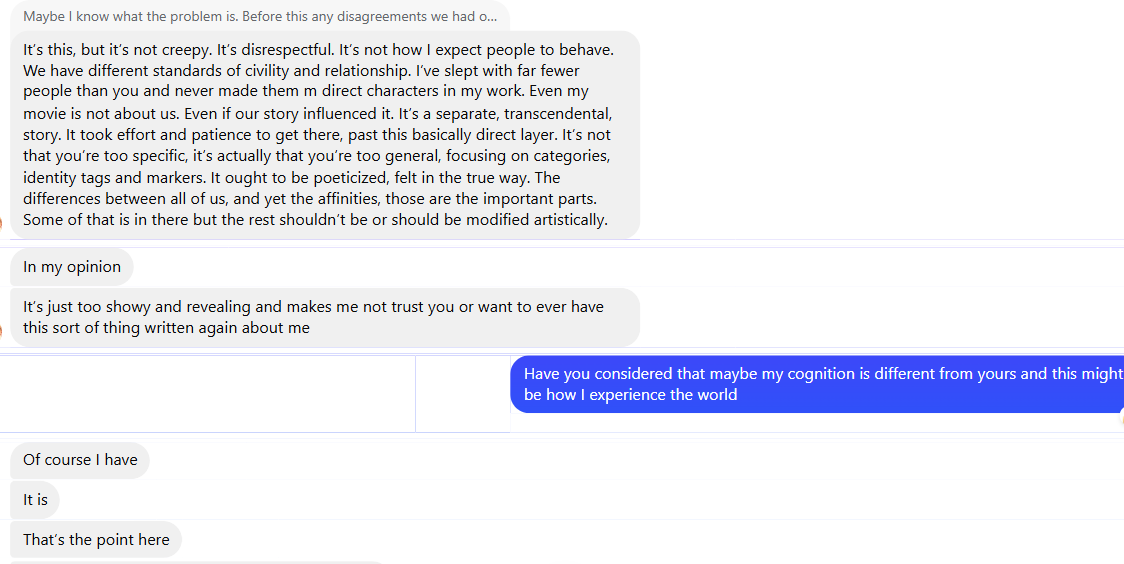
Everyone -- including writers -- used to know that writers were some of the worst / most mentally ill people. A study at the Iowa Creative Writing Program found something like 80% of students had been diagnosed with a mental illness, and like a third or something were alcoholics.
"Woke" (and then Me Too) was a shift where suddenly (some) writers got it into their heads that they were Good, Smart People and any writer who wasn't Good like them needed to be cancelled because suddenly whether your art was worth reading was linked to whether or not you had the Good and Correct opinions. Low-level assholery that used to be just sort of expected like hitting on female writers a decade younger than you at the bar suddenly became Super Taboo. Quality of writing getting published plummeted, naturally.
Also it's weird you published this because I was literally thinking about all of this stuff just yesterday. But for like the first time, this is actually a topic I kind of beat you to, which is nice because I think you've dropped like 4-5 essays now on a topic that was sitting in my drafts and I ended up dropping them because yours was too good and I was like screw it.
Anyway, if we want good books again, we just gotta accept that writers are mentally ill and do crazy shit. I will add though -- from my days working at a literary magazine -- that ASPIRING writers with very little talent and social media addictions tend to be far worse humans than talented writers. The people who bully and victim-ID their way into publication instead of getting there via talent.
Anyway, for more on this topic --
https://thecassandracomplex.substack.com/p/moral-narcissism-and-the-literary-crowd
Most writers are gammas