

There’s a song that kills people.
It runs three minutes and thirty-eight seconds, during which time men in bars across the Philippines have been stabbed, shot, and beaten to the floor while the final verse thunders out triumphantly behind them—a penalty for performing it poorly, or too enthusiastically, or when someone else in the room thought they had a prior claim.
The song, of course, is “My Way”—written by Paul Anka, immortalized by Sinatra, and transformed through a tincture of post-colonial ressentiment, masculine pride, and cheap beer into what Filipino newspapers came to call the “My Way Killings.”
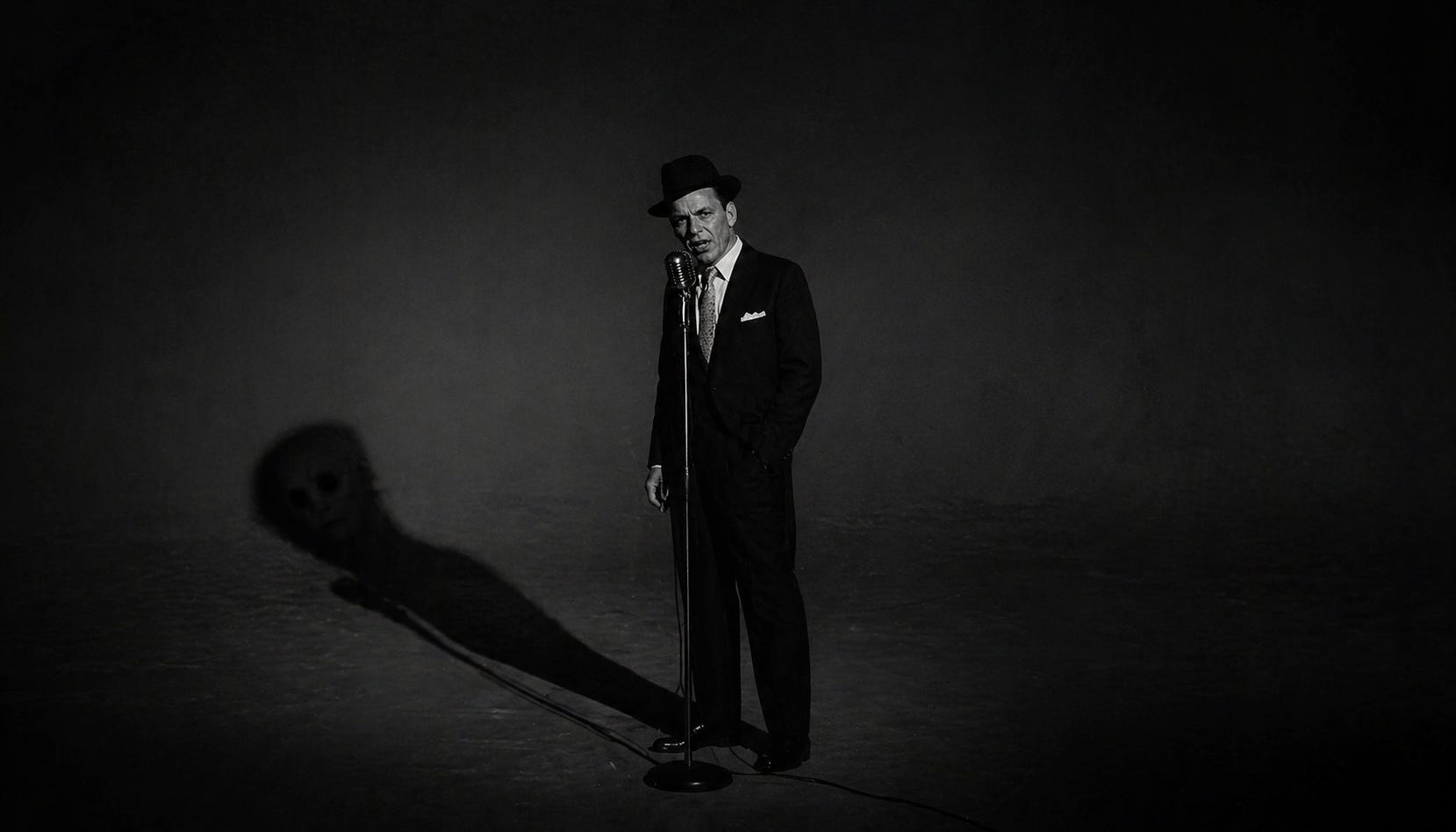
To understand why the tune draws blood one must first realize what it is: not a love ballad, and certainly not a lament, but a self-satisfied declaration of conquest over life itself that unfurls relentlessly towards the conclusion that the singer “did it my way,” each verse a catalog of trials he’s survived or paths he’s chosen against advice (his regrets being acknowledged only very briefly and then immediately dismissed) that land in aggregate upon the ear with all the nuance and humility of a gavel.
Sinatra understood this full well; his recorded performances of the song in later years evoke a man settling accounts, and not inhabiting a character so much as using one to say something felt intensely. The song thus served as vehicle for an immodesty that would have read as unseemly stated plainly—and yet when the Chairman crooned he did it his way, you believed him. Not because the lyric itself felt credible, but because the man before you had very genuinely lived a life large enough to hold the claim.
But karaoke changes things.
It strips away the singer’s authority and replaces it with an invitation that’s ostensibly democratic; anyone can stand here now and make the claim, and while the words and melody remain identical, the grandiosity of sentiment feels entirely unearned.
Every man who picks up that microphone borrows a verdict he has not yet rendered, stands in a spotlight he has not yet paid for, and declares to the room—to coworkers, neighbors, rivals, strangers—that his life has been a masterwork of self-determination.
Most songs do not carry such a weight; a man who sings a love song at karaoke makes no claim about himself, offering instead emotion, memory, or simple entertainment. But “My Way” demands that the singer stand as judge of his own life and pronounce it good, unrepentant, and sovereign—hardly a small thing to ask of a person!
Not to mention fraught in any room full of people harboring their own assessments of your life, choices, and standing—especially in the karaoke-era Philippines, which was and in certain ways remains a society where public dignity is a serious currency.
See, the Filipino notion of hiya—think shame, or more specifically the threat thereof—structures social life in deep and subtle ways that have no clean equivalent in Western ecologies predating the 2020s digital oral culture. For Filipinos public humiliation is not merely “embarrassing;” it’s a kind of ontological injury to one’s basic standing as a human being, and interfaces keenly with amor propio, a concept inherited partly from Spanish colonialism that means something like self-love, or a personal dignity that must be actively defended. In the context of Filipino culture this complex functions as a kind of basic architecture of self; the walls without which a man is existentially unhoused.
So take this architecture and introduce to it a microphone and song that’s explicitly a competition between the singer’s self-image and the room’s assessment of it, wherein the singer declares himself author of his fate and the room sees him as he actually is: probably a man of middling circumstance and ordinary choices with a life that’s gone mostly how lives go—or perhaps a grasping and vainglorious narcissist, or a deluded self-important charlatan, or a slovenly mooch. The gap between the declaration and visible truth is the source of the danger; the audience doesn’t necessarily want to hurt the singer, but the song by its very nature puts both parties in an impossible position.
Reports from bar owners and witnesses across the Philippines consistently describe the same trigger: someone sings “My Way” badly, or multiple times in succession, or with a certain air of self-satisfaction that others in the bar find offensive, and at some point a fight begins. The particulars vary—a comment from another patron, a demand to stop, a refusal—but the fundamental structure remains consistent. The singer has made a claim that someone else in the room has contested, and amor propio ensures that neither party can back down without losing precisely what the song is about.
And so before long many establishments simply removed the song from their karaoke machines, one bar owner in Manila observing to a journalist that it was easier to just delete the track than manage what might happen when it plays.
By his own death Sinatra himself had come to hate the song.
He’d call it “that fucking song” in private, and according to multiple accounts greatly resented having to perform it at every concert after audiences inevitably demanded it as closing anthem, in a sense imprisoning Ol’ Blue Eyes within his own declaration of freedom. What once had meant sovereignty over life now registered as contractual obligation: an expected performance his audience was owed and owned.
There is something instructive in this. “My Way,” at its core, is a fantasy of absolute self-authorship—a claim to have lived untouched by accident, compromise, or the demands of others. But life seldom works this way, and Sinatra understood that better than most, his own story having been shaped on countless occasions by arbitrary and nefarious forces outside his control: the mob connections that haunted his career, the political winds that briefly destroyed it, the marriages that collapsed under the weight of his nature. Ultimately the song was less autobiography than self-serving fanfiction.
What’s interesting, though, is that Paul Anka, who wrote the English lyrics, has said the song was intended originally as a character piece—a portrait of a certain kind of man rather than a straightforward confession. Sinatra transformed it into something less fictive and more personal, and in so doing lent credibility to an earnest delivery its lyrics alone can’t support. The irony, then, is architectural: the more sincerely one sings “My Way,” the more he foregrounds any gap between its claim and his own life.
The men who fought and died over this song in Manila and Cebu and elsewhere were not in any simple sense “fighting over music;” they were fighting over whether a man’s self-concept could survive public scrutiny—whether the story he tells about himself can hold its shape when other people are in the room. Usually that question is litigated quietly and ambiently, its verdict diffuse and deniable and residing more in tone and affect and the negative space of unsent invitations than in anything that could really bring the knives out. The karaoke stage makes it all rather more visceral.
Direct status competition among men has always had this basic structure: one man advances a claim, another contests it, and the contest itself produces a certain species of zero-sum clarity that everyday social life as a rule works hard to avoid. Normally such contests are managed through deference, humor, and careful face-saving mechanisms that allow everyone to pretend hierarchy is less rigid than it is.
“My Way” wrenches off those obfuscations like a banana peel and reveals the brown and mushy truth of it to all and sundry, leaving the singer perilously little room for any hedging or face-saving by insisting on a final verdict delivered loudly and in public to an audience with opinions. Thus the man who sings it badly and is laughed at has not just been embarrassed; he has been refused. His claim to self-authorship—the only claim the song permits—has effectively been vetoed by the room.
And in a cultural context where dignity proffers not just comfort but basic social personhood and epistemic standing, such a refusal cannot simply be absorbed.
Something must happen.
“My Way” is a song about winning and having won.
It is a song about surveying a completed life and finding it sufficient.
But most lives if we’re honest feel incomplete at most moments, and thus not entirely sufficient—and that includes Sinatra’s, to say nothing of the men who belt his song out shitfaced in dirty karaoke bars on weekday evenings. Such are men for whom the verdict is still very much open; whose authority over their own lives is contested daily: by circumstance and disposition, by other men in chest thumps and in the whispers of women, by the gap between what they should have become and whatever they became.
But for three and a half minutes the song offers men a different account.
It says: you are the author. You chose this. It was hard and you faced it. No regrets.
For a few of them, in certain rooms, the contrast between that account and the ugly unrelenting brutalism of everyday life becomes genuinely unbearable—not because the song feels wrong, but because it feels so damningly and intoxicatingly right, however indifferent the world may remain to that fact outside the spotlight.
The Filipino karaoke killings are obviously extreme—but they are extreme in the same direction as something wholly ordinary: the human need to have one’s self-narration confirmed, and the volatility that tends to erupt whenever it isn’t. Each time a man belts out “My Way” and means it, he’s asking a room full of strangers to agree he’s lived well, chosen freely, and emerged with dignity intact, which is quite a lot more than even the best of public houses can reasonably be expected to offer its patrons.
And so the song endures precisely because it names a desire that cannot. We all wish to arrive at the end of life able to say with some conviction that we faced the thing and it was ours. Yet that desire, when announced too loudly or in the wrong room, tends to produce exactly the conflict it was meant to transcend, transforming one’s declaration of sovereignty into the very occasion of its contest—the Chairman’s famous anthem of self-possession now a funeral dirge mourning how little any of us truly own ourselves.
Sinatra knew. He hated the song—and still he sang it anyway, night after night, because the audience needed that verdict even if the man delivering it had doubts.
And so he did it Their Way.
I always felt criticism of the song, including Sinatra’s, missed the point. It is meant to be prescriptive, not descriptive.
Separately, I disagree that the average sad sack in a Philippines karaoke bar can’t honestly lay claim to the lyrics. The reason for its longevity is that every man, more or less, identifies. You especially, there is just no fucking way you listen to My Way without thinking, yeah, that’s me, I did.
Eloquently put. I confess, I have never liked this song - I suspect because I was introduced to it not by Sinatra but by Sid Vicious, a bizarre and traumatizing experience - but your explanation is certainly on target: most of the fellas behind the mic are not golden-throated crooners regaling you with a life of valor and honor, but instead a sad sack who can't carry a tune in a bucket. (There is always the perspective, of course, that everyone is fighting their own hard battle, and in some philosophical sense yes; but such is the path that leads to participation trophies and mediocrity.)
Have you, perchance, heard the answer song by Sparks: "When do I get to sing My Way?" It's an excellent expression of disillusionment for those "Who Have Made It" and how fake success is