

There exists a theory—one as old as the games themselves—that two Pokémon were switched at birth.
Look at Venonat: a round purple thing, all fur and huge red eyes, small pale mouth.

Now look at Butterfree—the creature it does not become:

Same red compound eyes, same gormless little mouth, same stubby blue limbs.
But instead Venonat evolves into Venomoth, who shares almost nothing with it:

Meanwhile, a few entries back in the Pokédex, adorable little Caterpie hardens into Metapod: a rather less adorable green crescent who evolves into Butterfree despite its ridged silhouette showing up almost line for line in the ashen wings of Venomoth:
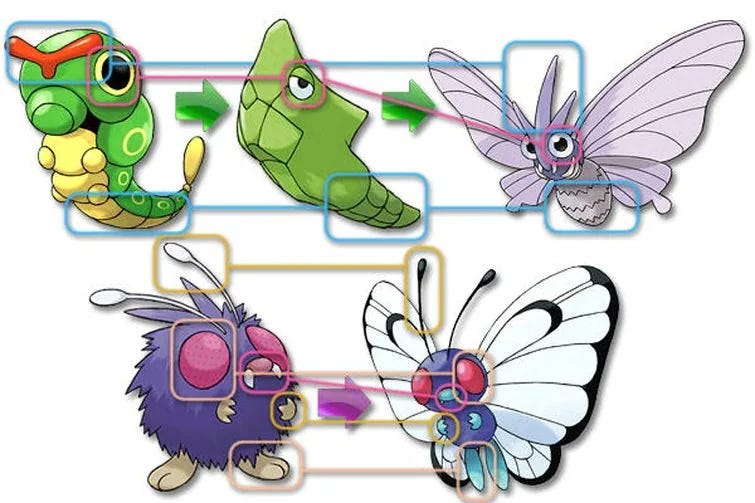
The pieces fit perfectly; they’re just in the wrong boxes.
And so the theory holds that somewhere in development—presumably late at night and under deadline—two sprites were transposed and no one caught it (or if anyone did didn’t say anything), such that the butterfly and moth exchanged childhoods in an error that would ship with the final product and so stay that way forever.
Nintendo has never confirmed or denied it either way.
And that, I’m increasingly convinced, is rather the whole point.
See, what I find interesting about this theory is that it’s also true outside the game—because it turns out Lepidopterists will tell you, if you let them, that one can’t look at a caterpillar and know with any certainty which one it will become.
Butterfly and moth larvae crawl the same stems, eat the same leaves, wear the same greens and browns; there’s no mark on them that reveals its category.
The distinction so important to us—butterfly, said with light in the voice, and moth, said a rather different way—is not even a real one in nature.
Butterflies are simply moths that fly in daylight.
The taxonomy as we understand it was drawn up by the observers, not the observed, even though the process of transformation is precisely the same for both.
But it doesn’t do to think about that part.
Because inside the chrysalis the caterpillar is not remodeled so much as dissolved; it digests itself into a slurry and rebuilds from almost nothing, in the dark, alone, over weeks, with nothing about this labor visible from the outside and no one to attend it.
Then what emerges gets judged in an instant.
The one with the right colors is planted a garden. People buy specific flowers to invite it closer; they photograph it on their children’s fingers; its arrival is called a blessing.
The other one—same order, same dissolution, same weeks in the dark—comes out dusted and grey and drawn helplessly toward lit windows, and it beats itself against the glass of houses it will never be let into, and in the morning it is swept from the porch with the leaves. Nobody asks what it went through in the cocoon.
And to be fair, nobody asks that of the butterfly either—it just never has to knock.
Though take another look at their faces:

Butterfree wears an expression of unbothered vacancy—red eyes fixed on nothing, small mouth slack. It’s the face of something that has never once been asked a difficult question and has floated through every open door assuming doors are just open.
Venomoth’s eyes are alert—if anything far too much so. They have the over-bright quality of a creature that sleeps badly and startles at porch lights; that watches the swatter’s hand; that came out of the dark with the dark still on it. One face that’s never needed to pay attention, and a second that’s never been permitted to stop.
We call the first one lovely.
The game, at least, is honest about one thing the world is not in that it shows who is permitted a middle.
Caterpie is given Metapod: a sanctioned stage of Becoming, named and numbered, in which the creature doesn’t do anything particularly interesting and isn’t expected to; just hardens and absorbs damage and gets carried away. That and waits.
But the waiting itself is dignified—even granted its own entry in the encyclopedia.
Though it’s worth pausing on the face the artists gave that waiting:

It isn’t serene or sleeping. Metapod looks angry.
Eyes narrowed, mouth set, a fixed and grinding fury—a rather strange expression to paint on the adolescence of a creature that emerges with no expression at all.
That anger goes somewhere—just not into Butterfree.
Venonat, meanwhile, receives no such stage. It is a larva—or perhaps merely a gnat?—that at some point no one records becomes a moth, arriving spontaneously from the aether to devour your finery and smear ignominiously across your windshield, as though those dark weeks never occurred and it had not also dissolved and transformed into something quite a lot greater than it was.
Because whatever it went through, it went through unnamed—and a becoming that has no name is remarkably easy to believe never happened.
Which of course makes it easy to believe the moth just is what it is, and always was.
We like to think the difference is essential—that some larvae simply are butterflies in the making, and carry that in them like a birthright, while the rest were always going to be moths, and that something in them must have always known that, or perhaps have chosen poorly, or merely have been made poorly; that belief certainly lends comfort to anyone standing in the garden and deciding what lands on them.
But the caterpillars, for their part, are identical; each and every one of them takes itself apart in the dark on faith—same dissolved body, same blind effort—while the verdict is invariably rendered afterward by parties who never saw the inside of the shell and in either case very definitely would not have found it beautiful.
Which brings us back to the swap, and also its quietest detail: that if the theory is right, the moth’s cocoon does exist in the game, and always has.
It is Metapod: that furious green crescent ridged exactly like Venomoth’s wings and filed post-hoc as the prettier and less toxic bug’s adolescence.
The formative stage the moth was never granted is sitting right there in the record—just attributed to someone else, the anger on its face an heir to the fact that it was never the butterfly’s anger to begin with.
Nothing that placid has ever gritted its way through anything. The fury belongs to the one who came out watching the door; he’s the one who did the dissolving, even if the ledger will eternally recount that the beautiful one did.
And perhaps that really was a mistake: tired artist, misfiled sprite, 1996.
Or perhaps someone in that office looked at two caterpillars, understood exactly how the world would sort what came out of them, and quietly crossed the wires so anyone who looked closely decades later would have to sit with the fact that the glorious one and the wretched one had hatched from the other’s beginning, and that nothing in the beginning had ever told us which was which.
Nintendo never told us either way, and it’s right that they didn’t.
Because, again: you can’t tell from the caterpillar.
Let's Go pokemon content from chudstack
It's a very lovely and uplifting piece when you get that it's not actually about Pokémon