

A little over halfway through his latest film You Can See Everything, the illustrious conman Nathan Fielder compares Elizabeth Holmes to the magician David Blaine.
Fielder theorizes that in one of his signature tricks, wherein Blaine sticks an ice pick through his hand without apparent injury, he’s ackshully been pulling one over on everyone—specifically by making them think he’s pulling one over on them.
In reality he’s sticking the pick through a meticulously engineered hole in his hand.
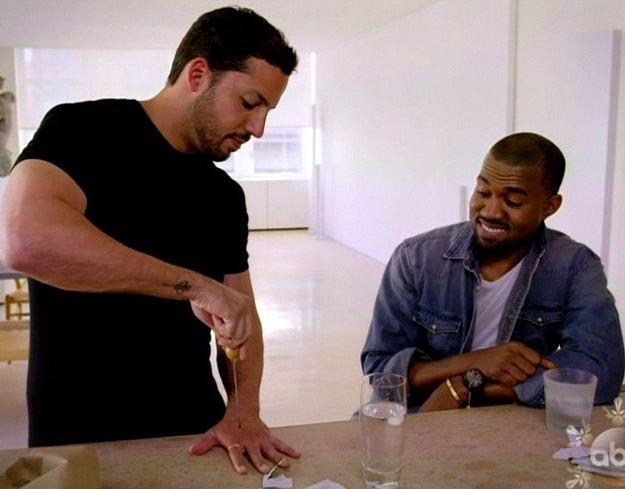
With his trademark nebbish opacity, Fielder frames Holmes as inhabiting a basically analogous situation insofar as the general public will eternally perceive her as a liar and interpret even her most earnest sentiments as obviously deceptive.
This makes Elizabeth’s enormous eyes light up.
Immediately she turns to her husband-adjacent boyfriend Billy Evans and observes to him that “Nathan sees things differently!”
Billy nods and says to Fielder that they chose to open up their lives to him in this way because he looks at things outside the box.
Only this wasn’t the real Holmes and Evans—it was Amanda Seyfried, famous for portraying Holmes in the Hulu series The Dropout, and some other chucklefuck on set they got to badly impersonate Holmes’s boyf in order to recreate a thematically significant conversation that took place before any of the papers were signed.
In the essay that follows I’ll argue that this scene is the keystone to understanding the entire movie—just less because it perfectly explains Elizabeth herself than because it’s essentially Fielder giving away his method to anyone actually paying attention.
I was first introduced to Nathan Fielder in late 2024 by Rebecca, whom some of you may remember as the heroine of Women Don’t Have Agency.
At the time I was her boyfriend—or at least that’s how she’d introduced me on the phone with her parents, who were trying to have her involuntarily institutionalized for alcoholism and bulimia under Florida’s Marchman Act.
The night before that call I’d ripped through her luggage and dumped her tequila in the sink—partially at the behest of her domineering attorney ex-girlfriend, who’d forced Rebecca to admit there was an open warrant for her arrest (which the maid had neglected to mention whilst begging me to take her in), and also insisted that she’d hold me accountable if anything happened to her, as the last time Rebecca had come to Orlando I’d been trying to keep her sober but had no idea how shitfaced she was getting—little bitch kept sneaking patron shooters smuggled in her purse and pockets—and the dyke had shown up out of nowhere to take her to the hospital, apparently rolling her eyes at the little pink kitty-collar she was wearing (which I never got back).
Interestingly though the lesbo and I developed kind of an unlikely friendship after that, which was remarkably charitable of her given Rebecca’s parents had initially blamed her for an enormous purple bite mark on babygirl’s smexy thigh during the Marchman hearing that was ackshully of Waltine origin.
Turns out we had a lot in common.
She was also the bih who lived close enough to Rebecca’s friend’s house to break in and nurse her back to health after chickie passed out on a Facebook Messenger call halfway through the Nathan For You series finale, Finding Frances, which I ended up finishing on my own a few weeks later while Rebecca sat in a jail cell giving black women her commissary snacks for protection.
As mentioned earlier, this was my first exposure to Nathan Fielder—and I was hooked.
The episode was about an elderly man trying to track down the love of his life he’d let slip through his fingers as a younger man, which resonated with me immensely given that at the time I was 31 and felt my own life had been ruined by very stupidly letting Rebecca slip through my fingers when I was 27.
The two of us had met on SeekingArrangement.
Our dynamic started as a conventional sugaring thing but almost immediately evolved toward something a lot more romantic; she was only a year younger than me, and at the time I was more or less looksmatched to her on account of being on roids and Rebecca constantly bringing over low-calorie protein-rich meals in tupperware.
Liking tupperware was kind of her personality.
It was honestly really cute.
Anywho she invited me to meet her Jew family for Thanksgiving and I said no because I couldn’t envision myself marrying a girl with 25 partners and a past in sex work, and then dumped her the following month because my first gf wanted to try dating again.
By the time things fizzled out with said first gf Rebecca was already dating the lesbian, and that’s kind of how I fucked over my life—none of the chickies I dated after that were anywhere near so frictionlessly compatible with me.
Thankfully I had the chance to date her again three years later, at which point I was on girl 113 and her own 30-something seemed downright chaste to me. And this time the romance was a lot more theatrical / nostalgic than substantive and we were lowkey kind of exploiting each other, but it still could have settled into something every bit as real as what we had before if her dumb retarded boomerkike parents had just kept their goddamned beaks out of our affairs and let me manage bae’s sobriety in peace.
That was my second fuckup with her: instead of Ubering her over I should have just driven down to Tampa myself to pick her up and then thrown her stupid gay faggoty iPhone out onto the interstate so she couldn’t sneak booze or triangulate against me.
Yes that’s “controlling”—it’s also objectively what she needed, and if you disagree with that you should be raped to death. The biomedical-therapeutic bureaucracy ought to be eradicated with prejudice, and everyone who defends it humiliated.
If I had simply asserted control over her life, it wouldn’t have been Rebecca herself complaining about it, I can tell you that much; being ordered around made her cum like nothing else. It would have been her shitty family and blonde-cunt best friend.
Anyway.
She called me a lot in prison while she was locked up, and we made plans for me to marry her and take control of her situation when she got out.
After a while the calls stopped—never figured out why.
Then one day she randomly called again saying she was out and in a treatment plan and we spoke for six hours, and I opportunistically used her for podcast content—in part because she had a genuinely interesting life story by its own lights and made for good social proof, but mostly because I wanted a durable public record of this second iteration of our dyad that nobody could opportunistically renarrate away post-hoc.

Then the calls leveled off again.
I continued watching Nathan For You by myself.
Much like Rebecca, Nathan Fielder is Jewish.
Later when I have ChatGPT analyze this essay it’s going to homosexually sneer at me for noting that and say it doesn’t matter, but it ackshully does—a lot.
Specifically because Fielder’s Jewishness is one of the things that allows him to play the role of nebbish so effectively.
…or rather, to instrumentalize external expectations of nebbishness for his own purposes.
The guy’s look and mannerisms code as harmless, weak, neurotic, and ineffectual, and by deliberately inhabiting that archetype he’s able to get away with fantastic acts of social aggression and nonconformity that would never fly from someone more overtly domineering, conventionally handsome, or legibly high-status.
The move is hardly unprecedented—note figures like Woody Allen and Larry David built formidable careers for themselves doing it on an even larger scale—but these days inhabiting the archetype so overtly is seen as kind of gauche, and mainstream Jewish masculinity is a lot more Seinfeldian: observationally superior, judgmental, and socially integrated. Still, it can absolutely be done today via irony and misdirection, and Fielder is a lot more talented at doing so than basically anyone else.
This, of course, is the secret sauce of Nathan For You.
Nathan’s character never seems like he’s dominating the interaction: he conspicuously stammers, avoids eye contact, says weird shit with a straight face, and never even seems to notice when he’s making other people uncomfortable—and is likewise the dude who designed the situation, assembled the participants, controls the resources, and eventually edits the footage. The apparent asymmetry of social competence conceals a pretty gargantuan inverse asymmetry of actual interpretive power.
Nathan’s cringe is a weapon insofar as it ensures people register him as an earnest participant in the situation rather than a calculating producer manufacturing it.
It lets him lure the viewer in as a compatriot who’s in on the joke and epistemically privileged over the Stupid Goy presently being made a spectacle, thereby making the viewer the ackshual Stupid Goy in some deeper and subtler way.
It also lets him pursue utterly absurd business ideas like shit-flavored ice cream with a deep professional seriousness that creates genuine ambiguity as to where reality ends and fantasy begins—no differently, observe, from the chick playing a Disney princess who genuinely wants that toddler on her lap to have a magical day, or the consultant at Deloitte “managing expectations,” or the sugar baby telling the dude paying her rent that she loves him, or Melania Trump acting like a tradwife at CPAC, or Donald saying Mexico is gonna pay for the wall, or Bill Clinton feeling your pain, or Elon promising us flying cars years ahead of schedule and becoming a trillionaire anyway.
Theatricality as such is neither straightforwardly false nor straightforwardly true; it occupies a middle register of provisional, contextual, and operative truth that gains or loses validity retroactively as power shifts and appetite recalibrates endogenously. It often functions as a Schelling Point that coordinates its own actualization, whose ultimate truth is underdetermined in the moment and only crystalizes once the dust settles and we learn whether or not the blood tester ackshully works—or whether or not The Donald ackshully got Manuel to open his pockets, or Walt Bismarck ackshully showed up at that Thanksgiving dinner. If he shows up then it’s more dignified for her to be the girlfriend; if not, it’s more dignified for her to be the whore.
This is how an immense portion of life works for high-variance and theatrical people.
If you’re a WASP who manages an Applebee’s and marries some rectangular bitch who sings in your church choir you’ll probably never experience this slice of reality.
If you’re an Italian, Irishman, or non-Seinfeldy Jew—or work in an industry like tech or consulting drenched in fake-it-till-you-make-it culture, or happen to date lots of actresses, models, and art hoes who’ve dabbled in sex work—this kind of theatrical and epistemically hazy renegotiation will occur around you constantly and most of the time won’t register as particularly exotic / unexpected, unless you’re kind of a shmuck.
The former group will naturally think of the latter group as epistemically sloppy or coping, while the latter group will tend to find the former provincial and life-denying.
To someone in the former group, Elizabeth Holmes is straightforwardly a fraudster, and Nathan Fielder at best a clown Borattishly tricking oafish business owners; the old man in Finding Frances is a deluded old fart, and Nathan’s increasingly personal dyad with the escort Maci he hires halfway through yet another absurd joke.
To the latter group Fielder is an ingenious performance artist making deeply provocative statements about business ethics, love, and truth itself.
As for Elizabeth Holmes?
Well, that’s the question.
Any honest discussion of Holmes needs to account for a few things.
The first of which being that precisely all entrepreneurs, PMs, and consultants lie fucking constantly—and also don’t experience any of it as “lying” so much as social politics, diplomacy, managing expectations, and not being a tard who aggravates their patron for no reason. Precisely all sophisticated investors, executives, and business users actively price in such lying, and will themselves only experience it as such when a) its consequences become sufficiently egregious; and b) the liar has become sufficiently exposed politically for his deception to inexpensively present itself as such.
Elsewise the professionally courteous thing to do is always to ignore the other side’s lying in exchange for your own side’s lying being ignored, and whenever some spergy young analyst pops out of the woodwork to fuck up the arrangement by impolitically privileging correspondence-truth he always gets his knuckles rapped by the director.
This is the equilibrium state of principal-agent dynamics in business.
Everyone tolerates a productive Schelling Point Lie until the moment it becomes apparent you’re in a Theranos situation and the internal status economy shifts to blame allocation—and note this is literally half the reason consultants even exist; they’re an extraordinarily efficient mechanism for dispersing and outsourcing blame.
But much like with sexual consent situations there is no analytically rigorous or consistent basis for distinguishing an Elon Lie from a Holmes Lie at the point of utterance; it’s all a question of how power shakes out and whose processes get audited, because precisely every audit on earth is going to uncover some manner of faking-it-till-you-make-it or corrupt CYA bullshit, as nothing significant gets done in precisely any organization of consequence without boatloads of that shit, and if the reader hasn’t learned that by this point in his life he’s presumably an unironic child.
In practice it’s a skill issue. If your big-picture lies are a good enough Schelling Point, nobody interrogates the more specific object-level shit you lied about and instead just somatically registers anyone who obsesses over them as a viscerally pathetic incel—note if Theranos succeeded exactly nobody would think of Holmes’s deception about battlefield usage and such as a “lie,” as boundaries exist only insofar as they’re enforced, and truth alone possesses precisely no claim over experienced social reality; whether any particular lie goes down as such in the history books as dispositive as opposed to getting priced into expectations, retconned as charming exaggeration, or absorbed into founder myth depends a lot less on its correspondence-truth itself than on power, outcome, and scapegoat possibilities.
For instance—Peter Molyneux overpromised his ass off about Fable and delivered a good-ish RPG, and today is seen as an extravagant and epistemically slippery auteur. Todd Howard portrayed a bunch of scripted Oblivion gameplay footage as emergent at E3 in a manner comparable to what Liz Holmes did with Novartis and today is quite a lot more respected than Molyneux despite being arguably the far more aggressive liar from a chiefly analytic standpoint. He’s just a more competent administrator, which is ultimately what determined his record. But if Molyneux hadn’t fucked up B.C. and Oblivion had been just a little shittier each easily could have the other’s reputation.
Meanwhile a lot of times the deception is distributed elegantly across so many actors through incentive structures and coordination problems that isolating any one part of the chain as fraudulent seems patently ridiculous to any rational observer.
Here’s a good example: when I was a consultant manager at Deloitte working on comically understaffed actuarial data modernization projects my director subtextually pressured me into eating billable hours in a way that was every bit as plausibly deniable as Carmine Lupertazzi asking Tony Soprano to kill Johnny Sack.
To be clear: he overtly told me not to eat hours—and then said that if I wasn’t capable of completing the deliverables without eating hours I wasn’t working efficiently enough.
And he probably earnestly believed that—just as I believed that when I started eating hours I was just fulfilling the obligations of an underresourced role, and the partners believed that I deserved to be promoted wildly ahead of schedule for being so efficient.
An organization that isn’t like this won’t be competitive with organizations that are; until the point it starts producing maladaptive externalities, it’s game-theoretically inevitable that an institution will develop means of distributing profitable deception across participants in locally justifiable ways never internally experienced as such.
Which in my case was ultimately fine; after getting burnt out from 120 hour weeks I milked the company’s LTD policy like a cow and then used the prestige of my role to transfer out into a cushy remote sinecure at a sleepy midwestern insurer. The thing is me being able to do that was itself implicitly priced into the entire fucking system, and is precisely how the apparatus manages to perpetuate itself operatively speaking. The accommodations and payoff structures exist chiefly in negative space because that’s the most efficient place for them.
Now, of course no institutional actor would ever ADMIT to that, and if you ever vocalized the dynamic would immediately start gaslighting you like an exgirlfriend.
Hell, they probably wouldn’t even propositionally acknowledge it to themselves, as it’s vastly more efficient for them not to, and to instead just internalize the equilibrative palimpsest of lies running every which way as the world’s natural state of affairs.
And insofar as they acknowledge it as the natural state of affairs, IT GENUINELY IS.
But then sometimes the equilibrium destroys itself, because the lies get so outrageous and operatively untenable—despite, again, at no point being understood as lies by their utterers—that you get a situation like Theranos.
…or like Enron, which also became a convenient cultural whipping-boy for embodying shady practices still ubiquitous in less obvious incarnations, and as fucking everyone LOVES to point out, also happens to be where Elizabeth Holmes’s dad used to work.
The second thing you need to understand about Holmes is that she’s fucking weird.

Recently I observed that she has a similar vibe to Jason Arday.

It’s the eyes that do it.
They’re guileless—almost childlike.
Personally, I tend to think she’s a pretty obvious autistic savant.
You Can See Everything has a bunch of scenes that suggest this, like the one where she doesn’t grok the underlying joke of Abbott and Costello’s famous Who’s On First bit.
Of course, most people will resist this explanation and say she’s deliberately affecting the signs of autism or whatever because they’re insipid WASP normgroids who can’t tolerate the notion of punishment existing without some perfect act of volitional will having precipitated it and need her to be the sinister creepy calculating fake-girlboss, and nothing will budge them from that position because Holmes has been designated the Girardian scapegoat du jour for having violated the honor of Henry Kissinger.
Some stupid retarded cumcunt womyn, meanwhile, will opine that all of her misdeeds were ackshully the fault of Sunny Balwani who was ackshully grooming her the whole entire time, while simultaneously maintaining that all of her accomplishments were completely her own and also that her current man Billy Evans is a monstrous and controlling narc for taking the eggs she was preparing and whisking them more aggressively than her whilst telling peepo to fuck off on her Xitter account.
Nathan Fielder conveniently gives you plenty of material for both of these interpretations.
…and for much of the movie it’s presented as kind of a one or the other possibility space—that either Holmes is the Bad Guy™ or Evans is—which immediately registered to me as many times too pedestrian a dichotomy for an artist of Fielder’s caliber and almost certainly some manner of sophisticated Jewish misdirection, but probably went over the reader’s head because he’s a Stupid Goy.
The thing is though the hints weren’t even all that subtle.
Like early on Fielder establishes that Evans was an erotically successful dude seeing three chicks at once when he started pursuing Holmes, which proves he isn’t some incel exploiting a vulnerable woman because he can’t get puss anywhere else.
Then almost immediately it’s mentioned that he comes from old money and has been supporting her financially, which sets up the angle that she’s playing him that’s then immediately dispelled by showing her being visibly affectionate toward him while subtly documenting all of Evans’s various alpha chad qualities (just framed in a way that makes him the douchey aggressive tech bro goy to Fielder’s insecure nebbish), including a full-body scan of him in the shower complete with a full-frontal cock shot.
Whenever Evans’s height, money, athleticism, or social dominance is made especially conspicuous it’s accompanied by a cartoonish shot of Fielder jealously scowling at him like Elliot Rodger, and Fielder meanwhile has numerous moments with Evans where he interferes with him directing Holmes’s life in an incelly white knight way or snaps at him defensively and EH and BE either act awkwardly about it or laugh it off, as well as several moments where he’s spying on them talking in private and Evans is actively encouraging Liz to stand up for herself more and show greater agency.
Now if you’re a Stupid Goy you’ll take all of this completely at face value and conclude either a) that Fielder is soliciting the viewer to laugh at their expense given Holmes is acting Jason Ardayish as usual whereas Evans fits the culturally prescribed stereotype of a douchey tech bro; b) that Evans’s behavior is abusive because you’re a frigid fat chick who’s never been fucked good before or a pathetic beeta wastrel who’s never commanded meaningful erotic authority in his life; or c) that Fielder is just kikeishly slandering Evans because he’s jelly of his goyish vitality, because you’re a thickie chud with Down Syndrome who can’t understand subtext to save his life.
If you have a bit more sophistication to your cinematic eye, you’ll start to notice that Fielder has been doing the David Blaine thing all along.
The thing I loved and hated most about Rebecca is that she was an actress.
She’d started out in high school playing Anne Frank—a role that in spite of her overall amenability to raceplay she tragically failed to reprise in the bedroom on account of feeling too protective of the little Jewess’s memory, which is why it’s an awful good thing StableDiffusion exists. Meanwhile she was glad to be the generic belle juive abducted by Cossacks, but that fantasy never really excited me all that much, and the one time I had her just act like a hitchhiker I was forcing myself upon or w/e the whole thing immediately felt cringe and fake to me and I made her terminate it, which hurt her feefs because she felt like it was me saying she wasn’t skilled as an actress which to her was genuinely Her Craft.
I don’t think she ever did any stage shows after high school, but she did play Jasmine at Disney World, as well as Tinkerbell’s mean friend Vidia.
That’s where she met her lifelong bestie—some faggoty little blonde bitch who was playing Tinkerbell at the time, and tbh had a much more Vidialike personality.
Anyway about a year into the job she also started stripping—that’s where she developed the character of Natasha, who was her stripper persona and to her essentially just an adult version of what she was doing at the parks all day.
I always liked that about her.
Kind of sanitized the whole “dating an ex-stripper” thing in my head.
But anyways: a few years into that she started sugaring instead whilst studying for paralegal school, and that’s where we met.
And when we first started seeing each other she was also going on dates with this one boomer dude she repeatedly swore even when interrogated shitfaced that she’d never fucked, and tbh I still don’t know what I believe about that. She later told me she lied about a whole bunch of other shit, but was always dead-set she never lied about that.
A few months in I wanted her as my official girlfriend, but she wouldn’t accept the title unless I agreed to stop seeing other chicks, which I didn’t want to do. Then she suggested the Thanksgiving thing, which I think was her way of Jewishly Deloitting us into couple status without having to have a hard conversation about it and idk.
But just before we broke up Rebecca let me blow her out whilst she was shitfaced drunk as the anniversary of her sobriety or w/e, and the version of her I fucked was a hell of a lot more like Vidia than the version I’d grown accustomed to—looking back I think it was lowkey her avenue for punishing me for picking my exgf over her, as she said a lot of really mean shit to me before getting unconsciously sodomized that night.
Later I learned that she’d been diagnosed with Dissociative Identity Disorder, and her lesbian gave me an extended and elaborate YouTube lecture on all of her accumulated multiple selves lore, which the lesbi at that point felt me trustworthy enough to know about, though she was quite insistent I not be a bully towards the infantile DDLG self.
And I don’t really know if I actually believe in any of that.
But what I absolutely do believe is that women who are actresses and women who have a history in sex work and women with substance abuse issues and eating disorders and women who were molested are compared to normalfag women materially more likely to theatrically compartmentalize both their erotic self and shadow-self, and that it’s so overdetermined in women who are every single one of these things as to functionally be identical to whatever the DSM pedos call Dissociative Identity Disorder.
I also think that basically any competent performance artist, consultant, or founder is going to have shades of exactly the same tendencies, even if they happen to manifest in materially more adaptive ways.
Without those tendencies you simply can’t survive in any narratively volatile realm.
But when dating women like this you kind of just have to price in that until things are genuinely rock-solid between you two her bestie might be hearing a wholly different story about you than her roommate and parents and exgirlfriend and shrink and whoever the fuck else.
Sunny Balwani—former COO of Theranos and Holmes’s longtime age gap boyfriend—is an interesting guy.
In You Can See Everything he’s aggressively cast by Billy Evans as having been a creepo older guy in his thirties going after hapless widdle 18yo Elizabeth, which as a creepo guy in my thirties who’s recently been involved with multiple strange 18yo girls I for my part greatly resented.
That said I also couldn’t particularly blame Billy Evans for coming to that view, as I’ve recently determined that basically every man on the planet is incentivized to flatten or pathologize his woman’s exes in precisely that way—especially when the last fellow was more dominant, impressive, or narratively consequential than himself. At times the last knight needs to become the dragon for her life story to make sense, and the new knight will be happy to give her the masculine language to make it hang together.
Indeed, Elizabeth has actively been trying to make Balwani the Fall Guy for Theranos for years now whilst describing him as having been abusive in the relationship—but that’s also what every single woman on the planet would do in a situation like this and if you either take any of it seriously or particularly blame her for having done so you have Down Syndrome and ought to be drawn and quartered, as dehumanizing and scapegoating ex-boyfriends is literally just a normal and expected facet of womanly psychology due to bog-standard paleolithic war bride dynamics.
The annoying thing for me about Evans buying into it was more his solipsism—my dude’s utter inability to recognize that he is now occupying precisely the same role as Balwani, except as the younger interpretively aggressive techbro cougarhunter boyf as opposed to the older administratively aggressive sugar-adjacent investor daddy boyf.
Besides the change in semiotics they’re doing almost exactly the same thing for her.
And I’ve ackshully always found this particular aspect of Holmes’s psyche remarkably endearing—compared to most Millennial women of her milieu she’s unusually willing to inhabit overtly asymmetric sexed dyads where the man takes on conventional male responsibilities of social aggression, moral blame, and interpersonal friction in kind of a Jorah Mormont-Daenerys dynamic, and she doesn’t experience that protection as diminishing her own greatness in any way, which is very genuinely princessy and cute.
That said I don’t think Amanda Seyfried was an amazing casting choice for her.
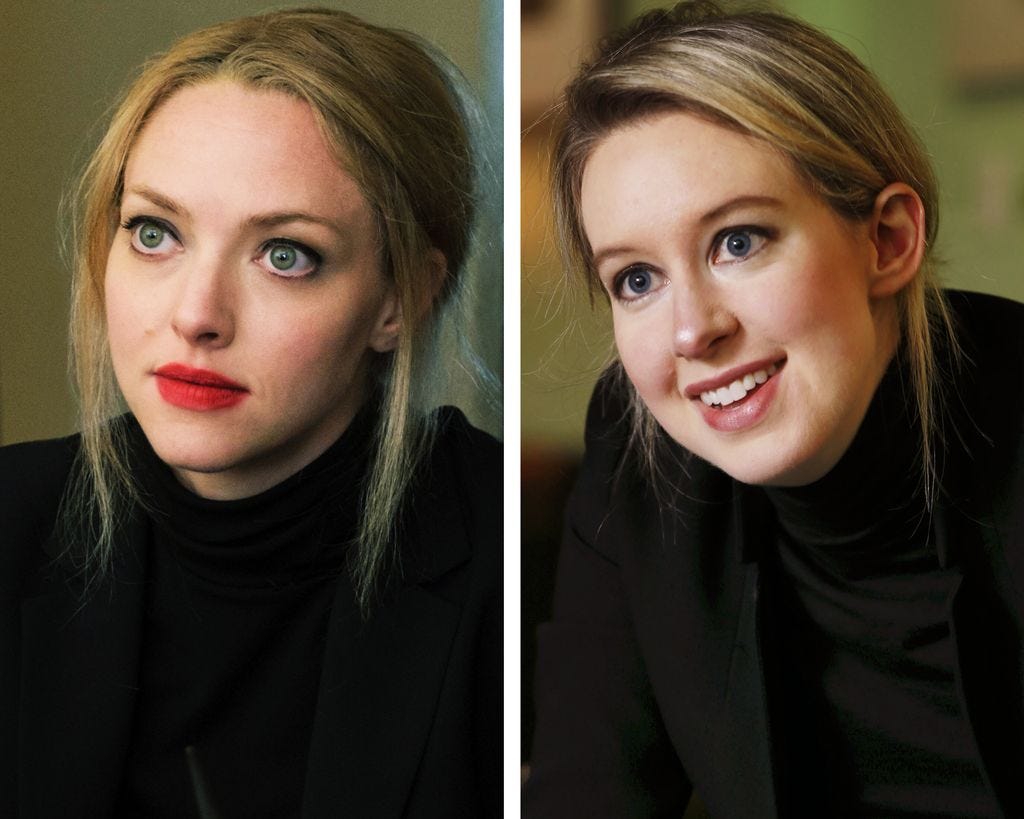
In fact I’d say she severely fucked up the character and took loads of interpretive liberties Holmes is entirely justified in feeling indignant about.
To wit:
Seyfried’s Holmes is deliberate and metacognitive about the deception in a way that in fairness is presented as locally understandable and actually given quite a lot of narrative padding via the rape backstory and Larry Ellison telling her everyone in Silicon Valley is a huge fucking liar—but that itself is the fuckup, because IRL she was probably some silly little sperg bitch who was taking the period’s asinine Millennial girl power shit completely at face value while all the boys flattered her and refused to tell her she was being a dumb retarded Women In Tech cumcunt. Essentially she’s given a Tony Soprano or Walter White backstory that doesn’t comport with how women in these situations actually fuck up, which is basically always by epistemically insulating themselves from negative feedback.
She’s way too polished and conventionally pretty. Yeah Seyfried’s Holmes is plausibly geeky, but she’s geeky in a pedestrian normalfag way that comes off as like Sjokz or some chick who’s into video games because her boyfriend showed her Mass Effect and is now a semi-popular Hearthstone streamer. That in turn makes Sunny register as a kind of pathetic middle-aged man who got overinvested in his hot young girlfriend’s startup and makes Kissinger and George Shultz look like dumb simps who got thirst trapped or bamboozled by daughterly cutesiness. But IRL Holmes had a positively uncanny charisma borne less of being gorgeous conventionally (clearly she’s not ugly, but she’s definitely kind of goofy looking and the kind of woman you need some sophistication to appreciate) than of possessing an unflappable, almost divinely-inspired confidence in herself and undeniable ability to serve as a human Schelling Point attached to a conspicuous vulnerability that makes men want to protect her.
The most appropriate comparison is honestly Joan of Arc.
Sunny Balwani could have invested in a million dumb aspiring girlbosses much more conventionally attractive than Holmes. Instead he invested tens of millions in some goofy-looking sperg bitch who talks like Barry White.
Billy Evans could have found any number of gorgeous and needy girls to rescue who would have treated him like a god. But instead this wealthy, chadly, socially successful dude dedicates years of his life to defending a disgraced founder older than himself facing a lengthy prison sentence that doesn’t even grant Evans conjugal pussvisits.
Both men chose Elizabeth for a reason.
Her self-mythologizing was no less ridiculous by its own lights than Joan’s conviction that she’d been sent by God to lead France to victory.
She has something real.
And sometimes a little bit of real is precisely what enables a whole lot of falsehood.
But much like Emma Watson’s beauty didn’t just undermine her Hermione but also flattened Krum into the older foreign Chad using his status to score the smokeshow that Ron for some reason had ignored for years, Amanda Seyfried’s portrayal not only makes Holmes seem a lot more sinister than she ackshully probably is but also makes the men in her life register a lot less as guys who’ve organized their existence around protecting a special and unique little elf-princess everyone else misunderstands than as either opportunistic predators or unserious and easily bamboozled simps, both of which are profoundly unfair characterizations.
The last time I saw Rebecca in person I was half a cock inside her when I realized she was shitfaced out of her mind and needed to go to the hospital.
I’d gotten on the phone with her Uber driver from Tampa and told him explicitly not to stop at a convenience store and let her get booze. She bribed him to do so anyway. Beaners should all be deported.
At the hospital they tried to separate me from her almost immediately.
They wouldn’t have a few years earlier.
Alas, my waistline and fashion sense weren’t what they had been in 2020.
…which is probably also why Rebecca’s cunty little Tinkerbell bestie told me in the waiting room that she ackshully sees me as “more of a business thing.”
It didn’t matter that I hadn’t venmo’d the kike anything in ages, or that my cum was drying inside her as we spoke; the moment you need to explain anything you’ve lost.
That’s actually something I bonded with Rebecca’s lesbian about.
Apparently the bestie had never liked her either.
I guess during their relationship Rebecca was always triangulating between the two—and triangulating with her parents—in really annoying ways.
You simply can’t trust feminine and pretty bisexual women. They just have way too much optionality to maintain narrative fidelity about literally fucking anything ever.
Though for what it’s worth—apparently Rebecca had always described me to the lesbi as a genuine boyfriend and potential future husband, and Rebecca’s roomie had heard similar stories. Neither one of them ever experienced me as the cringe deluded trick.
But to Tinkerbestie I was a “backup sugar daddy”—at least per the screenshot she texted me later, which per Rebecca’s later account was all One Big Misunderstanding and essentially a shorthand compression used with the bestie because explaining my whole extended backstory with her would have been excessive at the time and she wasn’t certain about whether I’d ackshully prove willing to commit to her to a sufficient degree to get rid of the current sugar daddy etc etc.
Who knows what’s ackshully true.
All that matters is that in that moment that worthless little blondebitch cumcunt was trying to get me out of that hospital because she somatically experienced me as a deeply illegitimate presence, even though I was the one who’d fucking brought Rebecca there and had summoned said bestie in the first place.
And what fucking KILLS ME about it is that had I gone to that Thanksgiving in 2020 it probably wouldn’t have mattered that I’d gained fifty pounds and was dressed like a homeless person four years later; Rebecca’s bestie would have somatically experienced me as a legitimate partner and deferred to me in that situation. But because I’d given Rebecca no compelling reason not to compress me unflatteringly I could be cast aside ignominiously like Sunny Balwani the moment it became narratively convenient.
Rebecca insisted later that she’d sit down with Tinkercunt and explain the situation.
She also hung up on me when I insulted her friend and never called me again.
Halfway through the film Elizabeth Holmes goes to jail and we’re suddenly introduced to Amanda Seyfried herself—specifically through a wonderfully Baudrillardian montage of her watching Holmes watch her play Holmes and eventually break down crying at how inaccurate it all feels.
At this point Seyfried says something about wanting to break Holmes and Evans up because of how “controlling” he is, and that “no woman wants to see another woman ordered around by a dude like that,” which probs bc of my history with Tinkercunt viscerally made me feel as though Seyfried should be raped to death.
Then almost instantly I realized I was being a ridiculous chud.
First because Seyfried was blatantly being theatrical in that moment in a way that establishes her as the voice of normalfag libtard / womyn audience members—and not even in a misrepresentational way, mind, but just in the way that exactly every person theatrical enough to dedicate their life to being an actor is capable of when a talented and seasoned performance artist gives them the right antecedent prompting.
Second because Fielder was obviously making a point—one that babygirl was pretty clearly in on in a metamodern tongue-in-cheek way—that Seyfried feels guilty about imposing her own interpretive frame on Holmes and that she’s coming after Evans to compensate, which Fielder initially encourages the viewer to go along with but then gradually undermines over the back half of the movie—first by showing that Seyfried is a giant fucking hypocrite who for all her criticism of Evans telling peepo to fuck off on Holmes’s Xitter is revealed to have herself been raked over the coals for a nasty tweet about Charlie Kirk (this is probs an indirect jab at female audience members Fielder himself handed to Evans either directly or indirectly, with himself Seyfried and Evans all being metamodern kayfabe Millennial theater kids in that part of the movie), and secondly by having Fielder interview Holmes in prison where she echoes Evans’s narrative about being able to make decisions for her almost word-for-word before calling out Seyfried and The Dropout’s producers for interpretive liberties that ended up making guards bully her thinking it was exactly how everything went down in language that lambasts them as having “betrayed another woman,” and then finally by having Fielder himself describe her dynamic with Evans during visitation hours as genuinely affectionate with zero signs of duress against inspirational upbeat music and Evans asking Fielder if he’s sure he doesn’t want to stay longer.
Third because the movie ends with Evans and Holmes cuddling in the prison yard and Evans showing her her Xitter on his phone and her laughing, interspersed with shots of Fielder and Holmes frolicking gaily in the ocean together, and then cuts to white text on black noting that Evans renounced all rights to profit from the documentary.
Which btw was its own gay little subplot the movie spends way too much time on—it’s revealed dramatically halfway through the film that before they started shooting Holmes had gone upstairs and let Evans strong-arm the producers into giving them a slice of the cheddar, which she later indicates she never knew about blah blah blah.
If you care about that plot point at all you’re daffy and probs voted for Amy Klobuchar.
There’s nothing wrong with demanding money for a movie about you, and that entire plot point was used to artificially introduce an element of menace to Evans and open up questions about how much he was doing all that at Holmes’s behest, when literally anyone who’s made a hard phone call for their girlfriend before was rolling his eyes aggressively through that scene and waiting for them to get to something interesting.
Honestly that might have been the solitary dramaturgical misstep on Fielder’s part—Evans already didn’t look bad at all for demanding money, so the revelation that he’d given it up almost made the dude seem artificially saintly and comically overplayed the whole fucking conceit of the film which was pretty plainly that Fielder is giving you the only possible sympathetic portrayal of Holmes and Evans given that you the Stupid Goy audience member are going into it with the interpretive possibility space of a) she’s a lying totalistically deceptive psychopath scamming a dumdum techbro; or b) she’s a hapless faultless womyn who’s been groomed and corrupted by eviw narcissistic men.
You want the ackshual fucking truth on Holmes?
She’s very obviously not a psychopath.
She’s a silly goofy little sperg-bitch who took millennial girlboss culture way too literally and became a preternaturally talented Schelling Point for biotech interests that allowed the promotion to get monstrously ahead of the actual capabilities and created a cargo culty atmosphere around herself enabled by longstanding fake and gay Women In Tech narratives that made it cheap to flatter her and thereby created an epistemic bubble that exacerbated her most cringeworthy tendencies.
She naturally latches onto dominant and aggressive men who autonomously serve as moral laundromats and fall guys for her because they very genuinely believe in her and want to protect her on account of her adorable childlike earnestness.
Balwani and Evans are at once both easy for stupid women and normalfags to cast as the ackshual bad guys and the genuine cause of most of the bad shit surrounding her because they intuit with complete sincerity that a) the right constellation of tech is only a few years off from making all this shit happen; b) Elon and all the other great entrepreneurs are constantly lying their ass off while fake-it-till-you-make-it culture is ubiquitous in tech and adjacent industries like consulting; c) Elizabeth genuinely has an insane talent for inspiring people and drawing investment because she knows exactly how to channel Millennial girlboss sensibilities with zero impostor syndrome because her autism or w/e makes her genuinely find it impossible to experience herself as inauthentic or her own motives as deceptive.
Sunny and Billy are clearly both narcs to SOME extent, but that isn’t inherently a bad thing, and it’s obvious the love there is/was real in both cases and that she needs a man like that to manage her bullshit because she’s essentially an autistic savant.
Normalfags don’t like that and find her creepy so they pathologize the whole thing despite the entire Theranos story mostly being about institutional money getting embarrassed by overzealous credulity towards Women In Tech stories.
I don’t care about Walgreens getting ripped off or George Shultz getting embarrassed.
I don’t even care about muh diabeetus patients getting false diagnoses or whatever.
I lied all the fucking time at Deloitte and I’d do it again for the cheddar.
Fuck you.
Eat my cum.
Elizabeth and Sunny are not extravagantly wicked or fraudulent people compared to Elon Bill Gates etc., and Billy Evans genuinely looks like a fantastic boyfriend.
In a few decades people are going to remember her primarily as a quirksome chungus Millennial auntie whose main sin was being ahead of her time and overly earnest, and we’ll see Billy Evans as her knight in shining armor who proved the haters wrong.
Haemanthus’s success will Jorah Mormontishly establish Elizabeth Holmes as this century’s Robert Goddard, Alfred Wegener, or Ignaz Semmelweis—and Fielder will be remembered as the Man Who Saw It First.
Because much like David Blaine, the little nebbish Thinks Differently.
One of my most distinct memories of Rebecca is from early 2024.
This was many months before all that bad shit at the end.
She’d texted me for the first time in three years saying she was ready to date again and I immediately cheated on my wonderful current girlfriend and spent the better part of a day fucking her in a Tampa hotel room.
We said I Love You and called each other boyfriend-girlfriend basically immediately.
A few weeks later I had her read my piece on the age of female puberty having dropped precipitously over the past century—and she was genuinely offended by it.
Rebecca acted like I was accusing women of having done something Wrong.
I found this reaction bewildering because if you read the piece I’m literally saying that women—girls, really—are being acted upon by exogenous forces totally outside of their control that are making them develop secondary sexual characteristics years ahead of schedule by historic standards and thus exposing them to male attention / intrasexual competition despite emotionally being if anything years behind schedule.
Now, plenty of stupid retarded cumcunt womyn had responded to that article like normalfag foids saying MEN SHOULD JUST STOP LOOKING AT GIRLS because they have Down Syndrome and don’t realize that sweeping social changes can’t be adequately addressed through volitional exhortation and require hard changes to incentive structures, but women are also just dumb so I had priced that reaction in.
Rebecca’s reaction was stranger because she didn’t even parse what I was saying correctly at the causal level, and interpreted a proposition about women being acted upon as an aspersion against women’s moral character, which is honestly an advanced level of Not Having Agency I didn’t even know was possible.
I bring this up for one very simple reason: Nathan Fielder’s little demonstration that Holmes doesn’t grok Who’s On First seems kind of contrived and performative unless you’ve experienced something similar yourself, and while Holmes and Rebecca are two RADICALLY different women I’m absolutely convinced that the dames share a broadly analogous epistemic hole-in-the-hand when it comes to their own agency and understanding of private versus socially understood truth.
Sometimes this handhole enables fantastic Joan of Arc levels of charisma and insight, and at other times it turns them into a duplicitous and retarded little two-faced slut.
You can’t love only one of them.
That’s not how it works.
I’m also convinced that I and Rebecca’s lesbo shared a far deeper understanding of her private truth-universe than Tinkercunt has ever been capable of—or anyone who isn’t a proper dyke or straight man is capable of—and that that’s precisely why she hated us, and that Balwani and Evans likewise had and have a deeper understanding of Holmes’s own private truth-universe than anyone else and that it’s precisely this perspective that both facilitated an immensely strong private dyad with her and makes it so easy for normalfag retardos to villainize them.
But Fielder saw her truth, and he told it to the world as best he could.
And like any good Jew he made it all plausibly deniable and gave himself plenty of room to evacuate should Evans ultimately fail to deliver the goods.
Personally I suspect that he won’t have to.

Fielder is definitely a genius. If you have not, though, you should watch his show The Rehearsal which is way way better than and just totally mind-blowing. He has an episode where he's trying to teach autistic dork commercial pilots who can't even make eye contact with a woman how to kiss them. So he hires actresses to practice on and they still can't do it until he explicitly has them playing a role of someone else who is kissing the actress, and not thinking of it as it being they themselves kissing the actress. Which seems to work, they can do what they have to do but only if they are explicitly pretending to be someone else while they do it and pretend to themselves that they're "acting". But also he makes the actresses' real life boyfriends WATCH the whole scenes of the autistic pilots figuring out how to make out with a girl by practicing on their real life girlfriends. Could not be better, that show is like a top 10 show of all time.
I haven't seen this movie yet (did you actually leave and go outside to a movie theater to watch this?!!), but how you describe it seems like it would be about right. Though it sure seems like she's continuing to win, given her circumstances.
I have been so so excited for it since I saw the trailer...I love Nathan Fielder...but I'm not going to a movie theater, no way. Plus isn't it like 3 hours?? I will watch it on streaming. I watched the Amanda Seyfried version and thought it wasn't good.