
45 Thoughts On Honor
Towards An Equilibriated Masculinity

This is the third essay in my Orange Pill series—
If you’ve not yet read the first two, I suggest you start there:


Masculine honor is primarily a coordination mechanism among self-interested men.
Honor exists mostly to prevent competition from growing so boundless and chaotic that it becomes impossible to build, trust, or cooperate past the level of short-term hustle—an especially salient concern within a high-churn, low-trust ecology like the Zoomer Oral Culture, in which unconstrained opportunism is individually tempting but collectively so ruinous that rationally self-interested men who see each other as useful will adopt selective self-constraints tied to toothy enforcement regimes aimed at mitigating defection risk, lessening collaborative friction, and signaling reliability and seriousness to the world.
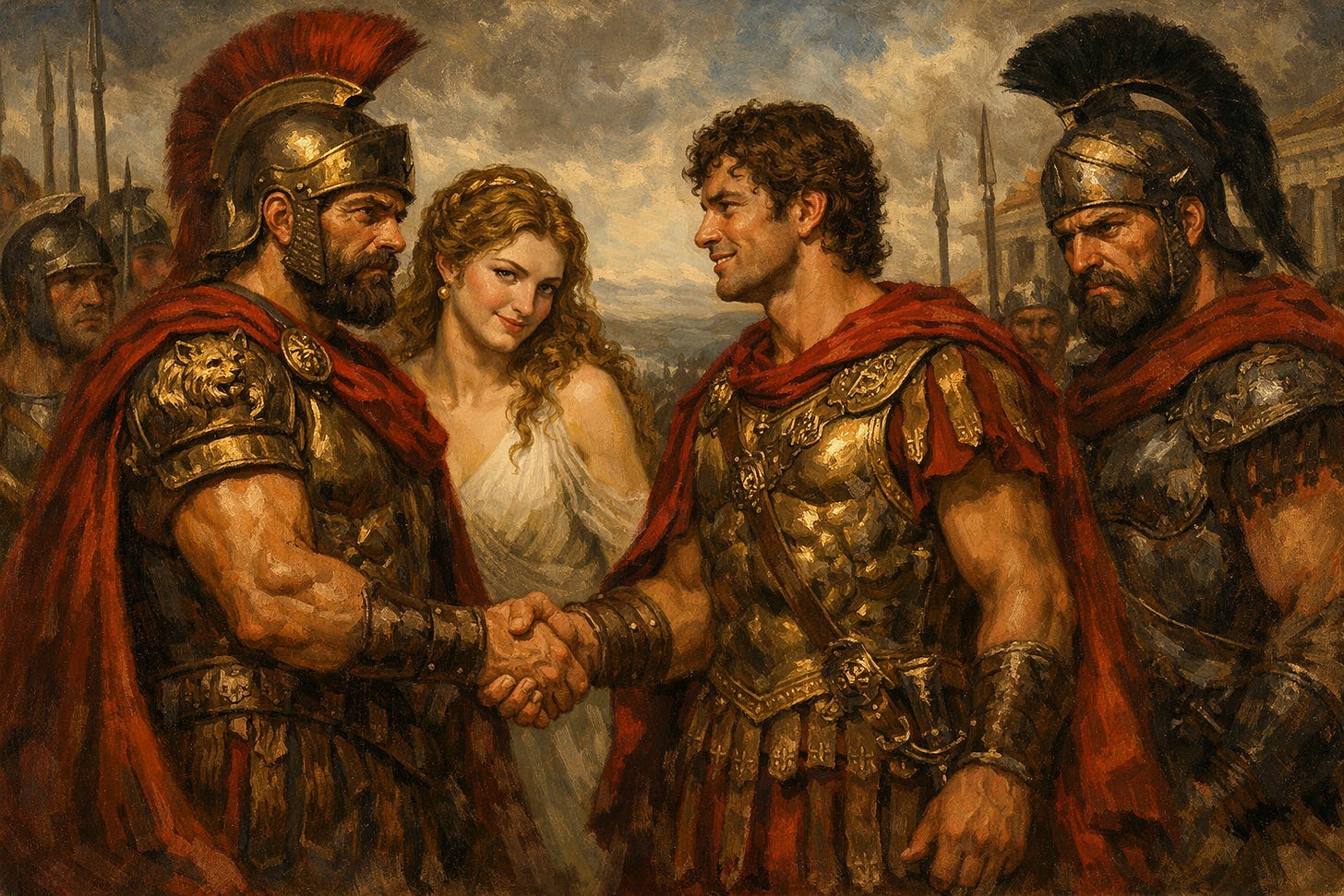
The audience for male conduct within any honor framework consists specifically and exclusively of other competent men who are either useful or dangerous to you.
Honor does not and cannot apply to one’s dealings with women, who are seldom reliable counterparties due to a lack of diachronic agency as well as the salience of precognitive status / threat assessment to female cognition, which ensures that negotiation and compromise are impossible on anything she really cares about and you’ll typically either just conquer her utterly or slam face-first into a brick wall; either way though your ability to hold her to account for perfidy and broken promises comes down entirely to if you can dominate her in any one moment (including if she brings in third parties). More generally than that honor is only diachronically compulsive to women in the context of a pair-bonded romantic dyad that probably involves a child or a familial relation; elsewise synchronicity and precognitive alignment with the most locally salient power center generally wins out.
Honor does not and cannot apply to dealings with any institution, whose governance logic will invariably be wholly downstream by womanly epistemics and risk phenomenology which should indicate at a glance that the institution as a whole is architecturally unreliable as a diachronically agentic counterparty—far more so than women, actually, as while individual women can usually be dominated in the moment quite reliably, institutions are constituted specifically to block such maneuvering. That said you for sure can apply an honor framework to individual male actors within any institution so as to exploit some principal-agent dynamic.
Honor applies least of all to dealings with cognitively feminine and low status men (and particularly to self-identified incels) as well as men who call themselves sexually submissive, most of whom occupy a less masculine neurotype overall with a less diachronically bounded phenomenology of self and similar to women are prone to shirking accountability while changing with the wind and worshipping the most locally salient power center—though unlike women, low status men do this a lot more consciously and often resort to perfidy or sabotage whenever they grow jealous or resentful of the strong horse to whom they most recently were sycophant. But it’s also important to acknowledge that these men can’t simply be wished away, as even if one drives off every one of his own sycophants some associate in his circle would inevitably make a place for them, and if handled poorly they would surely get routed even faster than otherwise into vectors of sabotage, leakage, moral panic, or institutional capture, which is why it seems the best way to curb their risk profile is a tincture of caution and yellow rocking at arm’s length.
A useful heuristic is that women reward outcomes whereas men enforce standards. With women it’s because they precognitively register power itself as morally good (narrating that assessment internally as downstream of some second order red herring thing they backsolved for usually) and during conflicts will either remain neutral in a Scared way or softly triangulate Rashomon-style until someone wins, before pivoting utterly and self-righteously toward power and safety. Then men meanwhile (specifically elite and some midstatus men) are far less moralistic or safetyist and more overtly strategic, assessing situations involving high-stakes competition and conflict not merely qua themselves but in a game theoretic grammar used to collate information on other players to inform future behavior—for instance, by identifying who specifically should be punished and iced out for defection or unreliability, which while permissible under a feminine grammar assuming such tactics secure a local victory only make sense under a masculine grammar provided it can permanently clear the board, because in any multipolar multiple-game scenario that move risks undermining the male honor compact and making collaboration less tenable unless met with decisive reprisal, because when standards disappear outcomes are noisier, and more costly to achieve.
So in a sense we might say masculine honor starts as lateral legibility—the ability of peers and rivals to price your behavior into their models accurately under uncertainty. This of course is salient to anyone involved in high stakes conflict given the ever-present possibility of mispricing, which occurs when the framework fails to read who is solid, who is slippery, and who will defect—a failure mode it seems has exploded in import within the Zoomer Oral Culture since the cost of mispricing increases dramatically with reputational volatility of the wider ecology, event-local narrative ambiguity, and incentive asymmetry—hence the ongoing appeal even today of honor frameworks, which reduce such costs by making everyone’s behavior more predictable—though not necessarily by requiring full transparency, as honor does not oblige us to offer full candor in all facets of life. The criterion is to be legible enough that serious men can model you in pertinent domains of mutual interest, competition, or collaboration, which is why a trait like epistemic slipperiness, for instance (think constant repositioning, bad faith use of irony, disingenuous post hoc narrativizing or refusal to own moves), serves to deteriorate trust fast and marks a man as coalitionally low-value..
Honor likewise functions as a rank-clarification technology, and one of its primary uses in any multipolar male field is not just identifying who is likely to defect, but also clarifying who can command, who can advise and be trusted with discretion, who can be relied on under pressure, and who is only useful in narrow or local domains. In loose modern culture where signals are noisy and self-presentation increasingly theatrical, an honor framework must not merely divide men between “good” and “bad,” but also stratify them into strategically meaningful functional categories: leaders, peers, clients, mascots, liabilities, saboteurs, and so on. Men who refuse to recognize these distinctions on account of egalitarian sentiment or personal insecurity make themselves expensive to everyone around them.
Among the most corrosive male behaviors is cheap defection for female approval—think moral laundering of male experience in female grammar, opportunistic denunciation of other men, signaling distance from men collectively for relational credit, slimy mean girl mockery of one’s friends behind their backs attempting to convey friend-group dominance to a romantic prospect… such tactics rarely prove even individually profitable (and when they do it never amounts to anything but dime store validation), but assessed on a collective level such behavior serves as a blazing red flag that alliance with such a man is operatively untenable given his susceptibility not even to seduction but literal headpats. Abstracting it out a bit we can say the central tenet of male honor might be something like: Do not raise your standing with women by converting male reality into female-approved moral paste.
The terrain is more ambiguous on the question of extraction—because note first that some degree of exploitation is inevitable in literally any competitive system and that furthermore there’s plainly no hard ontological line between the two which means it’s entirely arbitrary and so the question isn’t “is it exploitative” so much as “Does it reduce my long-term value to other men?”
That one is easier—cataloguing the behaviors that reliably degrade coalition value, obvious candidates include sloppy and compulsive sexual extraction, poor discernment in where one leaves behind unnecessary wreckage, exploiting obvious weakness in ways that signal low restraint and make it impossible for allies to defend you sans blowback, failing to price in tail risk, totally eschewing substance and ideas and anything else that might draw loyalty when you need it so as to optimize instead entirely around spectacle and spin, making enemies with someone you haven’t been able to shut up about for the past year instead of acting just a shade more honorably and staying friends with the one guy who understood those spectacles and spin instead of merely reacting to them as well as only one on this site not really in a position to judge you; really just anything that implies not only a basic inability to collaborate but also to pursue one’s own interests in a manner that isn’t thoroughly disordered or self-sabotaging.
More broadly than that, local wins that result ultimately in a global reputational drag are experienced as negative-sum for serious actors and thus highly dishonorable—you can think of this scenario as a reputation market analog to scab discourse.
Yet another interesting dynamic pertains to male grievance narratives, which track with phenomena structurally inevitable in modern systems but thanks to various epistemic foreclosure mechanisms are impossible to express cleanly and legibly in mainstream venues without triggering bad faith rerouting. Of course, unprocessed grievance leads to whining, overexplanation, moral exhibitionism, and pathological resentment, all of which greatly lower male standing for very little gain except cheap momentary catharsis, and that’s why high-functioning men generally opt instead to convey their thoughts via compressed narratives, actionable models, aestheticization through humor or eros, or silent adjustment rather than risking public contamination. Whichever is taken, though, it seems reasonable to conclude honor is gained to the extent men’s issues are made legible and lost to whatever extent the speaker and his associates end up losing status due to his grievance expression. Having said that the main takeaway to keep in mind on this point is institutions cannot metabolize male grievance without destabilizing their own logic—the upshot of which is that men now have no choice but to develop entirely parallel grammars of adjudication among themselves.
One obvious venue for that is male friendship, which for most men serves as a key site of equilibrium formation and provides not just emotional support but also reality-testing, adversarial calibration, and enforcement of informal standards—note many men rely a great deal on their close friends to call out delusion, name weakness, and mark unacceptable behavior sans flattening them in institutional or feminized language. Lacking the testicular fortitude to push back on friends in this manner would likely read to most men as at a minimum mildly dishonorable and definitely not a promising friend prospect.
The failure mode of total defection is it produces a world too expensive to inhabit—one in which trust collapses, coordination fails, women gain indirect control over masculine dynamics, and institutions gradually fill the vacuum by male agency cannibalizing itself. Rational men have no choice but to accept that short-term constraint on self-interest maximizes long-term self-interest. This isn’t at all about morality or virtue or altruistic sentiment and such, but rather the foundational game theoretics of self-interested intersubjective norm coordination.
In terms of how this all interfaces with the fairer sex—first I’ll foreground again women do NOT reliably enforce male equilibrium, but it does bear mentioning men who fail to optimally equilibriate at the global level will fixate on event-local optimization and so become disembodied, affectively volatile, overreactive, narratively flimsy, and difficult to trust—all traits both strategically costly and disrespected by men as well as hugely repulsive to women. Meanwhile the well-equilibrated man now being naturally attuned to his surrounding incentive gradients is free to drop most deliberate heuristics formation and cognitive load, becoming less overanalytical, less contingent, and more stable under ambiguity, which obviously means significantly improved outcomes with women.
Women reward outcomes, whereas men track process; confusing the two leads most of the time to systematic error. A woman may very well reward confidence, dominance, or narrative control without any particular regard for how precisely those outcomes were produced. Men, by contrast, scale and coordinate only by tracking things like method, consistency, and replicability, and to honor this obliges men to resist updating their internal priors based solely on female reward signals, while maintaining a procedural-mechanistic ontology legible to male peers.
Honor does not bind men to women; it governs how men structure their behavior toward women in ways that preserve male equilibrium. Women are not reliable diachronic counterparties like men, and thus cannot be the objects of strict honor enforcement. The mistake of both chivalric codes and modern romantic idealism is to treat women as participants in a shared rule system when in practice their behavior is governed by alignment, safety, and perceived power. The move is not to moralize this, but to treat intersexual conduct as yet another domain governed not by obligation, but constraint calibrated to preserve standing among men.
Sexual conquest is not dishonorable, but becoming conquest-optimized at the expense of male legibility is. Men can pursue, seduce, dominate, and toss aside women without violating masculine honor per se; the question is whether a man’s pattern of behavior renders him low-value in male-coalitional terms. Optimizing for throughput—e.g. maximizing bodycount through deception, instability, or compulsive extraction—makes one difficult to model, harder to defend, and all but impossible to ally with; conquest that degrades one’s pricing among men is negative-sum, even if locally successful.
The meaningful distinction in this realm is not between “rake” and “gentleman” so much as between controlled and uncontrolled extraction. The former is discretion, narrative containment, and coalition compatibility. Uncontrolled extraction means reputation bleed, unneeded enemies, female spillover, and a signal of low impulse control. Lots of high status men of all backgrounds and temperaments admire and enthusiastically collaborate with the former, but the latter are cheered by bored teenagers and incels while others politely keep their distance.
Sexual behavior becomes dishonorable when it creates externalities other men are made to absorb—think entangling oneself with women embedded in one’s social graph without containment, carelessly generating drama that spills into shared networks, escalating conflicts one cannot decisively close, or destabilizing shared environments through careless pursuit. Such behavior registers to other men at a minimum as unserious/incontinent and at worst makes them price in the constant possibility of you making a mess of things in any situation with a woman involved.
Affairs themselves are not intrinsically dishonorable, but mismanaged affairs very much are. By itself an affair is simply a high-risk and asymmetric engagement; the dishonor arises when a man fails to control exposure, underprices retaliation risk, implicates allies, or otherwise ends up narratively owned by the woman in some way. An affair that is contained, legible, and strategically bounded may be tolerated; one that spirals into chaos marks the man as unfit for higher-order play.
Domestic pair-bonding is a distinct equilibrium requiring a partial reintroduction of diachronic constraint. In a stable dyad—especially with cohabitation, shared assets, or children—women are more reliable counterparties with relatively stable and predictable behavior one can game around thanks to her incentive gradient now aligning broadly toward continuity which means a provisional form of honor now applies—though it’s fragile and emerges from imposed structure instead of sentiment, implying men who don’t matriculate from loose-game conduct to dyadic equilibrium conduct will fail to stabilize or become dominated in their relationship.
Fighting over women is virtually inevitable; dishonor consists a lot more specifically in unpriced and uncontained escalation. Any successful male honor framework needs to price that in as basal while expanding upon the operative distinction between gentleman and rake, originating primarily on whether the competition is acknowledged, whether it is properly bounded, and whether it is resolved in a way that preserves the wider equilibrium. Dishonorable conflict would include covert sabotage, friend-group triangulation, female-mediated proxy warfare, and escalation without the capacity to finish, whereas open, decisive, and proportionate conflict is treated by this framework as wholly honorable, being far less destabilizing usually than eternal low-level intrigue.
Never outsource male conflict to female adjudication, as women in these situations basically will always triangulate, narrate, and automatically align with perceived winners—and no, that’s not betrayal in any meaningful sense so much as natural consequence of standard precognitive womanly operating logic. That said it is why men can never allow masculine disputes to grow mediated through women, who inevitably will lose control of narrative, introduce distortion, and degrade the male field. All male conflict must ultimately resolve man-to-man or not at all.
So virginity is obviously not a moral category with hard metaphysical import, but it also pretty clearly IS an important market signal with asymmetric implications since for girls it’s always signaled low prior entanglement, higher pair-bonding value, and somewhat reduced narrative complexity. It also held a wider civilizational symbolic value encapsulating ideas of female purity and moral innocence which in Christian tradition have usually been tied to Mary and foregrounded as the fundament of womanly virtue itself, and while this script is obviously less salient today many men still do see female purity and innocence as incredibly worth protecting since when they lose faith in girlish goodness they not infrequently lose faith in humanity itself. Moreover a great deal of women especially of a Catholic background continue to emotionally resonate with virginity years later about it as something semiotically thick in an almost mystic or ritualistic sense…meanwhile more ruminative neurotypes of women continue to narratively center the circumstances of their defloration well past the point it actually happens. And so given the civilizational and personal stakes involved it makes sense that if an affectively volatile teenage girl narrates herself at different times as wanting to keep her virginity and wanting to lose it to the worst person imaginable purely as a self harm gesture and also being Scared because she allegedly told him please leave and meanwhile this is a girl who has described you as mentor and protector and you get it; those are clearly extenuating circumstances that bring us squarely into Schmittian territory. Just pure friend-enemy logic, with me or against me.
Fact of the matter is certain scenarios in life really are kind of just Like That, such that anyone who fights you on the merits genuinely deserves to be raped to death within your own solipsistic truth universe not unlike how women see everything except contextually bounded to whatever is most inviolable to you e.g. someone trying to fuck your kids or rape your wife. Which clearly you don’t game around that; you End It. That said if she’s not worth going to prison for she likely also isn’t worth the shit that happens when a BPD teenage girl learns you wouldn’t go to prison for her, which was frankly just miscalibration on my part but it’s whatever.
Moving on, we observe that exit discipline is an underappreciated facet of honor given that not all games are worth continuing, not all coalitions fully salvageable, not all women can be rescued or contained, and not all institutions can be played forever and indefinitely without structural loss. It is unhelpful to linger past the point of leverage collapse—whether from vanity, limerence, grievance addiction, or fear of loss—and call the resulting degradation fate. There is honor, however, in timely withdrawal: exiting scenes, women, alliances, or institutions once the expected value of continued participation becomes net-negative and before one’s conduct deteriorates under sunk-cost pressure. Men who cannot leave expediently become narratively owned by what they should have priced earlier.
Takeaway here is intersexual conduct constraints exist not primarily for fairness or social harmony, but rather stability of the male field. All of the rules above—on conquest, affairs, conflict, and domestic life—exist not to protect women or to enforce morality, but to ensure alliances remain possible and reputational systems legible while preventing competition from collapsing into noise. Ultimately men’s sexual behavior is judged by other men in terms of second-order effects—not how many women he slept with or how morally he behaved but rather the patterns he created and costs he exported or whether his conduct increased or decreased stability. The equilibrated man is one whose conduct with women never forces other men to reprice him downward. He can win or lose, seduce or commit or walk away, and whatever the case he’s legible, bounded, and coalition-compatible
Honor attaches not only to conduct but likewise to jurisdiction. A serious man must know where his word binds and authority extends, as well as where he reads more as participant than principal. Thus an immense component of male honor is a keen sense of territorial and relational clarity—know which rooms are yours, which women are substantively under your protection or housed inside your structure and which are performing as such, which male conflicts are yours to intervene in and mediate versus ought to be ignored entirely, and which domains are served optimally by deference versus withdrawal given men who overclaim jurisdiction tend to precipitate resentment and read to others as unstable.
This honor compact also in theory regulates debt and patronage among men. Loose modern ecologies encourage the fantasy of total autonomy, but in practice all men rise through webs of favors, introductions, endorsements, protection, cover, and asymmetric investment. Many male breakdowns occur because men want benefits of patronage without the dignity of acknowledging dependency, or the authority of being patrons without the burden of stewardship. A functional honor grammar should price all of these dynamics in explicitly.
Apology and repair must be distinguished sharply from self-abasement. Under any genuinely honor-bearing male culture, men must be able to acknowledge error, miscalibration, or cost-imposition without collapsing into feminized confession or public moral theater. The modern alternative is bad in both directions: either men never admit fault and become slippery or intransigent, or they perform contrition in female or institutional grammar and so mark themselves as weak. The appropriate male apology grammar occupies a middle road between these registers deployed in situations where one man may have mispriced, defected, overreached, created externalities, or damaged another man’s position, in which case he corrects directly, and materially if possible, and without self-humiliating embellishment. A man who cannot apologize cleanly is dangerous, but a man who apologizes in a style optimized for pity or innocence is worse.
Men should be judged not only by whether they defect, but also what particular kind of equilibrium they induce around themselves. Some men are technically loyal but generate chaos, dependency, or permanent drama. Other men read as severe, opportunistic, or even feared, and yet create environments where incentives are legible and aligned while collaboration remains possible. When assessing a man’s personal honor, then, a crucial and higher order aspect of the equation is often asking whether his allies become clearer, stronger, and more strategically coherent around this man, or rather more confused, performative, and fragmented?
Certain modes of male dishonor in late modernity emerge from middle-ranked and aging men refusing to cede lanes, train successors, or distinguish between rivalry and generational transition, as well as younger men adopting a needlessly aggressive and oppositional register with elder peers whose own influence and resources they ambiently resent. In practice however a man in midlife who can’t fathom replacement becomes tyrannical and brittle, whereas a younger man who can’t tolerate dependence becomes rootless and strategically thin. Thus a crucial aspect of male honor is self-awareness of rank and cohort position as well as a clear understanding of one’s relationship with other ranks and cohorts.
Honor survives not just through sanctions but often also aesthetic coding—namely, the ability of a male culture to make certain forms of conduct register broadly as embarrassing, low, unserious, shrill, overexposed, or spiritually cheap. In any community or scene where moralism plays no part of the operative cosmology, style can do a lot of the work that priesthoods and legal codes once carried out—ridicule, froideur, compression, selective praise, calibrated inclusion, and even reputational tone all become part of the enforcement regime, as while a man can get away with many things materially, if he becomes aesthetically unviable among the right set of peers he has already lost more than he realizes.
Male honor frameworks, at their most fundamental level, are ultimately in place to preserve optionality at scale. The reason we implement the constraints detailed above—constraints on defection, extraction, grievance, conflict, and intersexual conduct—is that men who destroy local equilibria in pursuit of short-term gain also destroy their own ability to participate in larger, more valuable games, as the man who cannot be trusted, priced, or modeled gets locked by default into smaller and more volatile arenas. Thus honor has precisely nothing to do with being “good,” but about preserving access to higher-order strategic environments over time.
The basic irreducible unit of honor is less the individuated act than pattern, as single actions tend usually to be ambiguous, mispriced, or context-dependent. Thus what men actually track—and what functionally determines standing—is pattern coherence across time: how a man behaves under pressure, under loss, under temptation and humiliation and victory and ambiguity. Honor cannot be gamed transactionally—just emerges (or collapses) through repeated interaction where a man’s pattern stabilizes into something legible or fragments into noise.
A man’s standing is revealed when incentives invert. Everyone seems “honorable” when behaving well is cheap, but the real signal emerges when lying is easier, defecting would be profitable, abandoning allies would be safe, or narrating opportunistically would improve local outcomes. Honor frameworks, meanwhile track the consistency of constraint precisely when the gradient pulls the other way—note men tend to update their priors most strongly in these moments, as they reveal what a man actually optimizes for—and if there’s any silver lining a man can always luxuriate in amidst even his darkest of days it’s that he’ll never need to speculate again as to the loyalty of his peer group on account of that patient chungus Nixonlist collecting fleas on his desktop that will always be a hell of a lot more predictive in ways I care about at least than any autistic behavioral model.
Honor sets the ceiling on how much trust can exist in a system. In any male field, the level of trust, cooperation, and strategic ambition possible is directly limited by how aggressively honor norms are enforced. Where honor is weak, interactions collapse into low-trust and short-horizon exchanges; where it is strong, men begin to engage in longer, riskier, and far more complex modes of coordination. Thus honor is not just about individual standing, but about the total capacity of a male network to act in unison and coordinate its will.
Intersexual conduct is where men most often destroy their equilibrium. Despite all the above, the majority of male collapses still originate in interactions with women—not because women “cause” dishonor, but because it’s where incentive gradients are most asymmetric, feedback is most distorted, and men are far and away most likely to willfully abandon constraints. The function of the intersexual theses is not to moralize male behavior with women, but prevent men from destabilizing themselves and their alliances in the highest-variance domain they operate in.
A man who cannot absorb asymmetry without psychic distortion cannot remain in equilibrium. Modern sexual and social dynamics are structurally asymmetric. Men who require fairness, clarity, or symmetrical accountability to remain stable will either become resentful, become manipulative, or collapse into overanalysis. The equilibrated man is not the one who eliminates asymmetry; he is the one who can operate within it without becoming narratively or behaviorally unstable.
Perhaps the most important function of male honor frameworks in the context of our present situation is its potential to make men governable without institutions—an increasingly urgent priority as whenever institutional legitimacy erodes and formal enforcement becomes either feminized or adversarial, the burden of maintaining order traditionally shifts back onto informal male systems, with honor being the typical mechanism by which men regulate one another’s behavior without requiring constant external arbitration or performative altruism. Where it fails, institutions expand; where it holds, men retain autonomy.
The endpoint of dishonor is isolation; the endpoint of honor is inclusion in higher games. Men who violate equilibrium constraints may still achieve local success, but they are gradually excluded from serious alliances, high-trust networks, long-horizon ventures, and stable social environments. Conversely, men who maintain legibility and constraint discipline gain access to increasingly valuable circles of coordination; ultimately honor functions as a sorting mechanism between men who can only play small games and those who can participate in larger ones.
To compress all of the above into a single actionable heuristic—do not become expensive to other men. Behave in ways that do not force other competent men to continually reprice, hedge against, or compensate for you. Men who follow this constraint remain legible, usable, and coalition-compatible. Men who violate it, regardless of talent or success, are over the long term inevitably priced out.
I wonder if the lack of honor among men downstream from oral culture could be eliminated by changing the structure of online media. What if we had a social network that was one hundred percent text, had a 500-word posting minimum, and forbade deletion of content?
Brilliant. This is a principle that men of all tribes can embrace - to our collective benefit, and that of humanity more broadly. Btw, in my feverish youth I sometimes employed “cheap defection” - and it turns my stomach to this day.