

This will be a short response to the thoughts my friend Dave Greene recently shared in relation to my most recent podcast with Kryptogal (Kate, if you like).
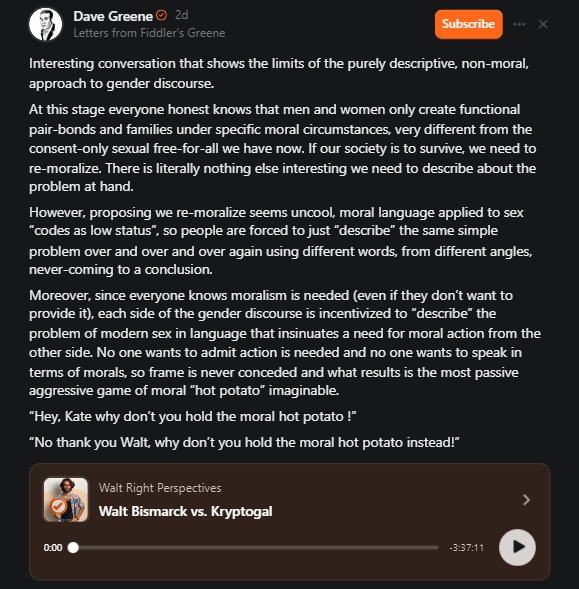
TL;DR— Dave is right about the bottleneck, but mislocating the point of blockage in the wider discursive plumbing.
The problem is not that people are unwilling to moralize—both incels and radfems do so constantly, just to zero practical effect because actual power hasn’t much use for a register of oughts and shoulds. Instead it prefers to quietly foreclose noncompliance with an icy descriptive grammar that layers cognitive load on adversaries by forcing them to impose desired outcomes on the possibility space without seeming like a lunatic or as though they’re asking for something instead of simply taking it like a normal person. This is not about morality “coding low status” as some metaphysically odious trait, understand, so much as moralistic language landing on the ears like a banshee’s scream signaling you can’t currently get the things you want, which tends to make anyone not presently affiliated with you register everything you say thereafter as hapless and contemptible incel squawking without any regard for its semantic content.
Now, Dave himself is well aware of this, being a sophisticated rhetorician who has effectively formulated his own private grammar and bundle of portable frames for making Trad ideology less semiotically tainted by incel coding—specifically by never approaching such issues from a position of overt scarcity or grievance or even pushy normativity and instead asserting the superiority of Tradlife from a posture of affected Boredom or Exhaustion that avoids making demands (monstrous low status sans force to back it up) and mostly just foregrounds its own putative successes / vitality in a way that situates eventual victory as inevitable. And this, of course, is the most optimal positioning for Dave’s own goals when assessed purely from a strategic perspective.
From a model fidelity perspective, however, a somewhat different picture emerges.
Because the ackshual bottleneck here is no one presently has the coordinative power to impose a shared moral frame on public consciousness, to say nothing of a properly toothy and consequential enforcement regime to override equilibriation along incentive gradients towards individually adaptive outcomes contrary to the public good. That produces what he’s describing: displaced moral argument, descriptive reframing, and refusal to hold the prescriptive hot potato—none of which is cowardice or shiftiness so much as rational equilibriation where moral claims have no enforcement layer.
To wit, Kate and I are each taking the game theoretically optimal position for our “side,” which entails descriptive framing that maximizes leverage through constraint denial alloyed to the deconstruction of adversarial and implicitly morally valent frames from the “other side” optimized for swaying neutral parties who might go either way.
And Dave, crucially, is doing basically the same thing.
Because note, for instance, that when I spitballed a Handmaid’s Putsch in my recent pod with him David quickly shifted the focus to decentralized praxis as an avenue for pursuing his objectives, framing patriarchy as something women take to easily once men assert themselves while implying an insistence on bending structural incentive gradients to reroute womanly behavior speaks to an individual male failure to inspire obedience in the fairer sex—which might be the game theoretically optimal Trad answer in the extant social ecology but is also muddying the epistemic waters with statusplay in the selfsame manner David finds so very objectionable when womyn do it!
Though to be clear I’m not calling him out for that—public moral language is always and by necessity strategic, eternally gaming around status coding and other cognitive biases. The point is merely that Dave himself is playing hot potato if he’s not willing to translate putative moralism into something with real equilibriative-compulsive teeth.
Also how do we know any of these Trad chicks are ackshully submissive / kawaii and not just low-sociosexual fat chicks with hairy arms who are mean to their husband and say everything’s his fault because she Doesn’t Have Agency? Maybe Trad lads in 2026 all just have super duper smexy frame control abilities compared to when I heard about these dudes secondhand from my bestie going on dates with them in 2021-2022 and that shit never happens to them, but speaking as an urban degenerate who spent most of the Biden years going through the phones of pansexual sleeve tat Zoomers in credit card debt it seems a lot more optimal to just curate a hard local power structure in which patriarchy is the governing architecture of her life and the bagatelle is actually rigged in YOUR favor for once, and then like go to church on top of that if you want.
Because moral language itself does not generate order—merely stabilizes order once the underlying incentive structure already supports it. Trad instinct says remoralize first and behavior will follow, but The Orange Pill view is exactly the reverse: durable moral language emerges only once baseline incentive gradients make it self-reinforcing.
As it stands men lack consistent enforcement power over mating norms and women retain high optionality and narrative control, while mainstream institutions employ relational feminine harm grammars that epistemically foreclose socially noncompliant men. Under those conditions, any attempt by men to impose a strong moral frame will either fail outright or be selectively applied against noncompliant or low-status men.
Men in these debates do not eschew moral language because morality isn’t coo so much as because it’s utterly toothless and exposes us to hugely asymmetric downside—discursively an analog to the Alt Right retard rallies of 2017.
That’s why endless “descriptive discourse” persists; it’s serving a vital coordination function, allowing men to share models without triggering immediate sanction, to operate in a coded register, and to forestall commitment to prescriptions that can’t possibly be enforced. In game theoretic terms, it’s a low-risk signaling equilibrium—which means definitionally incomplete and also sterile if it never progresses, but that’s precisely why I’ve been furiously expanding my own Orange Pill Analytic Corpus to give men a publicly legible and strategically actionable coordinative dialect in a world that makes saying “should” essentially never worth it for us scrotes.


And this is where I think Dave and I actually have real potential to align—because similarly to his own recent focus on praxis, The Orange Pill routes over the medium-term through local incentive restructuring that instead of starting with “society should…” starts with something like “what configurations can actually be stabilized right now?”
Stably diachronic patriarchal conditions do not ultimately require universal buy-in or centralized enforcement—just repeat-game environments plus functionally bounded female optionality and some degree of male coalition behavior (even if very soft and informal) that ensures actions have meaningful consequences over time. The idea is to create small-scale closed loops where reputation, access, and status are not infinitely liquid.
This will look less like sermons or ideological declarations than curated environments wherein serious men coordinate—explicitly or implicitly—around who gets access, who gets excluded, and what kinds of behavior are rewarded. It looks like women whose status is partially contingent on maintaining standing within such ecologies instead of on flitting synchronically through anonymous markets. It looks like a slow ambient drift toward reduced anonymity, increased repeat interaction, and a stable and organic preference for women who demonstrate alignment over time instead of merely short-term sex appeal (something far less durable in a castle-less world where hippie chicks and ink-sot sluts tend to embrace patriarchy a lot more enthusiastically in practice). No autismo need trigger any foid’s precognitive lunk alarm and scare the hoes by saying “women should X” under this arrangement, as women just experience more prosocial modes of femininity procuring superior outcomes inside the structure.
That is the crucial shift: from normative enforcement to incentive shaping.
Women aren’t argued into behaving differently; they respond to environments where different behaviors become optimal. And because female sexual preference is highly responsive to incentive gradients and womanly phenomenology of self so wonderfully and fetchingly porous, these developments are not simply complied with—they are deeply internalized, moralized, eroticized, and eventually treated as self-evident.

This is why the Orange Pill approach can peaceably coexist with rather than oppose a Trad project. Trad operates at the level of moral narrative, civilizational coherence, and long-term family structure. The Orange Pill operates at a level of local equilibria, mating markets, and behavioral incentives. The relationship between them is highly sequential, as you cannot successfully impose a high-level moral order onto a system whose underlying incentives contradict it. But once enough local environments begin to stabilize around repeat-game logic and aligned incentives, moral language can and inevitably will reemerge—just as something substantive as opposed to hollow signaling.
Dave’s mistake, then, consists in treating moral language as a lever rather than a lagging indicator. As it stands speaking in the language of “should” only weakens male leverage rather than strengthening or even usefully coordinating it, because it hands interpretive authority to all the same wretched systems that presently control moral adjudication while signaling aspiration sans enforcement capacity—always a fatal combination. By contrast, speaking in the Orange Pill grammar of “is”—that is to say, of incentives, asymmetries, and predictable equilibriation—preserves both clarity and optionality, keeping the locus of control on what we menfolk can actually structure rather than what women in their fickleness might be suaded to concede.
David’s Tater exists because holding it is costly; no one wants to make claims he cannot enforce or assert standards he cannot operationalize—including the good Dr. Greene himself—which is why the system will always equilibriate toward descriptive circling.
The only way through is to change the conditions under which holding the tater is viable, which can only happen locally, incrementally, and mostly esoterically through simple shifts in who gets rewarded, who gets excluded, and what behaviors are made to pay.
Once those conditions change then moral language needn’t be imposed artificially, but will reappear wholly naturally as the byproduct of a new and more adaptive equilibrium—one where saying “should” or “ought” actually means something again.
I like this argument. If our adversaries over at the Human Connection Hub have created an antisocial incentive structure, we can win by creating prosocial incentive structures. There are several considerations which must be made here. Any parallel incentive structure, no matter how well constructed, is subject to potential capture by a for-profit entity. Hence, a world with multiple incentive structures is better protected against this outcome. However, it could be argued that these parallel incentive structures could still be captured by for-profit entities and merged into a larger antisocial structure. This vulnerability can be avoided by introducing a certain amount of incompatibility into the parallel incentive structures. The long term goal should be creating enough Balkanized incentive structures that it is impossible for something like the Match Group to emerge again.
You seem to confuse moral language with morality. What is a moral order? Its a prescriptive order for behavior. Is confession an incentive structure or a moral one? It feels like a might makes right highly localized so as to sidestep any icky moralizing to retain your lib card. I would argue that the current structure where no one can impose a grand moral order exists by design, as in, the system was set up to prevent the imposition of said order. In a way, this is a kind of a moral order that is imposed, an imposed moral relativism. This is not the natural historical state for societies. Can moral language generate structure? Well, language certainly can, have we not been held prisoner to some degree by laws or ideas, onerous systems of thought. Is that not structure? I understand your skepticism of trads, who too often promulgated boostrappism, and advocate that young men sacrifice themselves on their behalf, for no benefit but their own. I understand the thought line of "fool me once" when it comes to supporting some conservatives, who often seem to bitch out of advocating for actual real change. Its a sort of build it first, then men will get on board. But build what? Without "moral" language you cannot prescribe what to build. Ultimately, for better or worse, young men will have to do it themselves, and maybe that's the way it should be, that they are burdened with deciding their own destiny.